
Why a Strength Building Routine Could Be the Most Important Thing You Do for Your Health
A solid strength building routine is one of the highest-return investments you can make in your long-term health — not just for how you look, but for how long and how well you live.
Here’s what a basic strength building routine looks like:
- Train 2-3 days per week — full-body sessions work best for most beginners
- Focus on compound movements — squats, presses, rows, and hinges
- Use progressive overload — add reps or weight each week to keep improving
- Rest 48 hours between sessions — muscle is built during recovery, not just during training
- Start simple — bodyweight or light dumbbells are enough to begin
You don’t need a fancy gym or hours of free time. Two 30-minute sessions per week is enough to start seeing real results.
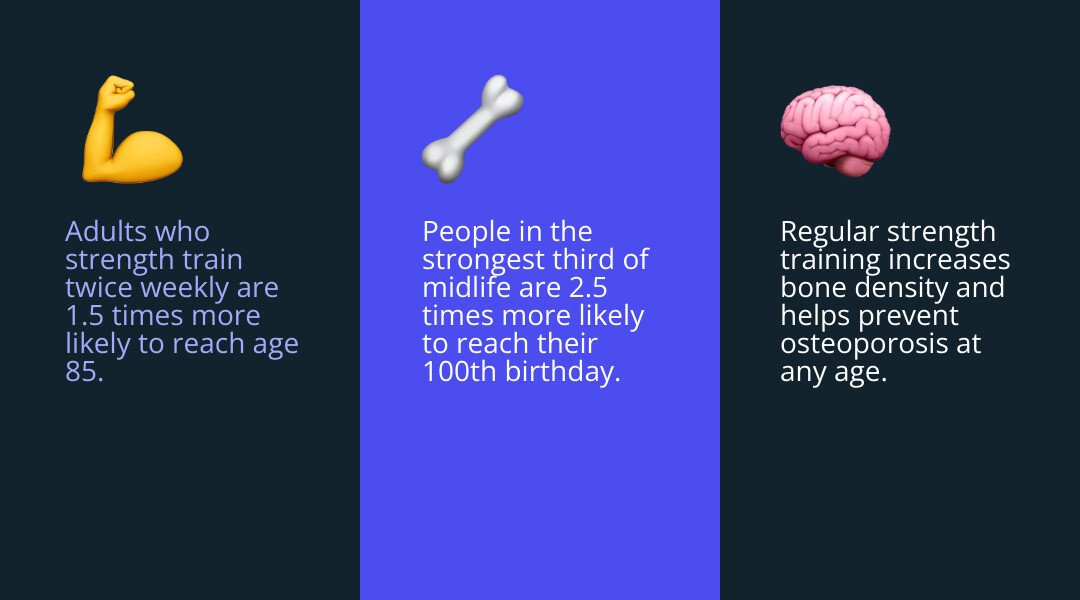
Here’s the thing most people miss: strength training isn’t just about muscle. Research shows that adults who strength train at least twice a week are 1.5 times more likely to live to age 85 than those who don’t. People in the strongest third of the population in midlife are 2.5 times more likely to reach their 100th birthday.
That’s not a small edge. That’s a life-changing difference.
Yet only about one in four adults meets the basic recommended guidelines for strength training. Most people either don’t know where to start, get overwhelmed by conflicting advice, or burn out after a few weeks of all-or-nothing effort.
This guide cuts through the noise. Whether you’ve never lifted a weight in your life or you’re returning after a long break, you’ll find a clear, science-backed path forward.
Strength building routine terms to remember:
The Science of Strength: Why You Need a Strength Building Routine
When we talk about a strength building routine at Primedy Health, we aren’t just talking about getting “huge” or spending six days a week in the gym. We are talking about functional survival. As of May 2026, the medical community is more aligned than ever: muscle mass is a primary predictor of health span.
Strength training, often called resistance training, involves any activity that makes your muscles work harder than usual. This creates microscopic tears in the muscle fibers, which the body then repairs, making the muscle stronger and often larger. But the benefits go far deeper than the surface.
For our neighbors in Mount Airy and Frederick, strength training for seniors and osteoporosis is a critical topic. As we age, we naturally lose lean muscle mass—a process called sarcopenia. If we don’t actively fight back with resistance, we lose mobility, balance, and independence.
Beyond the bones, strength training is a metabolic powerhouse. It improves insulin sensitivity and helps manage chronic diseases like Type 2 diabetes and heart disease. It even sharpens cognitive function; research suggests that the combination of aerobic exercise and strength work can significantly improve thinking skills in older adults.
At Primedy Health, we believe in Sustainable Fitness 101. This means choosing a routine you can actually stick to for the next thirty years, not just the next thirty days.
Aerobic vs. Strength Training: A Comparison
| Feature | Aerobic Exercise (Cardio) | Strength Training (Resistance) |
|---|---|---|
| Primary Goal | Cardiovascular health / endurance | Muscle strength / power / bone density |
| Calorie Burn | High during the activity | High after the activity (EPOC) |
| Impact on Muscle | Maintains existing muscle | Builds new muscle tissue |
| Bone Density | Minimal impact | Significant increase |
| Longevity Factor | Improves heart health | Predicts mobility and survival |
The Longevity Factor in 2026
In 2026, we have more data than ever regarding the “Longevity Factor.” We now know that being in the strongest third of the population during midlife makes you 2.5 times more likely to reach your 100th birthday. Why? Because strength is the ultimate insurance policy against the “frailty trap.”
When you have a consistent strength building routine, you reduce all-cause mortality risk by 10-17%. This isn’t just about avoiding falls; it’s about maintaining a metabolic engine that processes blood sugar efficiently and keeps systemic inflammation low. Muscle is an endocrine organ—it sends signals to the rest of your body to stay young.
Metabolic and Bone Health Benefits
One of the most common questions we get in Carroll County is about weight management. While cardio burns calories while you’re doing it, muscle burns calories while you’re sleeping. Muscle tissue is metabolically expensive; it requires 6-10 more calories per pound daily than fat tissue just to exist.
Furthermore, resistance training is the primary modifiable factor for bone density. By putting stress on the bone through muscle contraction, you signal the body to deposit more minerals, effectively preventing or reversing osteoporosis. For a deeper dive, check out our Step-by-Step Guide to Strength Training Program.
Getting Started: Equipment and Safety for Beginners
The biggest barrier to starting a strength building routine is often the belief that you need a massive rack of weights or a gym membership. While we love a well-equipped facility, you can see significant gains with easy strength training at home.
Before you start swinging weights, we always recommend medical clearance, especially if you are over 40 or have been inactive for a while. Once cleared, your first priority isn’t “how much” you lift, but “how well” you move.
Essential Gear and Household Alternatives
If you aren’t ready to invest in a full set of dumbbells, look around your kitchen.
- Water Jugs or Milk Cartons: Fill them with water or sand for adjustable weights.
- Soup Cans: Great for high-rep arm or shoulder work.
- Sturdy Chairs: Essential for sit-to-stands, tricep dips, or as a balance aid for squats.
- Backpacks: Fill a bag with books or cans to create a “weighted vest” for lunges.
While these work for a while, eventually you’ll need more precision. Why Your DIY Fitness Plan is Failing You often comes down to a lack of measurable progression. If you’re ready to level up, The Ultimate Beginner Home Workout with Free Weights can help you transition to real equipment.
Mastering Form and Avoiding Injury
We have a saying at Primedy Health: “Leave two in the tank.” This means you should stop a set when you feel you could only do two more reps with perfect form.
Key Safety Principles:
- The 2-Second Rule: Count “one-one-thousand, two-one-thousand” on the way up, and the same on the way down. Controlling the “eccentric” (lowering) phase is where most of the strength gains happen.
- Breathing: Never hold your breath. Exhale during the effort (the “push” or “pull”) and inhale as you return to the start.
- Core Bracing: Imagine someone is about to poke you in the stomach. Tighten those muscles before every lift to protect your spine.
- Rest Intervals: For strength, rest 90-180 seconds between sets of big movements like squats. For smaller moves, 60 seconds is plenty.
For those looking to get serious about the big lifts, Mastering the 5×5 Program for Maximum Compound Strength provides a rigorous framework for form mastery.

The Blueprint: Designing Your First Strength Building Routine
If you want real results, you need a plan. Random acts of exercise yield random results. The 2026 Strength Blueprint emphasizes full-body training three times a week. This is superior to “body part splits” for most people because it allows you to hit every muscle group more frequently.
We designed The Busy Life Fitness Program for Real Results specifically for people who can’t live in the gym. By training the whole body in one session, if you miss a Wednesday, you haven’t “missed leg day” for the whole week—you just pick it back up on Friday.
Beginner and Intermediate Workout Structures
A “Perfect” full-body session doesn’t need twenty exercises. It needs about six. According to The PERFECT Full Body Workout Routine, you should focus on these movement patterns:
- Squat Pattern: Goblet squats or bodyweight squats.
- Hinge Pattern: Romanian deadlifts or glute bridges.
- Push (Horizontal): Push-ups or bench press.
- Pull (Horizontal): Seated rows or inverted rows.
- Push (Vertical): Overhead press.
- Pull (Vertical): Lat pulldowns or assisted pull-ups.
Sample Beginner Routine (3 Sets of 8-12 Reps):
- Goblet Squat: (Using a dumbbell or water jug)
- Push-ups: (On knees or elevated on a table if needed)
- Seated Row: (Using a resistance band)
- Glute Bridge: (Focusing on squeezing the glutes)
- Plank: (Hold for 30-45 seconds)
Advanced Progressions for Your Strength Building Routine
Once you’ve mastered the basics, you’ll need to move toward barbell strength workouts. This allows for “Double Progression”—where you first increase the number of reps you can do with a weight, and once you hit the top of your range (say, 12 reps), you increase the weight and drop back to the bottom of the range (8 reps).
Advanced trainees might also incorporate supersets (doing two exercises back-to-back) or periodization (changing the intensity and volume over several weeks) to avoid plateaus.
Maximizing Results: Nutrition, Recovery, and Timelines
You don’t get stronger in the gym; you get stronger while you sleep. The workout is the stimulus; the recovery is the result. At Primedy Health, we teach our clients to stop guessing and start measuring your success.
Nutrition and Muscle Protein Synthesis
To build muscle, your body needs building blocks: protein. The science-backed target for 2026 is roughly 1.6 grams of protein per kilogram of body weight (or about 0.7 to 1 gram per pound). If you weigh 150 lbs, aim for 105-150 grams of protein daily.
Don’t forget hydration! Muscles are about 75% water. Even slight dehydration can decrease your strength by 10% or more during a session.

What to Expect: The 2026 Results Timeline
People often quit because they don’t see a six-pack in seven days. Here is the realistic 2026 timeline for a new strength building routine:
- 1-2 Weeks: You’ll feel stronger, but your muscles won’t look different. This is “neurological adaptation”—your brain is getting better at telling your muscles to fire.
- 4 Weeks: You’ll notice everyday tasks feel easier. Groceries feel lighter. You might see a slight increase in muscle “tone.”
- 8-12 Weeks: This is where body composition changes. If your nutrition is on point, you’ll see visible muscle growth and fat loss.
- 6 Months+: This is the “lifestyle” phase where your metabolic health has fundamentally shifted.
For long-term success, many find that Sustainable Fitness Coaching Online provides the accountability needed to push through those first few months.
The Role of Progressive Overload
If you lift the same 10-pound weights for the next five years, your body has no reason to change. Your muscles called and they want these customized strength training plans because they need a challenge.
Ways to achieve progressive overload:
- Add weight (even just 2.5 lbs).
- Add reps (going from 8 to 10).
- Add sets (going from 2 sets to 3).
- Slow down the tempo (making the muscle work longer).
- Decrease rest time (forcing the muscle to recover faster).
Frequently Asked Questions about Strength Training
How many days a week should I train for maximum strength?
For 90% of the population, 2 to 3 days per week is the “sweet spot.” Training twice a week delivers about 80% of the benefits of training three times. Unless you are a competitive athlete, training more than 4-5 days a week often leads to diminishing returns and injury.
Can I build muscle using only bodyweight exercises?
Absolutely—especially as a beginner. Push-ups, squats, and lunges provide plenty of “mechanical tension” to signal growth. However, you will eventually hit a “ceiling” where your body weight isn’t enough of a challenge. At that point, you’ll need to add external resistance (weights or bands) to keep progressing.
Is one set enough to see real results?
Surprisingly, yes. Research shows that a single set of 12 to 15 repetitions, taken to the point of muscle fatigue, can build muscle almost as effectively as three sets for beginners. If you are strapped for time, a “one-set-to-failure” routine is infinitely better than doing nothing.
Conclusion
Building a strength building routine is about more than just aesthetics; it’s about claiming your future. Whether you are in Mount Airy, Frederick, or anywhere in Carroll County, the principles remain the same: start simple, focus on form, and stay consistent.
At Primedy Health, we specialize in making this process objective and sustainable. We take the guesswork out of the equation so you can focus on showing up. You don’t have to be a “gym rat” to be strong; you just have to be a person who refuses to be weak.
Ready to see what your body is actually capable of? Start your journey at the Primedy Health Club and let us help you build a foundation that lasts a lifetime.