
Why Most Fitness Plans Fail (And What Actually Works)
Coach supported progress goals are the structured, collaborative targets you set with a professional coach — built around your real life, your actual starting point, and a clear plan for getting from where you are to where you want to be.
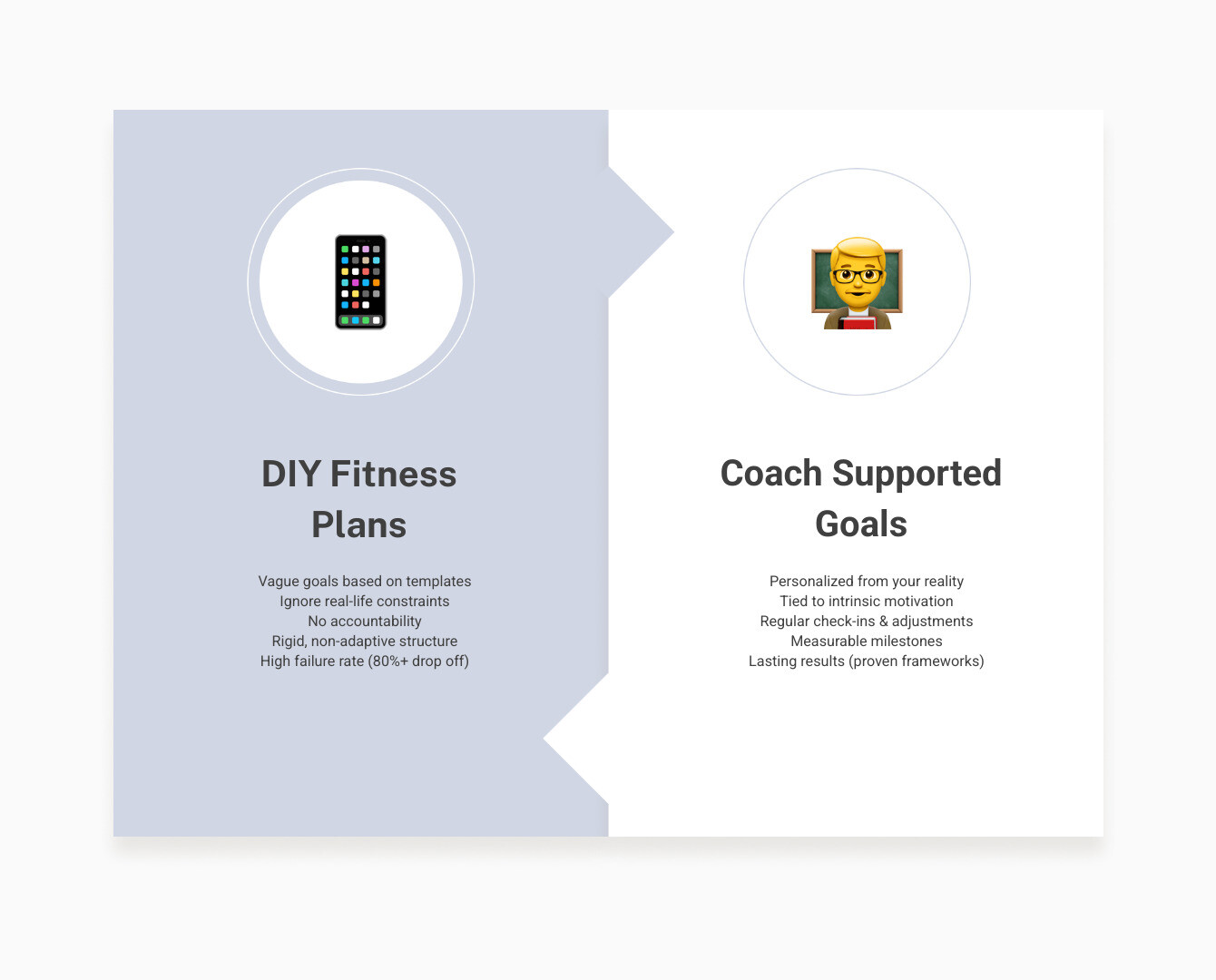
Here’s what separates coach supported goals from DIY plans:
- Personalized starting point — a coach maps your current reality before designing anything
- Deeper “why” — goals are tied to what actually matters to you, not just day-one excitement
- Structured accountability — regular check-ins keep you on track when motivation fades
- Adaptive planning — your coach adjusts the plan when life gets in the way
- Measurable milestones — progress is tracked and celebrated, not just assumed
You’ve probably been here before. You set a goal in January, downloaded a workout app, followed it for two or three weeks — then life happened.
That’s not a motivation problem. That’s a structure problem.
Most DIY fitness plans collapse not because you don’t care, but because they were never built around your actual life. As one coaching framework puts it, goals that fall apart by week three were usually never connected to reality in the first place.
In April 2026, the fitness industry is flooded with apps, templates, and 12-week challenges. But the data keeps pointing to the same conclusion: what drives lasting results isn’t more information — it’s the right support system.
That’s exactly what coach supported progress goals are designed to provide.
The Science of Coach Supported Progress Goals
When you embark on a fitness journey alone, you are often staring at a scoreboard without a playbook. At Primedy Health, we utilize coach supported progress goals to shift the focus from vague desires to scientific precision. This process isn’t just about “trying harder”; it’s about leveraging proven frameworks like the GROW model to ensure every step you take is purposeful.
The science of Health Coaching suggests that goals are most effective when they meet the SMART criteria: Specific, Measurable, Attainable, Realistic, and Time-bound. However, we take it a step further by ensuring your goals have a meaningful “Aim.” This means uncovering the deeper reason why you want to change. Are you looking to lose weight just for a number, or do you want the energy to play with your kids in Watkins Park? Connecting to this intrinsic motivation is what prevents the “yo-yo” effect often seen in DIY plans.
According to Scientific research on the GROW model, coaching acts as a journey metaphor. You need a destination (Goal), a starting point (Reality), a map of the routes (Options), and the commitment to travel (Will). Without a coach to facilitate this, most people get lost before they even leave the driveway.

Collaborative Mapping for Coach Supported Progress Goals
The first thing we do during a Consultation is “grounding.” We don’t just ask what you want to achieve; we look at the truth of your current reality. This includes your training history, current capacity, injuries, and lifestyle stress.
In Mount Airy and Frederick, our clients lead busy lives. If your DIY plan calls for six days of training but your “Resources” — your time, energy, and recovery capacity — only allow for three, the plan is destined to fail. We collaboratively identify these obstacles at the outset so we can build a plan that actually fits into your Carroll County lifestyle.
Defining Success Beyond the Scale
Success in a coaching relationship is about more than just a final result; it’s about the ROI of your effort. We help you set milestones that trigger a positive dopamine response. When you hit a personal best in a lift or notice you’re sleeping better, we record those wins.
Through Personal Training, we move away from subjective “feeling” and toward objective data. Celebrating these small wins builds the confidence needed to tackle larger objectives. It turns the “boring Tuesday in week three” into a victory because you can see exactly how that session contributes to the larger picture.
The GROW Framework: How Coaches Map Your Journey
To achieve coach supported progress goals, we use the GROW Model, a standard framework developed in the 1980s that remains the gold standard in April 2026. This structure keeps our sessions focused and your progress steady.
- Goal: What do you want to achieve right now and in the long term?
- Reality: What is happening in your life today that impacts this goal?
- Options: What are the different ways we can get you there?
- Will: What specific actions are you committing to this week?
By Mastering the GROW Model, we turn a vague wish into a concrete agreement.

Exploring Options and Actionable Steps
A major pitfall of DIY fitness is the “one-size-fits-all” approach. You download a template and hope it works. In our coaching relationship, we act as facilitators. We brainstorm various routes to your goal, whether that’s through Pre-designed Programs or highly customized 1-on-1 sessions.
We ask open-ended questions: “What else could you do?” or “What if we removed this constraint?” This collaborative brainstorming ensures you have buy-in. You aren’t just following orders; you are choosing the path that makes the most sense for your schedule in Frederick or Mount Airy.
Committing to Coach Supported Progress Goals
The “Will” stage is where the rubber meets the road. This is where we define the specific actions, timelines, and milestones. We often ask clients on a scale of one to ten: “How committed are you to this specific step?” If the answer isn’t a nine or ten, we adjust the step.
This level of commitment is often missing in Group Training environments that lack a personal touch. By securing a specific “Will to act,” we help you overcome the natural resistance that arises when a program gets challenging.
Building Systems Over Just Setting Goals
One of the most profound shifts we help our clients make is moving from a goal-first mindset to a systems-first mindset. As James Clear famously noted, winners and losers often have the same goals. What differentiates them is the system they follow.
A goal is a momentary change. If you clean a messy room, you have a clean room — but if you don’t change the habits that made it messy, you’ll be back where you started in a week. We focus on fixing the “inputs” (your daily habits) so the “outputs” (your results) take care of themselves. We use Progress Tracking to monitor these systems, ensuring the process is sustainable for the long haul.
Adapting to Real-Life Challenges
Life in Maryland isn’t always predictable. Commutes on I-70, family obligations in Carroll County, and work stress can all derail a fragile DIY plan. Coach supported progress goals are designed to be “anti-fragile.”
Instead of relying on “hype” or temporary motivation, we build a “Recipe” that accounts for lifestyle stress. When a challenge arises, you don’t quit; you and your coach adapt the system. This is why our Members Only community thrives — because the structure supports them even when life gets messy.
Maintaining Accountability and Tracking Success
Accountability is often the “missing ingredient” in DIY fitness. It’s easy to skip a workout when no one is looking. In a coaching relationship, accountability is reframed as a reward — a way to ensure your hard work actually pays off.
| Feature | DIY Fitness Plan | Coach Supported Progress Goals |
|---|---|---|
| Tracking | Manual, often inconsistent | Professional coaching notes and summaries |
| Adjustment | Guesswork when results stall | Data-driven pivots based on reality |
| Accountability | Self-imposed (easy to break) | Structured check-ins and session prep |
| Success Measure | Usually just the scale | ROI, milestones, and habit consistency |
We use Coaching Notes Summaries to keep a record of your journey. These notes aren’t just for us; they are used for checkpoints, session preparation, and to provide you with a clear overview of your wins. You can access your data anytime through My Account.
Tracking and Celebrating Coach Supported Progress Goals
We believe in making progress visible. Whether it’s through digital dashboards or gamified milestones, seeing your progress in black and white is a powerful motivator. Some of our clients even use “gratitude letters from the future,” describing their achieved goals as if they’ve already happened to strengthen their emotional connection to the work. This isn’t just “feel-good” fluff; it’s a strategic tool for maintaining self-accountability.
Essential Skills for Progress Mastery
To maximize your results, both the coach and the client have specific responsibilities. Our coaches are trained in active listening and open-ended questioning. We don’t just tell you what to do; we help you discover what you are capable of.
As outlined in The Roles of a Job Coach, a coach’s job is to provide structure and support while the client takes ownership of the actions. To get the most out of coach supported progress goals, we expect our clients to:
- Be honest about their “Ground” (current reality).
- Show up consistently for check-ins.
- Communicate when the “Recipe” feels too difficult or too easy.
Frequently Asked Questions about Coach Supported Progress
What defines a meaningful progress goal?
A meaningful goal is one that is tied to your intrinsic “Why” and is built on the reality of your current life. It’s not just about a generic outcome like “losing weight”; it’s about a specific, measurable change that improves your quality of life in Mount Airy or Frederick.
How do coaches help when I hit a plateau?
When progress stalls, we return to the “Reality” and “Options” stages of the GROW model. We look at the coaching notes to see what has changed in your systems, stress levels, or recovery, and then we pivot the “Recipe” to kickstart progress again.
What is the client’s role in the coaching relationship?
The client is the driver; the coach is the navigator. You are responsible for the execution of the agreed-upon steps, while we are responsible for providing the structure, tracking, and adjustments needed to keep you moving forward.
Conclusion
Sustainable fitness isn’t found in a generic app or a fleeting burst of willpower. It is built through a structured, collaborative process that respects your reality and focuses on long-term systems. At Primedy Health, we bring professional expertise to the Mount Airy, MD community, ensuring your hard work translates into real-world results.
Don’t let another DIY plan fall by the wayside. Stop staring at the scoreboard and start following a system that works. Start your journey with professional Health Coaching today and experience the difference that coach supported progress goals can make.