
Why Most Fitness Routines Fail — and What Sustainable Fitness Habit Coaching Actually Does
Sustainable fitness habit coaching is a structured approach that helps you build consistent exercise and health behaviors that last — not just for a few weeks, but for life.
Here’s what it typically includes:
- Personalized coaching tailored to your schedule and goals
- Habit-based programming that makes exercise automatic over time
- Accountability systems so you stay on track without relying on motivation
- Nutrition and recovery guidance alongside your training
- Progressive goal-setting that builds momentum instead of burnout
You’ve probably been here before.
You start strong — new gym membership, meal prep on Sunday, morning workouts three days in a row. Then life gets busy. You miss a session. Then another. Before long, you’re back at square one, wondering why you still can’t make it stick.
The problem isn’t discipline. It’s the approach.
Most fitness programs are designed for quick results, not lasting change. They’re built on intensity and motivation — two things that are notoriously unreliable for busy adults juggling work, family, and everything else in between.
Research backs this up. It takes an average of 66 days to form a new habit — and that number can range anywhere from 18 to 254 days depending on the person and the behavior. Most people quit long before they ever reach that threshold.
That’s exactly the gap that sustainable fitness habit coaching is designed to close.
The Science of Sustainable Fitness Habit Coaching
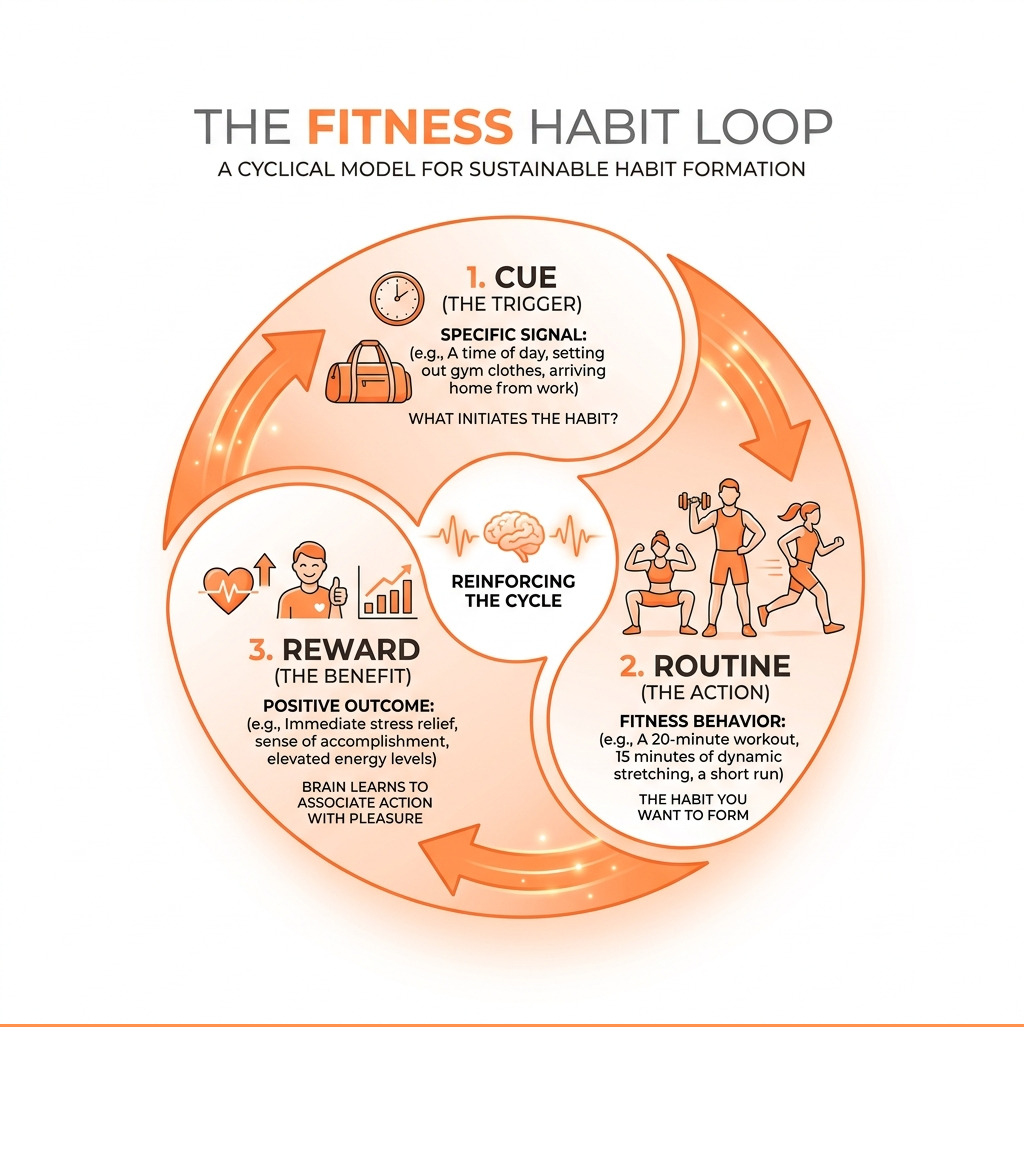
When we talk about making a change that lasts, we aren’t just talking about “trying harder.” We are talking about rewiring the way your brain perceives exercise. To do this effectively, we rely on proven psychological frameworks that move fitness from a “chore” to a “characteristic.”

Understanding the Dual Process Approach
Adherence to an exercise program isn’t a single event; it’s a psychological tug-of-war. The Dual Process Approach explains that our behavior is driven by two systems: conscious intention and unconscious habit.
Conscious intention is that voice in your head saying, “I want to lose ten pounds.” It’s great for getting started, but it’s incredibly taxing on your mental energy. Unconscious habits, on the other hand, are automated. Think about brushing your teeth; you don’t need a motivational speech to do it. Sustainable fitness habit coaching focuses on moving your workouts from the “high-effort intention” bucket into the “automatic habit” bucket. By reducing the mental load required to start a workout, we ensure long-term adherence even on your most stressful days in Mount Airy.
The 66-Day Reality Check
You may have heard the myth that it takes 21 days to form a habit. Unfortunately, research suggests that for most people, that’s just not enough time. On average, it takes 66 days for a new behavior to become automatic.
This timeframe is a vital reality check. If you expect to feel like a “gym person” after three weeks, you’ll likely feel like a failure when you still have to drag yourself there. Understanding that the window for automaticity can range from 18 to 254 days helps us set realistic expectations. Consistency is the only variable that matters during this window. If you miss a day, don’t panic—research shows that missing a single day doesn’t ruin the habit-forming process, provided you get back to it the next day. Scientific research on habit formation emphasizes that the “all-or-nothing” mentality is the biggest enemy of the 66-day journey.
Learn more from a Habit Fitness Coach about how to navigate these first two months without burning out.
Why Traditional Fitness Fails and How Coaching Fixes It
Most people fail not because they lack “willpower,” but because they are trapped in a cycle of “positive punishment.” When you jump into a high-intensity program after months of inactivity, your immediate “reward” is extreme soreness, exhaustion, and perhaps an injury. In behavioral psychology, this is punishment, and our brains are literally wired to avoid things that punish us.

Overcoming the Motivation Merry-Go-Round
Motivation is like a fair-weather friend—it’s there when things are sunny and easy, but it disappears the moment work gets stressful or the kids get sick. Relying on motivation leads to the “Motivation Merry-Go-Round”: you start fast, burn out, quit, feel guilty, and then wait for a “new spark” to start again.
Sustainable fitness habit coaching replaces this cycle with an identity shift. Instead of “doing a workout,” we focus on “becoming an active person.” This shift is supported by professional Health Coaching that focuses on sustainability over quick fixes. We look for the “hidden” negative habits—like late-night scrolling that leads to poor sleep—and replace them with behaviors that support your goals. To avoid the traps many fall into, check out these common workout mistakes after 30.
Reducing Behavioral Complexity
One of the biggest reasons people quit is that their routine is too complicated. If your workout requires a 30-minute drive, a specific set of equipment, and movements you don’t understand, the “behavioral complexity” is too high.
We fix this by starting small. We use regressions (easier versions of exercises) and progressions (harder versions) to meet you where you are. If a full squat is painful, we start with a box squat. By lowering the barrier to entry, we increase your “self-efficacy”—your belief in your ability to succeed. When you feel successful, you are more likely to return.
A Step-by-Step Guide to Lasting Change
Building a habit is like building a house; you need a solid foundation before you can put up the walls. We don’t want you to “exercise more”; we want you to exercise smarter.
Building Your Sustainable Fitness Habit Coaching Plan
To make fitness stick, we focus on “Process Goals” rather than just “Outcome Goals.”
- Outcome Goal: “I want to lose 20 pounds.” (This is the destination).
- Process Goal: “I will strength train for 30 minutes, three times a week.” (This is the map).
By focusing on the process, you gain “small wins” every day. We also utilize habit stacking, which is the practice of pairing a new habit with an existing one. For example, “After I drop the kids off at school (existing habit), I will drive straight to the gym (new habit).” Or, “While my coffee is brewing, I will do ten bodyweight squats.” This integrates fitness into your life rather than forcing it to compete with your life. For those just starting, our Foundations services are designed exactly for this phase.
Optimizing Your Environment and Accountability
Your environment often dictates your behavior more than your intentions do. If your gym bag is packed and sitting by the door, you are much more likely to go. This is an “environmental cue.”
Accountability is the other half of the equation. Whether it’s a spouse, a workout partner, or a professional coach, having someone expect you to show up changes the game. This is why we emphasize Personal Training and Group Training. In a community like Mount Airy, having a local support system makes the journey less lonely. You can find The Best Personal Trainers in Mount Airy, Maryland to help provide that initial push.
Foundational Pillars: Strength, Nutrition, and Recovery
A sustainable habit isn’t just about the time you spend in the gym; it’s about how you fuel and recover. At Primedy Health, we focus on a “minimal effective dose” approach—doing the things that provide the biggest results with the least amount of friction.
| Category | Sustainable Habit | Why it Works |
|---|---|---|
| Strength | Compound Movements | Hits multiple muscles at once; builds “real-world” strength. |
| Nutrition | Protein at every meal | Supports muscle repair and keeps you full longer. |
| Recovery | 7-8 Hours of Sleep | This is when your body actually changes and repairs itself. |
| Consistency | The “Fitness Habit Hour” | Dedicating 4% of your day to health (prep, movement, or rest). |
Strength Training for a Pain-Free Body
We believe strength is the foundation of health. However, many people avoid it because they fear injury or find it intimidating. Our approach uses progressive overload—gradually increasing the challenge so your body adapts without breaking. We focus on foundational movements: squats, hinges (like deadlifts), pushes, and pulls. These are functional movements that make carrying groceries or playing with your grandkids easier and pain-free. Check out our Pre-designed Programs for workouts that focus on these essentials.
Simple Nutrition and Recovery Habits
Nutrition doesn’t have to mean “dieting.” In fact, extreme dieting is the opposite of sustainable. Instead, we coach simple habits:
- Prioritize Protein: Aim for roughly 20-30 grams of protein at breakfast to fuel your day.
- Whole Foods: Focus on plants and animals. If it comes in a box with twenty ingredients, it’s an “occasional” food, not a staple.
- Active Recovery: On days you don’t lift, go for a walk or do some light yoga. This keeps the “habit” of daily movement alive without overtaxing your central nervous system.
- Sleep Hygiene: Keep your room cool (around 68 degrees) and turn off screens 30 minutes before bed.
Maintaining Momentum and Tracking Results
If you don’t track it, you can’t manage it. But tracking shouldn’t just be about the number on the scale—which can fluctuate wildly based on water retention and inflammation.
The Power of Objective Progress Tracking
We use Progress Tracking to look at objective metrics. Are you getting stronger? Is your resting heart rate dropping? Are your clothes fitting differently? By looking at data, we remove the emotional “sting” of a bad day on the scale.
Our average clients stay with us for over 18 months because we celebrate these milestones. We shift the focus from “losing weight” to “gaining capability.” When you see that you can now lift a weight that seemed impossible two months ago, your motivation transforms into genuine confidence.
Staying Resilient After Setbacks
Life will happen. You will get sick, you will go on vacation, and you will have “off” days. The difference between a successful habit-former and a quitter is resilience.
We teach the “never miss twice” rule. If you miss a workout on Tuesday, Tuesday is over. Don’t try to “make it up” by doing a double workout on Wednesday—that leads to injury. Simply resume your habit on Wednesday. Forgiveness is a tactical tool in sustainable fitness habit coaching. A long-term vision allows you to see a missed day as a tiny blip in a multi-decade journey of health.
Frequently Asked Questions about Sustainable Fitness Habit Coaching
How long does it typically take to form a lasting fitness habit?
Research shows it takes an average of 66 days, though it can range from 18 to 254 days depending on the individual and the complexity of the behavior. The key is not perfection during this time, but rather “temporal consistency”—trying to perform the action at the same time or after the same “cue” every day.
What is habit stacking and how does it work?
Habit stacking involves pairing a new fitness behavior with an existing, automatic habit—like doing squats while the coffee brews—to make integration into your daily life seamless. It works because it hitches a “ride” on a neural pathway that is already well-established in your brain.
Why is starting small better than a high-intensity program?
Starting small reduces behavioral complexity and prevents the “positive punishment” of extreme soreness, allowing you to build confidence and consistency before increasing intensity. It ensures that your brain associates exercise with “success” rather than “pain.”
Conclusion
Building a body you are proud of doesn’t require a 30-day “shred” or an extreme overhaul of your entire life. It requires the courage to start small and the structure to stay consistent.
At Primedy Health, we specialize in helping the busy residents of Mount Airy, Frederick, and Carroll County find a path to fitness that actually fits into their real lives. Whether you are looking for Personal Training, Group Training, or a total Health Reset, our focus is always on the long game.
Stop starting over. Start sustaining.
Start your journey with professional health coaching today and build a foundation of health that lasts a lifetime.