

Stop Guessing at the Gym: What Customized Strength Training Plans Actually Do
Customized strength training plans are personalized workout programs built around your specific goals, experience level, available equipment, schedule, and body — not a random stranger’s.
Here’s a quick comparison to help you decide what you need:
| Feature | Generic Routine | Customized Plan |
|---|---|---|
| Built for your goals | No | Yes |
| Accounts for your schedule | Rarely | Always |
| Adjusts as you progress | No | Yes |
| Considers injuries/limitations | No | Yes |
| Prevents plateaus | Hit or miss | Built-in |
| Equipment flexibility | Limited | Yes |
If you’ve ever downloaded a 12-week program, crushed it for two weeks, then slowly stopped showing up — you’re not alone. Most generic routines fail not because the exercises are wrong, but because the plan wasn’t built for your life.
The problem is real. Without a clear game plan, motivation fades fast. And repeating the same workouts week after week leads to plateaus, boredom, and eventually burnout.
Customized plans solve this by matching the program to the person — not the other way around.
In this guide, we compare the best approaches to personalized strength training, from app-based platforms to coach-led programming, so you can find the right fit.
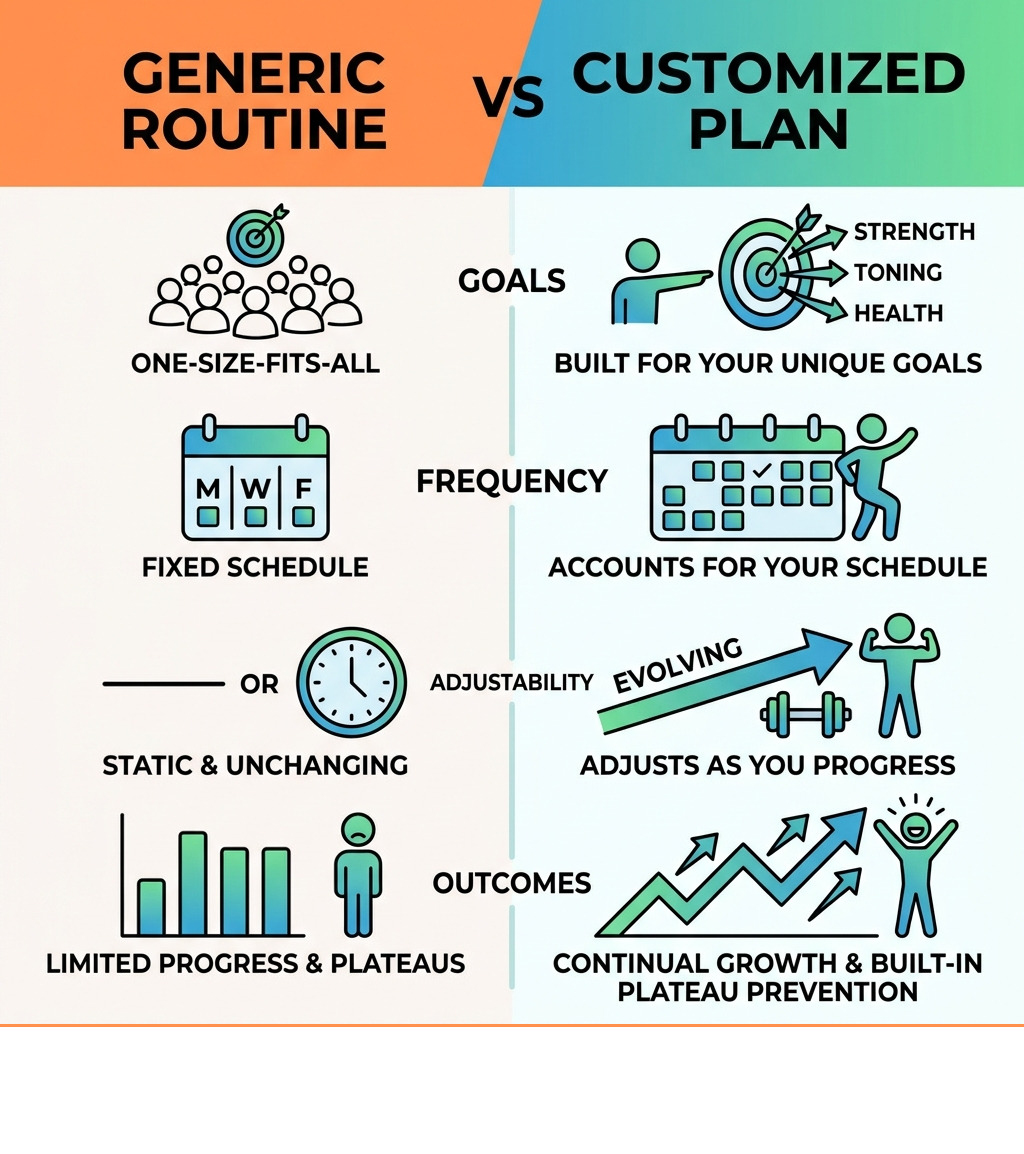
Why Customized Strength Training Plans Outperform Generic Routines
When you walk into a gym in Mount Airy or Frederick without a plan, you’re essentially “winging it.” While any movement is better than no movement, generic routines often ignore the most critical factor in fitness: specificity.
Customized strength training plans are designed to meet you exactly where you are. Unlike a PDF you found on a forum, a personalized plan evolves. If you have a busy week in Carroll County and can only train twice, a custom plan adjusts. If your bench press stalls but your squats are soaring, a custom plan pivots to address that imbalance.
This is where Personal Training shines. By focusing on your unique bio-individuality, we can ensure that every rep serves a purpose. Generic routines often lead to overtraining certain muscle groups while neglecting others, which is a fast track to injury. Custom programming prioritizes injury prevention by selecting exercises that fit your current mobility levels and anatomical structure.
The Science of Individualized Programming
The “science” isn’t just a buzzword; it’s about how your body responds to stress. Everyone has a different metabolic rate, varying ratios of muscle fiber types (fast-twitch vs. slow-twitch), and unique recovery capacities. Concepts like progressive overload help explain why the right amount of challenge, applied consistently, leads to long-term strength gains.
Research shows that for optimal muscle growth, most people should hit each muscle group 2 to 3 times per week. However, how you hit those muscles depends on your recovery. A 25-year-old athlete might recover from a heavy leg day in 48 hours, while a 50-year-old executive in Maryland might need 72 hours plus some targeted mobility work. Customized strength training plans account for these recovery windows, ensuring you aren’t breaking down muscle faster than you can build it back up.
Moving Beyond One-Size-Fits-All
We all have different “training ages.” Your training age isn’t how old you are; it’s how long you’ve been consistently lifting. A beginner needs to focus on Foundations – learning the fundamental movement patterns like the squat, hinge, push, and pull. An advanced lifter might need specialized techniques like tempo training or clusters to see progress.
Anatomical variations also play a huge role. For example, someone with long femurs will naturally squat differently than someone with short femurs. A generic plan might tell you to “squat to parallel,” but for your body, that might cause lower back pain. Personalized routines, like those offered through professional strength training programs, allow for exercise substitutions that respect your joints while still smashing your goals.
Key Components of Your Personalized Strength Program
A successful plan isn’t just a list of exercises; it’s a living document that manages your most valuable resource: time.

When setting up your plan, we look at three main pillars:
- Equipment Availability: Whether you have a full Health Club membership or a few dumbbells in your Mount Airy garage, your plan should reflect that.
- Time Management: Can you commit to 30 minutes or 60? Are you training 2 days a week or 5?
- Movement Patterns: We prioritize the “big rocks”—squatting, hinging, pushing, pulling, and carrying.
| Experience Level | Recommended Frequency | Typical Duration | Focus |
|---|---|---|---|
| Beginner | 2–3 days/week | 30–45 mins | Form, Consistency, Foundations |
| Intermediate | 3–4 days/week | 45–60 mins | Progressive Overload, Hypertrophy |
| Advanced | 4–6 days/week | 60–90 mins | Specificity, Weak Point Training |
Setting Goals for Your Customized Strength Training Plans
What do you actually want? Your plan for “getting jacked” will look very different from a plan designed for “longevity.”
- Hypertrophy (Muscle Building): Focuses on higher volume and hitting muscles 2–3 times a week.
- Absolute Strength: Focuses on lower reps with higher intensity (weight).
- Fat Loss: Combines strength training with a caloric deficit, often utilizing Customized Virtual Programming to keep you accountable at home.
- Longevity: Prioritizes mobility, heart health, and maintaining muscle mass as you age.
Addressing Specific Weaknesses and Mobility
Most of us sit at desks or in cars far too much. This leads to “sleepy” Glutes, tight Shoulders, and cranky Knees. A generic routine will tell you to “just do lunges,” but if your knees are bothering you, that’s bad advice.
A customized plan incorporates “pre-hab” or corrective exercises into your warm-up. By strengthening the stabilizers around your joints, you can lift heavier weights safely. This functional range of motion is what allows you to stay active in the real world, whether that’s hiking in Frederick or playing with your kids in Carroll County.
How to Build or Select Your Ideal Strength Plan
Getting started can feel like the hardest part, but it’s simpler when you break it down into steps.
- The Assessment: Before you lift a single weight, you need to know where you’re starting. This includes a movement screen and a strength baseline.
- The Selection: Decide if you want a Pre-designed Program that you can tweak, or a fully bespoke plan.
- The Schedule: Be realistic. It is better to have a “perfect” 2-day plan you actually follow than a “perfect” 5-day plan you quit after two weeks.

Matching Equipment and Lifestyle
Your lifestyle dictates your success. If you travel for work across Maryland, your customized strength training plans should include “hotel gym” or “bodyweight” alternatives. Many fitness platforms offer routines that can be done anywhere, while online databases provide numerous free options to filter by equipment.
For those who want a hybrid approach, semi-private personal training offers the community of a group with the attention of a personal trainer, making it easier to stay consistent.
Integrating Technology into Customized Strength Training Plans
It’s 2026, and tech is your best friend in the gym. From wearable data that tracks your recovery (like heart rate variability) to apps that provide real-time feedback, technology removes the guesswork.
Many of our clients use Virtual 1-on-1 Training to get expert coaching via video. This allows for form correction in real-time, which is something a static PDF simply can’t offer. Tech integrations also allow us to see your “objective progress”—not just how you feel, but the actual data showing you’re getting stronger.
Maximizing Results Through Recovery and Nutrition
You don’t get stronger in the gym; you get stronger recovering from the gym.
Macronutrient Balance and Sleep
If you are following customized strength training plans but sleeping four hours a night and eating nothing but processed snacks, you are spinning your wheels. Muscle repair requires protein and enough calories to fuel the process. Sleep is when your growth hormone peaks, repairing the micro-tears created during your workout.
Active Recovery and Deloads
A common mistake is thinking you have to go “all out” every single day. Successful programs include:
- Active Recovery: Light walking, yoga, or mobility work to keep blood flowing without adding stress.
- Deload Weeks: Every 4–8 weeks, you should reduce your intensity or volume. This allows your central nervous system to recover, preventing burnout and keeping your progress on an upward trend.
Avoiding Common Programming Mistakes
The biggest pitfall? Inconsistency. But close behind is “ego lifting”—trying to lift more than you can handle with good form.
- Neglecting Form: This is why we recommend beginners seek out a qualified personal trainer or visit a local fitness center to get eyes on their technique.
- Inconsistent Tracking: If you don’t write down your weights, you can’t ensure progressive overload.
- Overtraining: More is not always better. Better is better.
Frequently Asked Questions about Personalized Training
How often should I update my customized plan?
Generally, a “block” of training lasts 4 to 8 weeks. This gives your body enough time to adapt to the exercises and get stronger (progressive overload) without getting bored. After this period, we usually swap out some exercises or change the rep schemes to keep the stimulus fresh.
Can I combine strength training with cardio in a custom routine?
Absolutely! In fact, for longevity and fat loss, we encourage it. The key is “concurrent training”—scheduling your cardio so it doesn’t interfere with your strength gains. For example, doing a high-intensity run right before a heavy leg day might not be the best idea, but a light walk or a swim on an off-day is perfect.
What is the best way to track objective progress?
Move beyond the scale. Track the weight on the bar, your “reps in reserve” (how many more reps you could have done), your body measurements, and your energy levels. Apps that sync with your equipment can provide a “strength score” that gives you a clear picture of your evolution.
Conclusion
At the end of the day, the best customized strength training plans are the ones you actually do. Whether you are looking for Group Training in Mount Airy or prefer the privacy of your own home, the goal is sustainable habits.
Generic routines are a starting point, but they aren’t the finish line. To see real, lasting results that fit into your busy Maryland lifestyle, you need a plan that was built specifically for you. Stop guessing, start tracking, and give your muscles exactly what they’ve been asking for.
Ready to stop “winging it” and start winning? Start your journey with professional Health Coaching and let us build the perfect plan for your life.