
Why Objective Fitness Progress Tracking Is the Missing Piece in Your Workout Routine
Objective fitness progress tracking means using real, measurable data — like weight lifted, reps completed, body measurements, and energy levels — to know whether your training is actually working.
Here’s a quick summary of what it involves:
- Log your workouts — record exercise, weight, sets, and reps every session
- Track body composition — measure waist, arms, chest, and hips every 2-4 weeks
- Monitor effort levels — use Reps in Reserve (RIR) to gauge training intensity
- Check qualitative signs — energy, mood, sleep, and recovery matter too
- Review trends over time — look at 4-6 week blocks, not day-to-day changes
Here’s the problem most people run into: you go to the gym consistently for weeks, but you have no idea if you’re actually making progress. The scale barely moves. Some days feel hard, some feel easy. You’re doing something — but is it working?
Without data, you’re guessing.
Research shows that people who track their progress are 42% more likely to stick with their fitness routine. That’s not a small difference. That’s the gap between people who see results and people who quit.
But tracking doesn’t have to mean obsessing over every number. Done right, it gives you just enough information to make smarter decisions — without turning your fitness journey into a spreadsheet nightmare.
This guide breaks down exactly how to track your workouts in a way that’s clear, sustainable, and actually useful — especially if you’re juggling a busy life and don’t have time to waste on approaches that don’t work.
The Science of Objective Fitness Progress Tracking
In April 2026, the fitness landscape has shifted away from “guessing and checking” toward a more data-informed approach. At Primedy Health, we believe that Progress Tracking is the bridge between effort and results. Science-backed tracking provides unbiased feedback, removing the emotional rollercoaster that often comes with fitness. When you have a bad day at the gym, your log might show that you still lifted more than you did three weeks ago. That is the power of objectivity.
To make this data work for us, we utilize the SMART framework. SMART Fitness Goals You Can Actually Keep are Specific, Measurable, Attainable, Relevant, and Time-bound. Instead of saying, “I want to get stronger,” a SMART goal would be, “I want to increase my deadlift by 10 pounds over the next six weeks.”
By defining purpose with meaningful intent, we increase our focus and direction. Understanding How To Set SMART Fitness Goals And Achieve Them allows us to create a personalized approach. It transforms an abstract wish into a predictable process. When your goals are measurable, your motivation stays high because you can actually see the needle moving.
Using Objective Fitness Progress Tracking for Progressive Overload
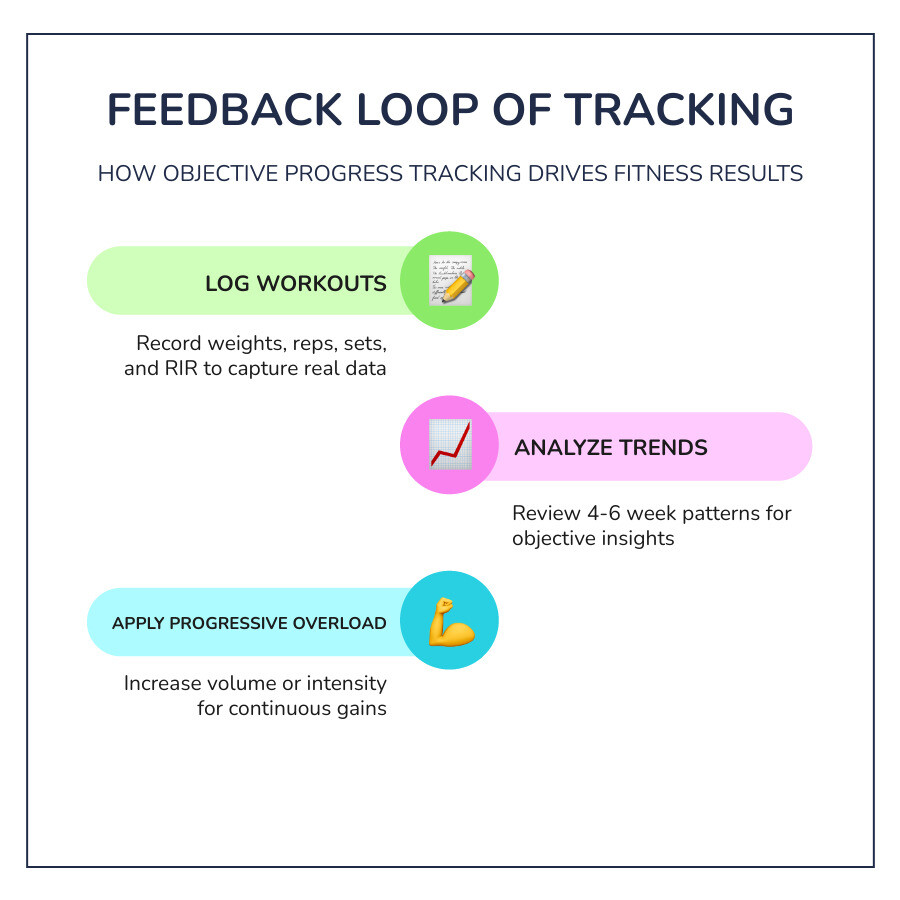
The “golden rule” of muscle growth and strength is progressive overload. This is the practice of gradually increasing the stress placed on the body during exercise. If you do the same ten reps with the same 20-pound dumbbells for three years, your body has no reason to change.
Through Health Club Training, we focus on three primary levers:
- Volume: The total amount of work done (Sets x Reps x Weight).
- Intensity: How heavy the weight is relative to your maximum capability.
- Frequency: How often you train a specific muscle group.
We organize these variables into “mesocycles,” which are typically 4-6 week training blocks. By using Pre-Designed Programs, we can ensure that each session builds on the last. Your data tells us exactly when to add five pounds or when to push for one extra rep, ensuring that you are always moving forward without overtraining.
Non-Numerical Objective Fitness Progress Tracking Methods
Numbers are great, but they aren’t the only way to measure success. Sometimes the scale stays stagnant while your body is undergoing a massive transformation. This is where non-numerical methods provide essential context.
- Progress Photos: Take these once a month in the same lighting and pose. They capture changes in muscle definition and posture that numbers miss.
- Clothing Fit: If your jeans feel looser in the waist but tighter in the thighs, that’s a clear sign of body recomposition.
- Body Measurements: Using a simple measuring tape on your waist, hips, chest, and arms can improve user retention by up to 65% because it shows progress even when the scale doesn’t budge.
- Joint Health: Monitoring how your body feels during movement is vital. Our Joint Health Category emphasizes that pain-free range of motion is a major indicator of success.
For those in the Maryland area, professional Fitness & Body Composition Assessments can provide a high-level baseline of where you stand, helping us tailor your program even further.
Core Metrics for Muscle Growth and Strength

To achieve maximum results, we must track the “Foundational Four” metrics for every work set:
- Exercise: The specific movement performed.
- Weight: The exact load used.
- Reps: The number of completed repetitions.
- Sets: The total number of rounds.
Beyond these, we use Reps in Reserve (RIR). RIR is a measure of how many more reps you could have done before your form broke down. For most strength gains, we aim for 1-3 RIR. If you finish a set and feel like you could have done ten more reps, the weight was too light. If you couldn’t have done a single extra rep, you hit “failure.”
At Primedy Health, our Foundations program teaches members how to use these metrics to manage fatigue. Effective Progress Tracking also requires monitoring your rest periods. Resting for two minutes one day and five minutes the next makes your data inconsistent. Keep your rest times steady to ensure your strength gains are real, not just the result of extra recovery time.
Balancing Numbers with Qualitative Indicators
While objective fitness progress tracking is the backbone of our philosophy, it shouldn’t cause obsession. We must balance quantitative data (the “what”) with qualitative data (the “how”).
If you added 20 pounds to your squat but you’re now too sore to walk and your mood has plummeted, that progress isn’t sustainable. We use Health Coaching to help members listen to their bodies.
| Quantitative Data (The Numbers) | Qualitative Data (The Feeling) |
|---|---|
| Weight on the barbell | Daily energy levels |
| Body fat percentage | Mood and mental clarity |
| Inches lost/gained | Quality of sleep |
| Total weekly volume | Muscle soreness and recovery |
| Resting heart rate | Motivation to train |
This balance is why we say Why Balance is a Strength Game. True fitness is about performance optimization and well-being. If your “numbers” are going up but your sex drive, sleep, and happiness are going down, we need to adjust the plan.
How to Identify and Break Through Training Plateaus

A plateau is when your progress stalls for several weeks despite consistent effort. Everyone hits them eventually. The beauty of having a workout log is that you can troubleshoot the “why.”
When we see a plateau, we use our Scan and Plan approach to look at the data:
- Is recovery the issue? Are you getting 7-9 hours of sleep and enough protein?
- Is the stimulus stale? Do we need to change the exercise selection or the rep range?
- Are you overtrained? If your strength is actually decreasing, your body likely needs a “deload.”
A deload week involves a 40-50% reduction in training volume or intensity. It’s a Health Reset that allows your central nervous system and joints to recover, often leading to a new personal best the following week. Without tracking, you might just try to “push through” and end up injured. With data, you can see the wall coming and step over it.
Frequently Asked Questions about Fitness Tracking
How often should I track my progress to avoid overthinking?
We recommend logging your workout metrics (weight, reps, sets) every single session — it only takes 30 seconds between sets. However, for body metrics like weight and measurements, less is often more.
Avoid obsessing over daily scale fluctuations, which are mostly water weight. Instead, look at weekly averages or monthly measurements. Tracking once a month is a fantastic way to see long-term trends without the daily stress. Consistency in the gym matters more than the frequency of your weigh-ins.
What are the best tools for accurately logging workouts?
While a simple notebook works, digital tools offer significant advantages. Apps like JEFIT or MapMyFitness can automate calculations like your 1-Rep Max (1RM) and provide instant graphs of your progress. Modern tools often include rest timers and next-session proposals, helping people see gains up to twice as fast.
Whether you prefer a digital log or a physical one, the best tool is the one you will actually use. Explore our Exercise Category for more tips on integrating technology into your routine.
How do I know if my training is sustainable?
Sustainability is revealed through your qualitative data. If you feel energized, sleep well, and look forward to your workouts, you are on the right track. If you feel “burnt out,” chronically sore, or mentally foggy, your current volume may be too high for your lifestyle.
Our Jumpstart program is designed to find that “sweet spot” where you get maximum results with minimum unnecessary stress, ensuring you can keep training for years, not just weeks.
Conclusion
At Primedy Health, based in Mount Airy, MD, we know that fitness isn’t just about working hard; it’s about working smart. By embracing objective fitness progress tracking, you take the guesswork out of your health. You move from “hoping” for results to “knowing” they are coming.
Whether you are in Frederick, Carroll County, or working with us online, our mission is to provide coach-led, sustainable strength training that fits into your real life. We help you set SMART goals, track the metrics that actually matter, and balance those numbers with how you feel every day.
Ready to stop guessing and start growing? Explore our Customized Virtual Programming to get a plan built entirely around your data and your life. Let’s build a stronger, more measurable future together.