
You Don’t Have Hours to Spend at the Gym — And You Don’t Need Them
Busy adult strength training doesn’t have to mean long sessions, complicated programs, or an all-or-nothing commitment. Here’s what actually works when time is short:
Quick Answer: How Busy Adults Can Build Strength Efficiently
- Train 2-3 days per week — research shows this is enough to build muscle and increase strength
- Use full-body or upper/lower splits — so a missed session doesn’t derail your whole week
- Focus on compound movements — squats, hinges, presses, and pulls give you the most return on your time
- Keep sessions to 35-45 minutes — quality effort beats session length every time
- Progress gradually — add a rep or a small amount of weight each week, not a new program
Most people don’t fail at fitness because they’re lazy. They fail because the plan they’re following asks for more time, energy, and recovery than real life can support. Work deadlines, family obligations, poor sleep — these aren’t excuses. They’re real constraints that a smart program has to work around, not ignore.
The good news? Studies at Tufts University have shown that strength training is one of the most powerful tools available for fighting age-related weakness and frailty. And you don’t need five days a week to get those benefits.
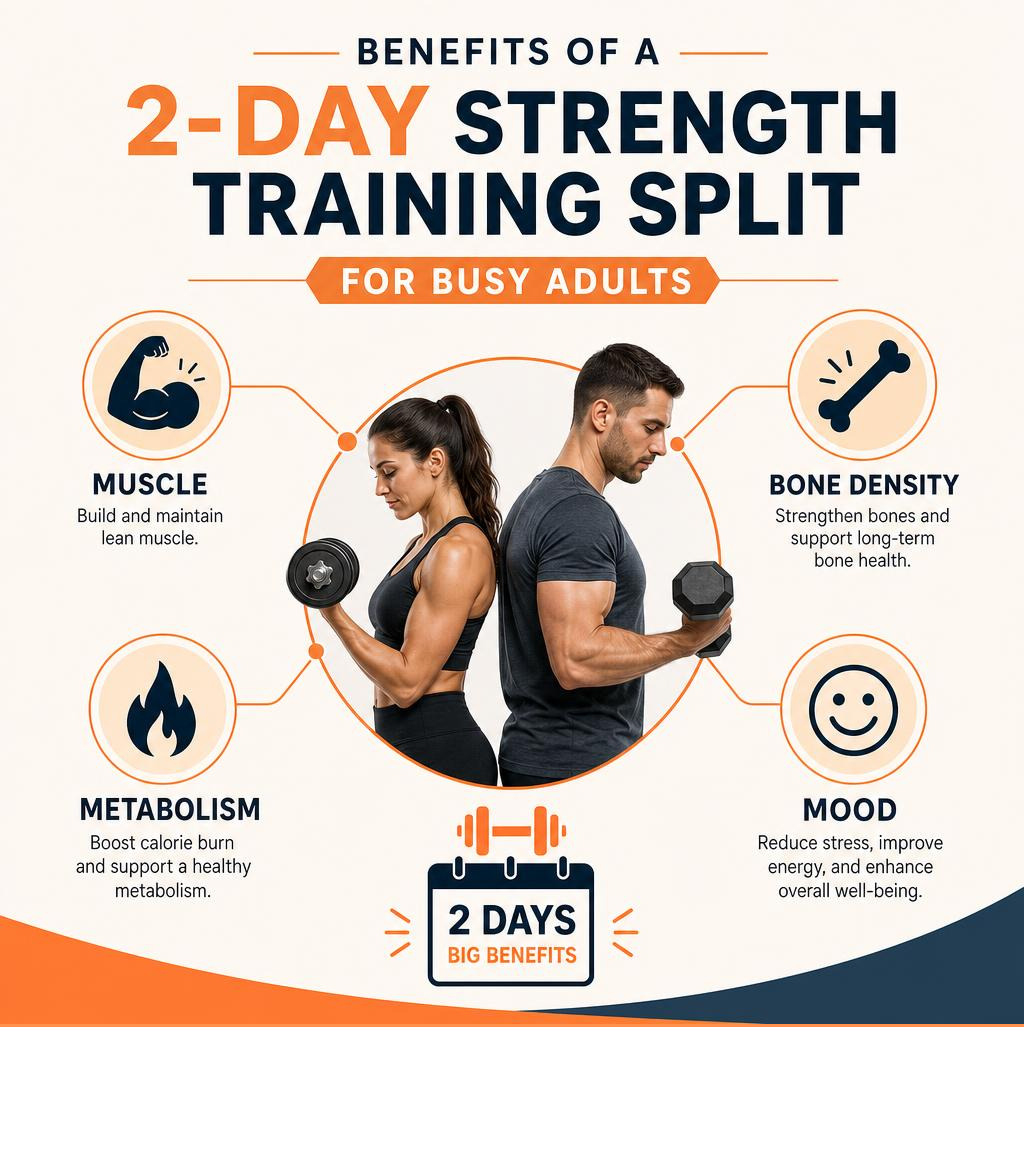
Two focused, well-structured sessions per week can build muscle, improve bone density, boost metabolism, and lift your mood. The key is knowing what to do in those sessions — and doing it consistently.
This guide is built for exactly that.
Common busy adult strength training vocab:
Why Efficiency Beats Volume in Busy Adult Strength Training
If you have unlimited free time, perfect sleep, a private chef, and no surprise meetings, then sure, a long gym program might work beautifully.
For the rest of us in Mount Airy, Frederick, Carroll County, and everywhere real life keeps happening, efficiency wins.
The goal of a time-efficient strength plan is not to do the least possible forever. The goal is to get the best return from the time you can actually protect. A 35-minute workout you complete twice a week beats a 90-minute plan you abandon after two Mondays.
Strength training is especially useful for busy adults because it supports several goals at once:
- Muscle preservation: Adults naturally lose muscle with age, especially if they are inactive. Strength training helps slow that decline.
- Bone density: Resistance training gives bones the loading signal they need to stay stronger over time.
- Metabolism support: More lean muscle can help support daily energy expenditure.
- Better posture and joint support: Strong glutes, hamstrings, upper back, and core muscles help your body tolerate sitting, driving, lifting, and life.
- Mood and stress relief: Strength training, especially when paired with regular walking or aerobic exercise, can support mental and emotional health.
- Better sleep: Many adults notice improved sleep quality once they train consistently, recover well, and stop using exercise as punishment.
The big mistake is assuming that more is always better.
More exercises, more soreness, more sweat, more days, more chaos – it can all feel productive. But feeling destroyed after a workout is not the same as building strength. For busy adults, the best program usually has:
- Enough work to stimulate progress
- Enough recovery to adapt
- Enough flexibility to survive a messy week
That is why we like structured, sustainable plans. If your life is already packed, your fitness program should reduce decision fatigue, not become another full-time job. Our Busy Life Fitness Program for Real Results is built around that exact idea: practical training that fits real schedules.
Here is the simple truth: the best workout plan is not the most impressive one on paper. It is the one you can repeat.
The Ultimate Two-Day Busy Adult Strength Training Plan

A two-day plan works best when it is focused, full-body-ish, and built around high-value movement patterns.
We want each week to include:
- A squat or split-squat pattern
- A hip hinge or glute-focused pattern
- An upper-body push
- An upper-body pull
- Posterior chain work
- Core or carry work
- Joint-friendly accessories
The posterior chain deserves special attention. That means the muscles on the back side of the body: glutes, hamstrings, upper back, lats, rear shoulders, and spinal stabilizers.
Why prioritize them? Because busy adult life tends to pull us forward. We sit, drive, text, work at desks, carry kids, haul groceries, and hunch over laptops. Strong posterior chain muscles help restore balance by improving posture, stabilizing hips and shoulders, and reducing stress on cranky joints.
A two-day plan can be organized in a few ways. For very busy adults, we like this format:
| Training Day | Main Focus | Best For | Sample Movements |
|---|---|---|---|
| Day 1 | Upper body with posterior chain emphasis | Posture, shoulders, back, pressing strength | Row, lat pulldown, incline press, push-up, face pull, rotator cuff work |
| Day 2 | Lower body with posterior chain emphasis | Glutes, hamstrings, knees, hips, bone strength | Glute bridge, split squat, hamstring curl, leg press, calf raise, core carry |
This is not a random list of gym exercises. It is a strategy.
You are training the muscles that give you the most practical payoff: getting up from the floor, carrying bags, protecting your back, climbing stairs, improving posture, and feeling less like your body is held together by coffee and hope.
Designing Your Day 1 Upper Body Routine
Day 1 should train your back, shoulders, chest, arms, and shoulder stabilizers without beating up your joints.
A good upper-body day for busy adults includes one major pull, one secondary pull, one press, and one shoulder-health movement.
Try this structure:
| Exercise | Sets | Reps | Why It Helps |
|---|---|---|---|
| Chest-supported row | 3 | 8-12 | Builds upper back without stressing the low back |
| Neutral-grip lat pulldown | 3 | 8-12 | Trains lats and supports shoulder function |
| Incline dumbbell or machine chest press | 2-3 | 8-12 | Builds pressing strength with less shoulder strain than some flat pressing |
| Push-up or elevated push-up | 2 | 6-12 | Practical upper-body strength you can scale |
| Cable face pull or band pull-apart | 2 | 12-15 | Trains rear shoulders and posture muscles |
| Banded external rotation | 2 | 10-15 | Supports rotator cuff strength and shoulder control |
If you train at home, use dumbbells and resistance bands. If you train in a gym, machines and cables are excellent joint-friendly options. Machines are not “cheating.” They are tools. We are adults. We are allowed to use tools.
For a deeper beginner-friendly breakdown, see our Step-by-Step Guide to Strength Training Program.
Upper-body safety tips:
- Use a neutral grip when possible if your shoulders feel sensitive.
- Stop a set when your form starts changing.
- Keep 1-3 reps “in the tank” on most exercises.
- Do not chase soreness in the shoulders. Shoulder joints are not impressed by ego.
- Use controlled lowering instead of bouncing or rushing reps.
A great Day 1 session should leave you feeling trained, not wrecked.
Designing Your Day 2 Lower Body Routine
Day 2 focuses on the muscles that keep you strong, stable, and capable: glutes, hamstrings, quads, calves, and core.
For adults over 40, adults returning after time off, or anyone with joint concerns, lower-body training should be challenging but controlled. We want strength without turning stairs into a horror movie for the next three days.
Try this structure:
| Exercise | Sets | Reps | Why It Helps |
|---|---|---|---|
| Glute bridge or hip thrust | 3 | 8-12 | Builds glutes with low knee stress |
| Split squat or supported split squat | 2-3 | 6-10 each side | Builds legs, balance, and hip stability |
| Seated or standing hamstring curl | 3 | 10-15 | Direct hamstring work for knee and hip support |
| Leg press with feet slightly higher | 2-3 | 8-12 | Trains legs while reducing balance demands |
| Calf raise | 2 | 10-15 | Supports ankles, walking, and lower-leg strength |
| Farmer carry or dead bug | 2 | 30-45 seconds | Trains trunk strength and real-life carrying ability |
At home, you can swap:
- Leg press for goblet squat to a box
- Hamstring curl machine for stability ball hamstring curl
- Hip thrust machine for dumbbell glute bridge
- Farmer carry for suitcase carry with one dumbbell
Our Ultimate Beginner Home Workout with Free Weights can help you build a simple home setup without needing a garage that looks like a professional training facility.
Lower-body safety tips:
- Start with a 5-10 minute warm-up.
- Use a shorter range of motion at first if knees or hips are sensitive.
- Add depth slowly over time.
- Choose supported versions when balance is a limiter.
- Avoid pain that is sharp, worsening, or joint-specific.
Muscle effort is fine. Joint pain is feedback. Listen to it.
How to Progress and Track Your Gains Without Losing Your Mind

Progress is not magic. It is measurement plus small improvements.
The reason many busy adults spin their wheels is that they change workouts too often. Every week is a new video, new class, new app, new exercise, new promise. That can feel exciting, but it makes progress hard to measure.
Strength improves when you repeat key movements long enough to get better at them.
That does not mean you do the exact same thing forever. It means you keep the foundation stable while gradually increasing the challenge.
Tracking Progress in Busy Adult Strength Training
You do not need a complicated spreadsheet with 47 tabs and a motivational quote from a Viking.
You need to track the basics:
- Exercise
- Weight used
- Sets completed
- Reps completed
- How hard it felt
- Any joint discomfort or form notes
Example:
| Exercise | Week 1 | Week 2 | Week 3 |
|---|---|---|---|
| Chest-supported row | 30 lbs x 10, 10, 9 | 30 lbs x 11, 10, 10 | 30 lbs x 12, 11, 10 |
| Glute bridge | 40 lbs x 12, 12, 10 | 40 lbs x 12, 12, 12 | 45 lbs x 10, 10, 9 |
That is progress.
Notice that we did not need to max out, collapse dramatically, or buy a shirt that says “beast mode.” We simply added reps, then increased weight when ready.
Good tracking can include:
- Workout log
- Notes app
- Training app
- Spreadsheet
- Coach-led tracker
- Progress photos every 4 weeks
- Strength numbers
- Body measurements
- Energy, sleep, and consistency markers
Scale weight can be useful, but it is not the whole story. Strength training can improve body composition even when the scale changes slowly. If your rows, presses, squats, and carries are improving, your body is adapting.
For simple systems, read How to Track Your Workout Results Without Losing Your Mind and Virtual Strength Progress Tracker The Future of Gains.
Managing Progression and Overload Safely
Progressive overload means gradually asking your body to do a little more over time.
That can mean:
- More reps
- More weight
- More sets
- Better range of motion
- Slower tempo
- Better control
- Shorter rest, when appropriate
- More consistent weekly completion
For busy adults, we often prefer double progression.
Here is how it works:
- Pick a rep range, such as 8-12 reps.
- Start with a weight you can lift for about 8-10 good reps.
- Each week, try to add 1 rep somewhere.
- When you can complete all sets at the top of the range, increase the weight slightly.
- Repeat.
Example:
| Week | Dumbbell Press Result | What To Do Next |
|---|---|---|
| Week 1 | 25 lbs x 10, 9, 8 | Keep same weight |
| Week 2 | 25 lbs x 10, 10, 9 | Keep same weight |
| Week 3 | 25 lbs x 12, 11, 10 | Keep same weight |
| Week 4 | 25 lbs x 12, 12, 12 | Move to 30 lbs next time |
This is boring in the best possible way. Boring works.
Reps in reserve are another important concept. If you finish a set and feel like you could have done 2 more good reps, you had 2 reps in reserve.
For most busy adults, most sets should end with 1-3 reps in reserve. This protects recovery and lowers injury risk, especially if you are over 40, under-slept, or returning after a break.
When to hold steady instead of progressing:
- You slept poorly for several nights.
- Your joints feel irritated.
- Your form got worse last session.
- Work stress is unusually high.
- You are sore in a way that affects movement.
- You missed a week and are restarting.
Progression is not a straight line. It is more like Maryland weather: mostly predictable, occasionally ridiculous.
Nutrition, Recovery, and Equipment for Home or Gym Workouts
Training only two days per week does not mean nutrition and recovery do not matter. In fact, they matter more because you want to get the most from each session.
Protein: the muscle-building foundation
Most adults doing strength training benefit from prioritizing protein at each meal. Many evidence-based recommendations for active adults fall around 1.2-1.6 grams of protein per kilogram of body weight per day, depending on goals, age, and medical needs.
A simpler starting point:
- Aim for 25-35 grams of protein per meal.
- Include protein at breakfast, not just dinner.
- Use easy options: eggs, Greek yogurt, chicken, fish, lean meat, tofu, cottage cheese, protein smoothies, beans, or lentils.
- If appetite is low, use smaller protein servings more often.
If you have kidney disease or a medical condition requiring protein restriction, talk with your healthcare provider before increasing protein.
Hydration: simple but underrated
Dehydration can make workouts feel harder and recovery slower. Start with the basics:
- Drink water consistently through the day.
- Add electrolytes if you sweat heavily.
- Check urine color as a rough guide: pale yellow is usually a good sign.
- Do not wait until your workout to start hydrating.
Sleep: your free recovery supplement
Sleep is when your body repairs and adapts. If you train hard but sleep poorly, your progress may feel slower.
Try these basics:
- Keep a consistent bedtime when possible.
- Stop work and screens earlier when you can.
- Avoid large meals right before bed if they disrupt sleep.
- Keep the room cool and dark.
- Treat sleep as part of the program, not a bonus.
Minimal equipment: what you actually need
You can train at home or in a gym. Both work.
For home training, the simplest setup is:
| Equipment | Why It Helps |
|---|---|
| Adjustable dumbbells | Covers presses, rows, squats, hinges, carries |
| Resistance bands | Great for rows, pull-aparts, warm-ups, rotator cuff work |
| Flat or adjustable bench | Supports pressing, rows, step-ups, hip thrusts |
| Exercise mat | Floor work, core training, stretching |
| Small open space | About enough room to lie down and step backward |
You do not need a massive basement gym. A corner of a room can work.
For gym training, useful tools include:
- Dumbbells
- Cable station
- Lat pulldown
- Chest-supported row
- Leg press
- Hamstring curl
- Adjustable bench
- Machines for joint-friendly substitutions
For busy parents and caregivers, convenience is everything. If getting to the gym adds too much friction, start at home. If home has too many interruptions, train at the gym. There is no moral superiority either way. The best location is the one where the workout actually happens.
If family life is the main scheduling challenge, our Busy Mom Fitness Coaching Because Chasing Toddlers Isn’t a Workout Plan offers a practical look at building fitness around real responsibilities.
How to fit workouts into a hectic week
Try one of these schedules:
| Schedule Type | Day 1 | Day 2 |
|---|---|---|
| Standard week | Monday | Thursday |
| Weekend anchor | Wednesday | Saturday |
| Parent schedule | Tuesday morning | Friday lunch |
| Rotating schedule | Next available day | 2-4 days later |
The exact days matter less than the pattern: avoid stacking both hard sessions back-to-back if possible.
Use a minimum workout fallback when life gets wild:
- One lower-body move
- One upper-body push
- One upper-body pull
- One carry or core exercise
That can be done in 20 minutes. It keeps the habit alive.
Busy adults do not need perfection. They need a plan that bends before it breaks.
Frequently Asked Questions About Time-Efficient Workouts
Is Busy Adult Strength Training Effective with Only Two Days a Week?
Yes, two days per week can be effective, especially for beginners, returning exercisers, adults over 40, and anyone whose schedule makes higher-frequency training unrealistic.
The key is that each session must be purposeful. Two random workouts are not the same as a structured two-day plan.
A good two-day program should:
- Train major muscle groups at least twice across the week, directly or indirectly
- Use compound movements
- Include enough challenging sets
- Allow recovery between sessions
- Progress gradually over time
- Be repeated consistently for several months
How does two days compare to longer or more frequent workouts?
| Plan | Pros | Cons | Best For |
|---|---|---|---|
| 2 days per week | Easy to schedule, strong recovery, sustainable | Less total weekly volume | Busy adults, beginners, returners |
| 3 days per week | Great balance of frequency and volume | Requires one more protected time slot | Adults who can recover and schedule it |
| 4+ days per week | More exercise variety and volume | More recovery demand, more missed-session risk | Experienced lifters with stable schedules |
More days can help, but only if you can recover and stay consistent. For many busy adults, two high-quality days beat four inconsistent ones.
Research and real-world coaching both point to the same idea: the minimum effective dose works when the effort is focused and repeated.
What Equipment Do I Need to Start Training at Home?
You can start with very little.
The most realistic home setup is:
- One pair of adjustable dumbbells or several fixed dumbbells
- A set of resistance bands
- A bench or sturdy elevated surface
- Enough floor space to lie down and step back into a lunge
- A notebook or app for tracking
If you have no equipment yet, start with bodyweight:
- Elevated push-ups
- Split squats
- Glute bridges
- Wall sits
- Planks
- Step-ups
- Slow tempo squats
- Towel rows if safely set up
Then add resistance as soon as bodyweight becomes too easy. Muscle needs challenge. Eventually, your glutes will file a complaint if you only give them air squats forever.
For gym training, choose equipment that lets you train hard with good control. Machines, cables, dumbbells, and benches are all useful.
The best equipment is not the fanciest. It is the equipment you can use safely and consistently.
How Do I Avoid Joint Pain and Injuries After 40?
Adults over 40 can absolutely build muscle and strength. The principles are the same, but the margin for nonsense gets smaller.
Here is how to train smarter:
Warm up longer.
Use 5-10 minutes for general movement, then lighter warm-up sets for your first few lifts. If you are over 50 or stiff that day, 10-15 minutes may feel better.
Use joint-friendly exercise choices.
Good options include:
- Chest-supported rows instead of unsupported bent-over rows
- Neutral-grip presses instead of painful straight-bar pressing
- Goblet squats to a box instead of deep barbell squats
- Hip thrusts or glute bridges instead of heavy deadlifts at first
- Leg press instead of unsupported squatting when balance or knees are limiting
- Cable or band work for shoulders
Leave reps in reserve.
You do not need to train to failure all the time. Most busy adults do better leaving 1-3 good reps available.
Progress slowly.
Add one variable at a time. Do not add weight, reps, sets, and a new exercise all in the same week.
Respect pain.
Muscle burn is normal. Sharp joint pain, nerve symptoms, or pain that worsens over time is not something to “push through.”
Recover like it matters.
Protein, sleep, hydration, walking, and stress management all support joint health and adaptation.
Get coaching when needed.
If you are returning after years away, managing old injuries, or unsure about form, coach-led training can save months of guessing.
What Common Obstacles Stop Busy Adults From Staying Consistent?
The usual obstacles are predictable, which means we can plan for them.
| Obstacle | What It Sounds Like | Better Strategy |
|---|---|---|
| All-or-nothing thinking | “I missed Monday, so the week is ruined.” | Do the next workout when you can. Keep rolling. |
| Too much soreness | “I can barely walk after leg day.” | Reduce sets, stop short of failure, progress slower. |
| No tracking | “I think I am stronger?” | Log weights and reps. Let the data talk. |
| Program hopping | “I found a new plan again.” | Repeat key lifts for 6-8 weeks. |
| Too many exercises | “My workout takes forever.” | Keep 5-6 high-value movements. |
| Lack of confidence | “I do not know what I am doing.” | Start simple or work with a coach. |
| Schedule chaos | “My week blew up.” | Use a 20-minute minimum workout fallback. |
The goal is not to remove every barrier. That would require moving to a cabin with no Wi-Fi and no responsibilities, which sounds peaceful until you remember laundry exists everywhere.
The goal is to build a plan that survives normal life.
Conclusion
Busy adult strength training works best when it is simple, structured, and repeatable.
You do not need to live at the gym. You do not need to destroy yourself. You do not need to wait until life calms down, because life has a suspicious habit of not doing that.
Start with two focused sessions per week. Prioritize compound movements, posterior chain strength, joint-friendly exercises, and gradual progression. Track the basics. Eat enough protein. Sleep as well as your life allows. Repeat.
At Primedy Health, we help adults in Mount Airy, Frederick, Carroll County, and across Maryland build strength through coach-led training, health coaching, and objective progress tracking that fits real life.
If you want support building a sustainable plan that works with your schedule instead of against it, start here: Primedy Health Coaching.