
Why Coach Guided Fitness Progress Is the Smarter Way to Train
Coach guided fitness progress is the structured process of a professional coach tracking, analyzing, and adapting your training based on real data — so your results don’t depend on guesswork or motivation alone.
If you’re looking to hire a coach to track your progress, here’s what that looks like in practice:
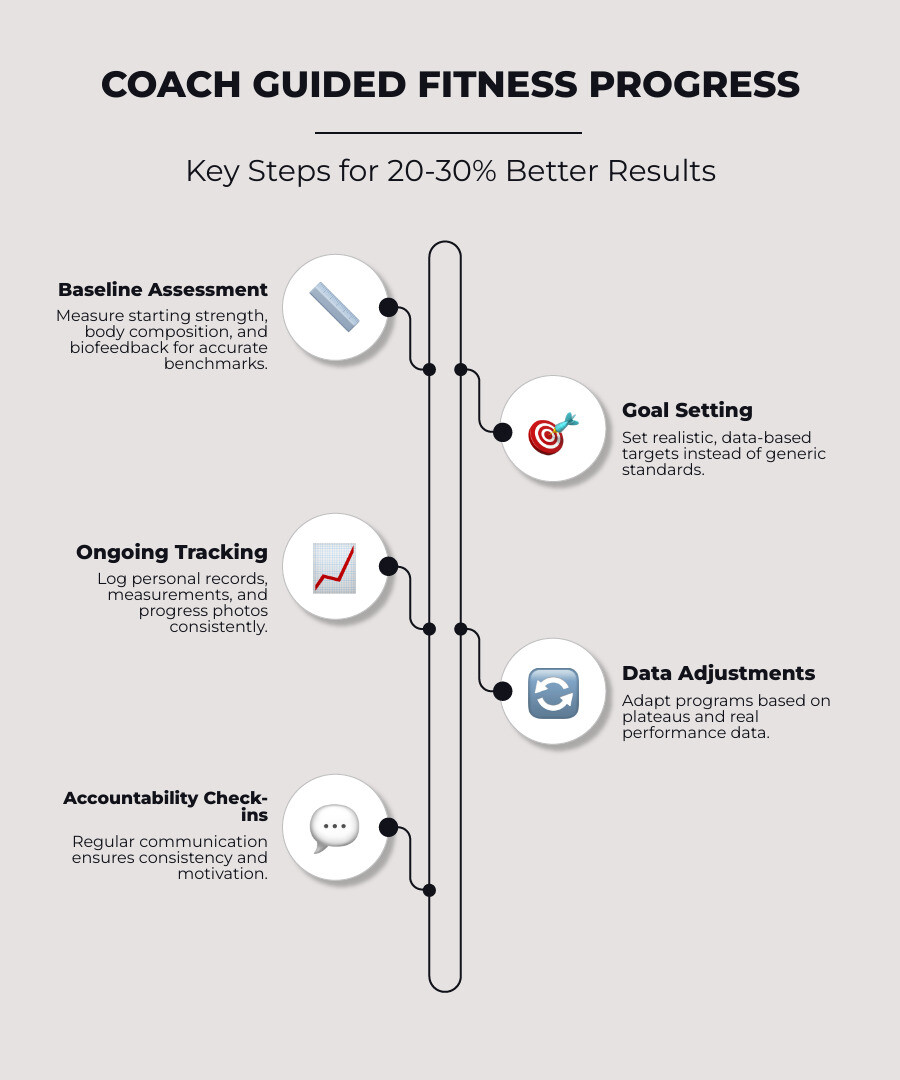
- Baseline assessment — Coach measures your starting point (strength, body composition, biofeedback)
- Goal setting — Realistic targets are set based on your data, not generic benchmarks
- Ongoing tracking — Key metrics like personal records, body measurements, and progress photos are logged consistently
- Data-driven adjustments — Your program adapts when you plateau or life gets in the way
- Accountability check-ins — Regular coach communication keeps you consistent between sessions
For busy adults juggling work, family, and fatigue, this structure matters more than almost anything else. Without it, most people spin their wheels — working hard but never quite knowing if it’s working.
The numbers back this up. Research shows that people who track their fitness consistently see 20-30% better results than those who don’t. That gap isn’t about talent or genetics. It’s about visibility.
When you can see your progress objectively — not just feel it — everything changes. A coach makes that possible.
The Science of Coach Guided Fitness Progress

At Primedy Health, we believe that “what gets measured gets managed.” But more importantly, what gets measured by a professional gets mastered. The science behind coach guided fitness progress isn’t just about spreadsheets; it’s about behavioral psychology and biological adaptation.
When you work with a coach, you aren’t just getting a workout plan; you’re gaining an external “second brain.” This concept of a second brain for fitness and focus allows you to offload the mental fatigue of decision-making. Instead of wondering if you should add five pounds to the bar or take a rest day, your coach uses objective data to make that call for you.
This professional oversight provides crucial behavioral reinforcement. When a client knows their coach is reviewing their logs, accountability skyrockets. We see this daily in our Personal Training and Health Coaching Services. It transforms “I should probably work out” into “My coach is waiting to see my stats.” This shift from internal motivation (which is fickle) to external accountability (which is reliable) is why guided progress leads to long-term habit formation.
Prioritizing Key Metrics for Long-Term Success
In fitness, the scale is a notorious liar. It doesn’t know the difference between muscle gain, water retention, or that extra-salty dinner you had last night. That’s why we prioritize a multi-dimensional approach to metrics.
We focus on:
- Personal Records (PRs): Are you getting stronger? Strength is the most objective indicator of progress.
- Body Composition: We look at how your clothes fit and use tools to Scan and Plan for Progress to see what’s happening beneath the surface.
- Biofeedback: This is the “secret sauce.” We track your mood, energy levels, and stress. If you’re hitting PRs but your energy is in the gutter, your progress isn’t sustainable.
- Digestion and Sleep: Using tools like the Bristol Stool Chart and sleep trackers, we ensure your internal health supports your external goals.
- Non-Scale Victories (NSVs): Carrying all the groceries in one trip or playing with your kids without back pain are the metrics that actually improve your life in Mount Airy.
Establishing a Comprehensive Fitness Baseline
You can’t navigate to a destination if you don’t know where you’re standing on the map. Every successful journey at Primedy Health begins with a comprehensive baseline assessment. We don’t just guess; we test.
During your initial assessment, we establish realistic expectations. If a client wants to lose 20 pounds in two weeks, it’s our job to provide the “brutal honesty” required for long-term success. We perform movement screens and performance tests to identify limitations or old injuries that need protection. This data allows us to build a program that challenges you without breaking you. Ready to find your starting line? You can Book a Consultation with us to get your baseline measured by experts.
Visualizing Transformation with Professional Photo Protocols

The human brain responds powerfully to visual reinforcement. While numbers on a screen are great, seeing a physical transformation in a side-by-side comparison is often the “lightbulb moment” for our clients. However, there is an art to taking these photos correctly.
To ensure your progress photos are an accurate reflection of your hard work, we follow strict protocols:
- Consistency is King: Use the same location, the same time of day (ideally morning), and the same form-fitting clothing.
- Lighting: Natural daylight is best. Avoid harsh overhead shadows that can hide muscle definition or create “false” contours.
- Angles: We require front, side, and back shots. This provides a 360-degree view of body recomposition—where you might be losing fat in your midsection while gaining muscle in your shoulders and glutes.
- Frequency: We recommend taking these every 4 to 6 weeks. Taking them daily leads to frustration because the body doesn’t change that fast; monthly photos show the “big picture” Progress Tracking that keeps you motivated.
By following a structured Coaching Guide for Habits of Health, we help clients reframe their mindset. We move away from self-judgment and toward objective observation. Those photos aren’t just pictures; they are evidence of your discipline.
Digital Tools and AI in Coach Guided Fitness Progress
The year 2026 has brought incredible advancements in how we monitor gains. We no longer rely on tattered paper journals that get lost under the car seat. Today, we utilize integrated digital ecosystems to streamline your journey.
Wearables like smartwatches and rings provide us with a stream of real-time data on your heart rate variability (HRV), sleep quality, and daily step counts. When this data is synced with our coaching apps, it allows for automated personalization. For example, if your wearable shows you only slept four hours, our system can alert us to dial back your training intensity for that day to prevent injury.
Our Virtual 1-on-1 Training leverages these tools to bridge the gap between Mount Airy and wherever you happen to be.
| Feature | Manual Logging (Old Way) | Automated App Tracking (Primedy Way) |
|---|---|---|
| Accuracy | Prone to human error/forgetting | Real-time, precise data sync |
| Analysis | Requires manual math/graphing | Instant visual trends and charts |
| Coach Access | Only during sessions | 24/7 visibility for the coach |
| Personalization | Slow to adjust | AI-assisted “SmartAdjust” features |
| Accountability | Easy to “fudge” the numbers | Objective data doesn’t lie |
Overcoming Plateaus through Data Analysis
Plateaus are a natural part of the fitness journey—they are actually a sign that your body has successfully adapted to the stress you’ve been giving it. The problem is that most people respond to a plateau by either quitting or working twice as hard (which often leads to burnout).
A coach looks at the data to identify why the plateau is happening. Is it metabolic adaptation? Are you unconsciously moving less during the day because your workouts are too hard? By spotting these trends, we can implement progressive overload strategically. We might tweak your volume, adjust your caloric intake by a mere 100-200 calories, or introduce a “refeed” week. This level of Customized Virtual Programming ensures that plateaus are just temporary pit stops, not the end of the road.
Enhancing Accountability in Coach Guided Fitness Progress
Accountability is the glue that holds a fitness program together. In our Group Training and individual sessions, we use technology to foster a “high-touch” environment.
We utilize “habit stacking” to make tracking second nature. For instance, we might ask you to log your water intake immediately after your morning coffee. This small anchor helps build the consistency needed for larger goals. Through our app, we provide positive reinforcement—celebrating when you hit a 5-day streak or reach a new weight milestone. This constant loop of “Action -> Data -> Feedback -> Encouragement” is what makes coach guided fitness progress so effective for real people with busy lives in Frederick and Carroll County.
Frequently Asked Questions about Fitness Tracking
How often should I take progress photos?
We recommend every 4 to 6 weeks. Taking them more frequently often leads to “body checking” and anxiety, as day-to-day changes are too small to see. Monthly photos allow enough time for genuine body recomposition to occur, providing that “wow” factor when you compare them side-by-side.
Are body fat scales accurate for tracking?
To be honest? Not really. Most home bioelectrical impedance (BIA) scales can have error rates as high as 8-15%. They are heavily influenced by your hydration levels, whether you’ve eaten, and even the time of day. While they can show trends over several months, we prefer using a combination of strength PRs, circumference measurements, and professional scans for a more accurate picture.
What should I do if my weight plateaus but I feel stronger?
Celebrate! This is the “Holy Grail” of fitness called body recomposition. If the scale isn’t moving but you are lifting heavier weights and your clothes feel looser, you are losing fat and gaining muscle simultaneously. Muscle is denser than fat, so you are literally shrinking in size while becoming more metabolically active. This is why we track more than just weight.
Conclusion
At Primedy Health, we aren’t interested in “flash-in-the-pan” transformations that disappear after a month. Our mission in Mount Airy, MD, is to provide you with sustainable gains through objective data and professional guidance.
Coach guided fitness progress takes the guesswork out of your health. It turns “I hope this works” into “I know this is working.” Whether you are training with us in person or through our Customized Virtual Programming, you deserve a plan that respects your time and your life.
Your Next Steps to Mastery:
- Audit your current tracking: Are you only looking at the scale? Start logging your strength and sleep.
- Standardize your photos: Take your “before” shots today using the protocols mentioned above.
- Seek professional eyes: Data is useless if it isn’t interpreted correctly.
- Focus on trends, not days: Look at your weekly averages to stay sane and motivated.
Ready to see what you’re truly capable of when science meets strength? Let’s start tracking your wins together.