

Most People Never Get Strong — Here’s Why That Changes Today
A full body strength and power workout trains every major muscle group in a single session using compound movements to build brute strength, explosive power, and muscle — all in three sessions per week.
Quick answer for busy readers:
| What you want | What to do |
|---|---|
| Build strength fast | Squat, deadlift, bench press 3x/week |
| Add explosive power | Include kettlebell swings or power cleans |
| Maximize muscle growth | Train each muscle 2-3x per week |
| Keep it time-efficient | 45-60 min sessions, no wasted moves |
| See first results | Expect strength gains in 4-6 weeks |
Look around any gym or fitness website and you’ll find no shortage of workout programs. Everyone wants to get strong. Everyone wants to add muscle. Yet most people never actually get there.
Why? Usually it comes down to three problems:
- Poor exercise selection — too many isolation moves, not enough compound lifts
- Bad programming — no structure, no progression, no plan
- Inconsistency — all-or-nothing cycles that lead straight to burnout
The good news is that the solution is simpler than most people think. Training every major muscle group together — rather than splitting them across five or six days — lets you lift more frequently, recover better, and build strength faster.
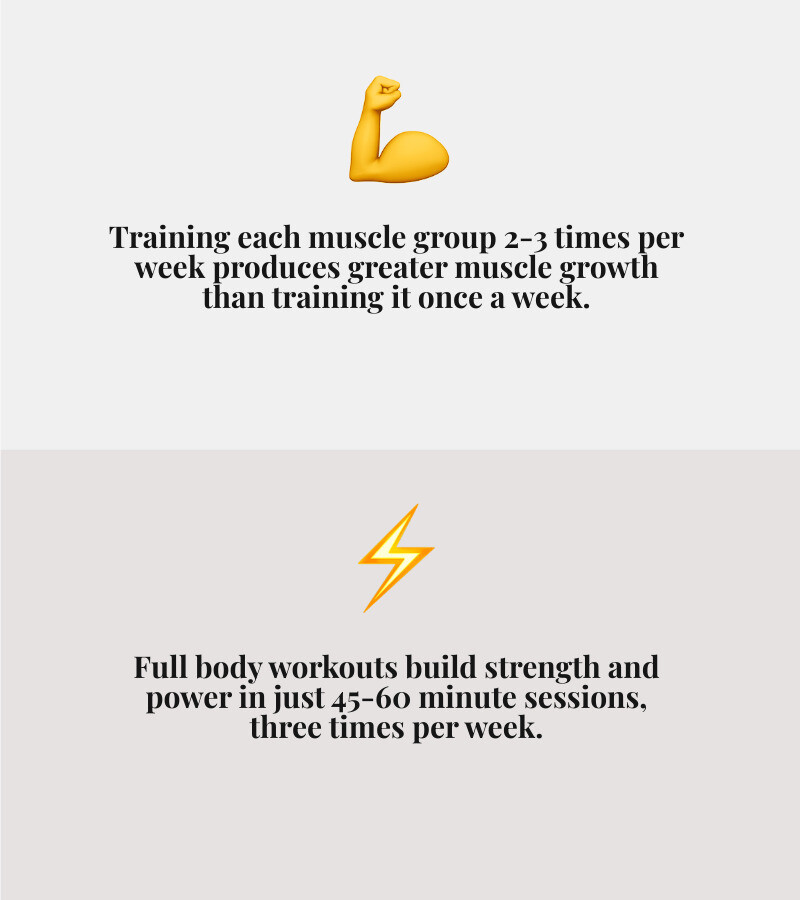
Research consistently shows that training a muscle group two to three times per week produces greater muscle growth than training it once a week. Full body workouts make that frequency automatic.
This guide gives you everything you need: the science, the exercises, the program structure, and the recovery strategy to stop spinning your wheels and start getting genuinely strong.
Full body strength and power workout terms to know:
The Science of the Full Body Strength and Power Workout

To understand why a full body strength and power workout is so effective, we have to look at how our bodies respond to stress. When we lift heavy weights, we aren’t just “toning” muscles; we are triggering a cascade of biological responses.
The primary driver here is Muscle Protein Synthesis (MPS). After a hard session, MPS remains elevated for about 24 to 48 hours. In a traditional “bro-split” where you only hit chest on Mondays, your chest muscles spend the rest of the week doing nothing. By using a Full Body Strength Workout Plan: The Ultimate Guide for Total Body Power and Muscle, you re-stimulate that growth process every 48 hours.
There is also a significant hormonal advantage. Large, compound movements recruit a massive amount of muscle mass. This high level of motor unit recruitment causes a spike in testosterone and growth hormone levels. These aren’t just “bodybuilding” hormones; they are essential for bone density, metabolic health, and even cognitive function.
Furthermore, a well-designed Step-by-Step Guide to Strength Training Program accounts for Central Nervous System (CNS) recovery. Unlike split routines that can grind down specific joints or small muscle groups through excessive isolation volume, full-body routines allow for “heavy-light-medium” undulating intensity, which keeps the nervous system fresh and ready to fire.
Why Frequency Trumps Volume in 2026
In May 2026, the consensus among sports scientists is clearer than ever: frequency is the king of hypertrophy and strength. When you distribute your weekly volume over three or four sessions rather than cramming it into one, you perform more “high-quality” reps.
Think about it: if you do 12 sets of chest in one day, the last 4 sets are usually low-quality junk volume because you’re exhausted. If you do 4 sets of chest three times a week, every single rep is performed with maximum force and better form. This leads to superior customized strength training plans that actually produce results without the crippling soreness that prevents you from living your life in Mount Airy or Frederick.
The Hormonal Advantage of Compound Lifting
Strength training is often called the “new anti-aging drug,” and for good reason. Using heavy weights for relatively high reps on basic exercises causes a systemic physiological response. It isn’t just about the muscle being worked; it’s about the signal sent to the entire endocrine system.
Research from institutions like UT MD Anderson highlights that even simple strength training can slow the aging process and improve metabolic markers. By focusing on a full body strength and power workout, you are maximizing the “bang for your buck” for every minute spent in the gym.
Core Movements for Brute Strength and Explosive Power
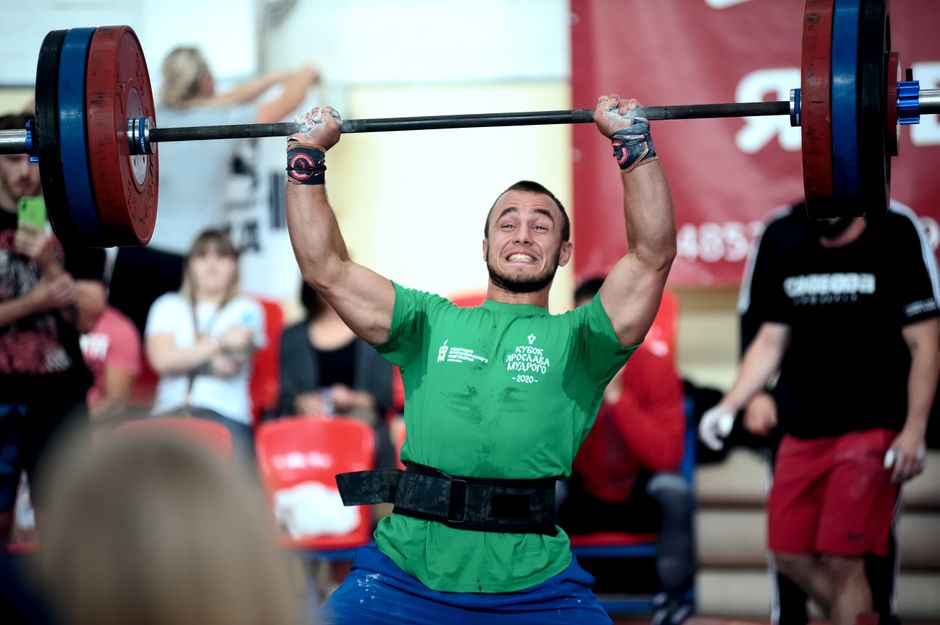
If you want to move like an athlete and look like a lifter, you need to master the movements that require “triple extension”—the simultaneous extension of the ankles, knees, and hips. This is the foundation of human power.
At Primedy Health, we focus on movements that translate to real-world capability. You don’t just want to look strong; you want to be strong. This requires a mix of absolute strength (moving heavy loads) and explosive power (moving loads quickly).
The Big Three for a Full Body Strength and Power Workout
The “Big Three” are the pillars of any serious barbell strength workout:
- The Squat: The king of all exercises. It builds the posterior chain, quads, and core.
- The Deadlift: The ultimate test of brute strength. It teaches you how to hinge at the hips and pull heavy weight safely from the floor.
- The Bench Press: The primary builder for the chest, shoulders, and triceps.
By mastering the 5×5 program, you focus on these three lifts to build a foundation of mechanical tension that forces your body to adapt and grow.
Explosive Movements for Athletic Power
Strength is the ability to exert force; power is the ability to exert force quickly. To develop true power, we incorporate:
- Kettlebell Swings: Excellent for posterior chain power and cardiovascular conditioning.
- Power Cleans: A simplified Olympic lift that teaches total-body coordination and explosiveness.
- Plyometrics: Box jumps or broad jumps that train the nervous system to recruit motor units rapidly.
Even if you are working out at home, you can use a beginner home workout with free weights to start developing these explosive patterns using dumbbells or kettlebells.
Structuring Your Program: From Beginner to Advanced
Structuring a full body strength and power workout requires more than just picking random exercises. It requires a plan for progressive overload—the gradual increase of stress placed upon the body during exercise.
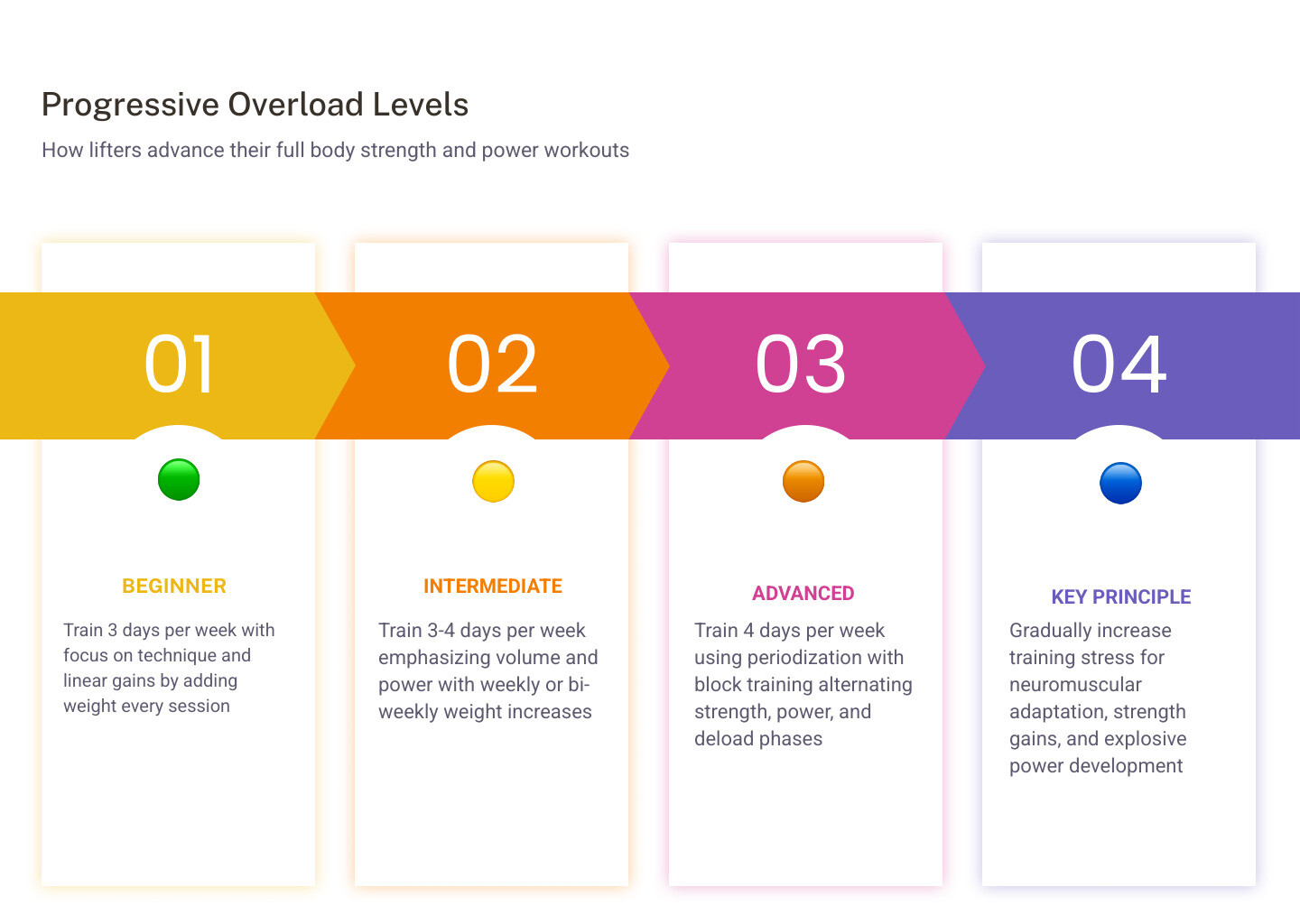
| Lifter Level | Frequency | Primary Focus | Progression Method |
|---|---|---|---|
| Beginner | 3 Days/Week | Technique & Linear Gains | Add weight every session |
| Intermediate | 3-4 Days/Week | Volume & Power | Weekly or bi-weekly weight increases |
| Advanced | 4 Days/Week | Periodization | Block periodization (Strength/Power/Deload) |
For most of our clients in Maryland, a 3-day split is the “sweet spot” for sustainable fitness. It allows for maximum intensity during the workout while providing 48 hours of recovery between sessions.
Programming Your Full Body Strength and Power Workout
A classic structure involves alternating between two different full-body sessions (Workout A and Workout B) on non-consecutive days (e.g., Mon-Wed-Fri).
- Workout A: Squat, Bench Press, Barbell Row, Kettlebell Swings.
- Workout B: Deadlift, Overhead Press, Pull-ups, Power Cleans.
This approach ensures you are hitting every movement pattern (push, pull, hinge, squat) frequently without overtaxing a single joint. This is the busy life fitness program that actually yields results because it fits into a real schedule.
The Role of Accessory Work and Supersets
While the big compound lifts do the heavy lifting (literally), accessory work fills the gaps. We use unilateral exercises—like lunges or single-arm rows—to correct muscle imbalances and ensure balance is maintained.
To save time, we often use supersets. Pairing a “push” move (like a bench press) with a “pull” move (like a row) allows one muscle group to rest while the other works. This keeps the heart rate up and gets you out of the gym in under an hour.
Maximizing Gains: Nutrition, Recovery, and Safety
You don’t get strong in the gym; you get strong recovering from the gym. If your nutrition and sleep are trash, your results will be too.
Nutrition and Supplementation for Power
To support a full body strength and power workout, you need to be in a slight caloric surplus (200–500 calories above maintenance).
- Protein: Aim for 0.7 to 1.0 grams per pound of body weight to support muscle protein synthesis.
- Carbohydrates: These are your primary fuel for explosive power. Don’t fear them.
- Creatine: One of the few supplements with mountains of evidence showing it improves power output and muscle mass.
- Hydration: Even a 2% drop in hydration can significantly decrease your strength levels.
The Importance of the Deload Phase
One of the biggest mistakes lifters make is trying to go 100% every single week. Eventually, your CNS will rebel. We recommend a deload week every 4 to 8 weeks.
During a deload, you might use 50-60% of your usual weights or cut your volume in half. This gives your explosive muscle fibers and nervous system a chance to regenerate. As noted in the 5-day Total-body Challenge, you often come back from a deload week stronger than when you started because your body has finally finished repairing the “hidden” fatigue.
Frequently Asked Questions about Full Body Training
Can I do a full body workout every day?
We don’t recommend it for most people. While “daily” training is possible for elite athletes, most lifters need 48 to 72 hours for muscle tissue to fully repair and for the nervous system to recover. Training every day usually leads to “junk volume” where you’re too tired to lift heavy enough to actually build power.
Is full body training better for fat loss?
Yes. Because you are using massive compound movements that recruit the entire body, the calorie burn per session is significantly higher than a “leg day” or “arm day.” Additionally, the EPOC effect (Excess Post-exercise Oxygen Consumption) means your metabolism remains elevated for hours after you leave the gym.
How long does it take to see strength results?
You will often see “neuromuscular” gains in the first 2 to 4 weeks. This is your brain getting better at “talking” to your muscles. Visible muscle changes and significant brute strength increases typically become obvious within the 4 to 8-week mark, provided you are consistent and tracking your metrics.
Conclusion
At Primedy Health, we believe that strength is the foundation for a high-quality life. Whether you are in Mount Airy, Frederick, or anywhere else in Carroll County, our goal is to provide you with the tools to build a body that is as capable as it is strong.
A full body strength and power workout isn’t just a trend; it’s the most time-efficient, scientifically backed way to transform your physique and your performance. Stop settling for programs that leave you tired but weak. Embrace the big lifts, prioritize your recovery, and start making objective progress.
Ready to take the guesswork out of your training? Start your journey with professional coaching and let us help you build a sustainable, powerful future.