
Why Habit Building Strength Sessions Are the Key to Lasting Fitness
Habit building strength sessions are short, consistent strength workouts designed to become automatic parts of your daily routine — and they’re one of the most effective ways to build lasting fitness.
Here’s how to get started:
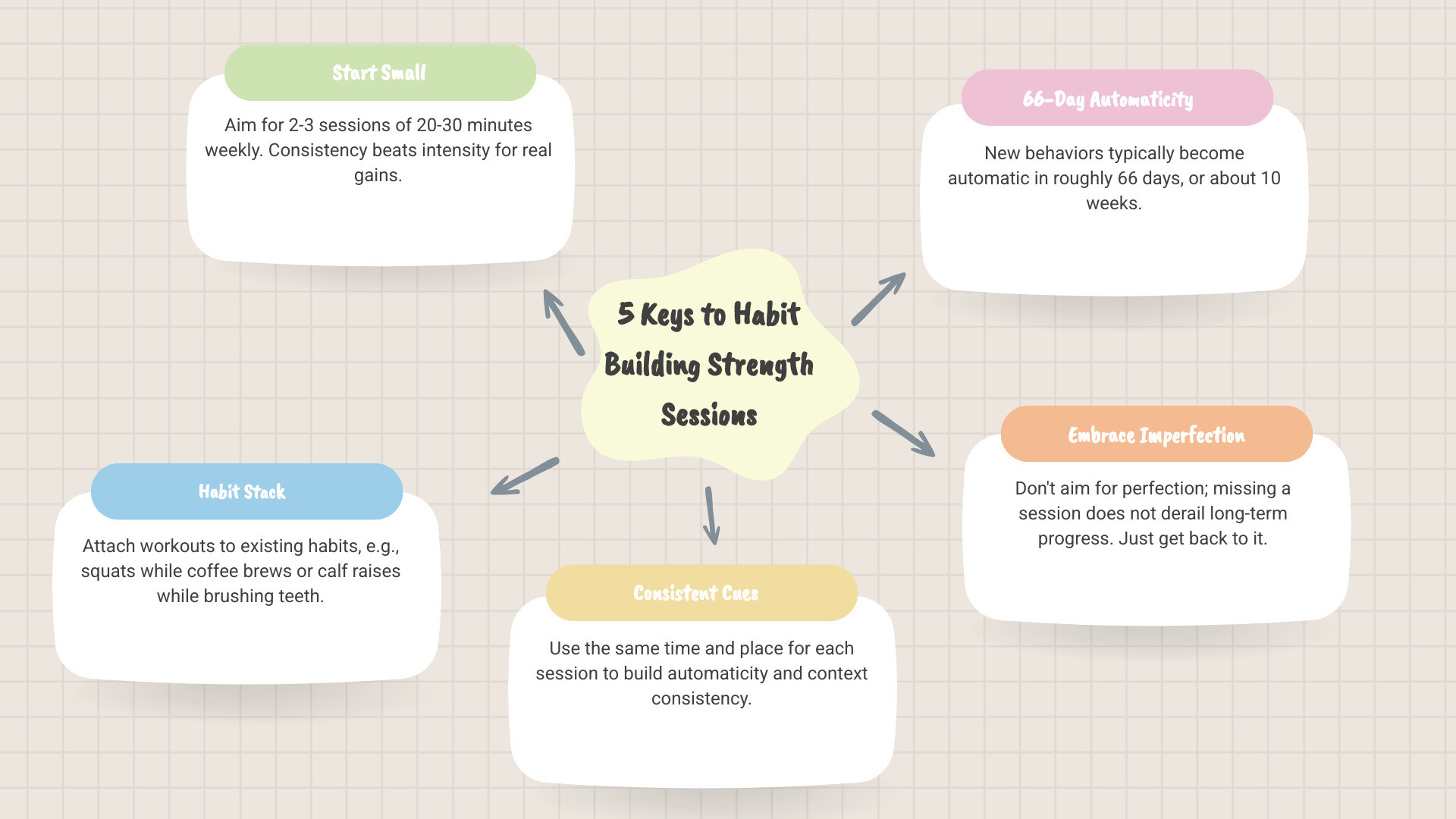
- Start small — Two to three 20-30 minute sessions per week is enough to see real strength gains
- Attach workouts to existing habits — For example, squats while coffee brews or calf raises while brushing teeth
- Use consistent cues — Same time, same place, every session
- Expect automaticity around 66 days — Research shows new behaviors become automatic in roughly 10 weeks
- Don’t aim for perfection — Missing one or two sessions does not derail long-term progress
Most people don’t struggle with strength training because they’re lazy. They struggle because their plan asks too much, too soon.
You start strong. Then life happens — a late meeting, a sick kid, a week of travel. Suddenly the routine is gone, and starting over feels harder than the workouts themselves.
Sound familiar?
The good news: you don’t need more motivation. You need a smarter system. One that fits inside the life you already have, not the one you wish you had.
That’s exactly what this guide is about.
Common habit building strength sessions vocab:
The Science of Habit Building Strength Sessions
Building a strength habit isn’t about “gritting your teeth” until you reach the finish line. It’s about leveraging the way your brain is already wired. When we talk about habit building strength sessions, we are talking about moving from “effortful” exercise to “automatic” behavior.

The concept of automaticity is central to our philosophy at Primedy Health. Research, specifically the famous study by Lally et al. (2010), shows that it takes an average of 66 days for a new behavior to become a habit. That is roughly 10 weeks. During this time, your brain creates new neural pathways that make the action of starting your workout require less and less willpower.
To set yourself up for success, we recommend following these 8 Steps for Planning a Balanced Strength Workout. One of the most critical steps is establishing consistent cues and triggers. A cue is something that tells your brain, “It’s time to lift.” This could be:
- Visual: Seeing your gym bag by the door.
- Time-based: It’s 5:30 PM on a Tuesday.
- Action-based: Closing your laptop after the final meeting of the day.
At Primedy Health, our Foundations program focuses on these psychological triggers just as much as the physical movements. By keeping the context consistent—exercising in the same place at the same time—you reduce the “decision fatigue” that often kills a workout before it starts.
Why Consistency Beats Intensity for Long-Term Gains
We’ve all seen the person who hits the gym for two hours a day, six days a week, only to disappear after a month. They chose intensity over consistency. For most of us in Mount Airy and Frederick, MD, that schedule is a recipe for burnout.
The secret to long-term strength is the “micro-workout.” Research shows you can see significant improvements in strength with just two or three 20- or 30-minute sessions a week. In fact, The 20-Minute Strength Habit highlights that short sessions aren’t a compromise; they are a superior strategy for busy people because they lower the psychological barrier to entry.
When a workout is only 20 minutes, you can’t use the “I don’t have time” excuse. By reducing friction—the mental and physical hurdles to starting—you make it easier to show up. Our Health Coaching services often help clients strip away the complexity of their routines to find this “minimum effective dose” that leads to maximum long-term results.
Using Habit Stacking to Automate Your Strength Sessions
If you want to make habit building strength sessions effortless, you need to use “habit stacking.” This formula, popularized by James Clear, is simple: “After [Current Habit], I will [New Habit].”
Habit stacking works because it hitches a ride on neural pathways that are already strong. You don’t have to remember to brush your teeth or make coffee; your brain does those things on autopilot. By “stacking” a strength move onto those actions, you borrow that momentum.

Real-world examples we love:
- The Coffee Squat: While your morning coffee is brewing, perform 15 bodyweight squats.
- The Toothbrush Raise: While brushing your teeth for two minutes, do 20 single-leg calf raises on each side.
- The Satellite Plank: While your Garmin or fitness watch is searching for a GPS signal before a walk, hold a plank.
For those who need a bit more guidance on how to weave these into a professional schedule, our Virtual 1-on-1 Training provides the personalized accountability to make these stacks stick.
Designing Your Habit-Based Strength Routine
To make a 20-minute session effective, you have to choose the right tools. You shouldn’t spend your limited time on bicep curls or calf extensions. Instead, focus on compound movements. These are multi-joint exercises that work several muscle groups simultaneously, giving you 90% of the benefits in a fraction of the time.
| Movement Type | Exercises | Primary Muscles Worked |
|---|---|---|
| Compound | Squats, Deadlifts, Push-ups, Rows | Quads, Glutes, Chest, Back, Core |
| Isolation | Bicep Curls, Tricep Extensions | Single Muscle Groups |
If you are looking for a roadmap, our customized strength training plans prioritize these big wins. You don’t need a fancy home gym, either. Minimal equipment—like a single kettlebell, a pair of dumbbells, or even just your own bodyweight—is more than enough to build a powerful foundation. If you’re just starting out, check out our Pre-Designed Programs for a plug-and-play approach.
Essential Movement Patterns for Habit Building Strength Sessions
A balanced routine doesn’t need 50 different exercises. It needs to cover the six fundamental human movement patterns. If you hit these, you’ve hit everything:
- Squat: Think sitting down and standing up (Goblet squats, air squats).
- Hinge: Pushing the hips back (Deadlifts, kettlebell swings).
- Push: Moving weight away from your body (Push-ups, overhead press).
- Pull: Bringing weight toward your body (Rows, pull-ups).
- Unilateral: Working one side at a time (Lunges, split squats).
- Core: Stabilizing the spine (Planks, carries).
For those who want to level up with more traditional equipment, learning how to get stronger with barbell workouts is a great next step once your habit is firmly established.
Progressive Overload Without the Burnout
The biggest mistake beginners make is trying to lift the world in week one. To keep your habit sustainable, you need to use progressive overload—the gradual increase of stress placed upon the body during exercise.
We recommend a “Double Progression” model. First, aim to increase your repetitions. Once you can comfortably hit the top of your rep range (say, 12 reps) with perfect form, then you increase the weight. This ensures your joints and connective tissues have time to adapt alongside your muscles.
You should also monitor your RPE (Rate of Perceived Exertion). On a scale of 1 to 10, most of your habit building strength sessions should feel like a 7 or 8. You should feel challenged but like you still have 1 or 2 reps left in the tank.
The key is to track your results without losing your mind. Use a simple log to note your sets and reps. Seeing those numbers go up over time provides the “intrinsic reward” that makes the habit feel satisfying. Our Progress Tracking tools are designed to make this data entry quick and painless.
Overcoming Obstacles and Sustaining Momentum
Even the best-laid plans hit snags. The difference between those who succeed and those who quit is how they handle the “life happens” moments.
Intrinsic motivation—doing it because it makes you feel capable and energetic—is a much stronger predictor of long-term success than extrinsic goals like “losing 10 pounds.” However, social accountability is the ultimate safety net. Whether it’s a partner or joining our Group Training sessions in Maryland, having people who expect you to show up changes the game.
Common Barriers and Fixes:
- Barrier: “I’m too tired after work.”
- Fix: Move the session to the morning or commit to just 5 minutes of “Plan B” movement (like a quick walk or 10 air squats).
- Barrier: “I’m traveling and have no gym.”
- Fix: Use a bodyweight-only circuit. Focus on push-ups, lunges, and planks.
- Barrier: “I feel like I’m plateauing.”
- Fix: Schedule a deload week. Every 4 to 8 weeks, reduce your volume (sets and reps) by 30-50% to allow your nervous system to recover.
At Primedy Health, we believe you should break habits, not banks. Sustainable fitness shouldn’t be a financial or emotional burden; it should be a source of strength that supports the rest of your life.
Frequently Asked Questions about Strength Habits
How long does it take to form a lasting exercise habit?
As mentioned, the average is 66 days. However, it’s important to realize this isn’t a magic switch. You will start to feel the “pull” of the routine much sooner—often around the 6-week mark. The goal is consistency over perfection. During these first 10 weeks, focus on the act of showing up rather than the intensity of the workout. If you need a professional to help bridge that gap, our Personal Training can provide the structure you need during that critical formation phase.
What if I miss a habit building strength sessions?
Give yourself a “free pass.” Research shows that missing one or even two days during the habit formation process does not significantly impact long-term success, provided you get back on track immediately. Don’t try to “make up” for missed sessions by doing a double workout the next day; that usually leads to injury or burnout. Just resume your normal schedule. And please, stop using napkins to track your fitness data—having a digital log makes it much easier to see that one missed day is just a tiny blip in a year of progress.
Can I build strength with just 20 minutes?
Absolutely. Efficiency is about the quality of the work, not the duration. By focusing on compound lifts and keeping rest periods between 60 and 90 seconds, you can accomplish an incredible amount of work in 20 minutes. Most healthy adults only need two sessions a week targeting major muscle groups to see significant health and strength benefits. Our Customized Virtual Programming is specifically designed for this high-efficiency approach.
Conclusion
Building a stronger version of yourself doesn’t require a total life overhaul. It requires the courage to start small and the systems to stay consistent. By focusing on habit building strength sessions, you aren’t just building muscle; you’re building a lifestyle that lasts.
Whether you are in Mount Airy, Frederick, or anywhere else in Carroll County, Primedy Health is here to support you. We provide the coaching, the structure, and the objective tracking you need to ensure your hard work actually pays off.
Ready to stop guessing and start growing? Let’s build a routine that actually fits your life. Explore our Health Coaching today and take the first step toward a stronger, more consistent you.