

Are You Coaching Blind? Why Online Coaching Progress Metrics Matter
Online coaching progress metrics are the measurable data points coaches use to track client results, guide programming decisions, and prove the value of their work.
The most important metrics to track include:
| Category | Key Metrics |
|---|---|
| Body Composition | Weight, body fat %, circumference measurements, progress photos |
| Strength | 1RM, total volume, personal records (PRs) |
| Endurance | Pace, distance, resting heart rate |
| Lifestyle | Sleep quality, energy levels, daily step count |
| Behavior | Workout adherence, habit completion, session attendance |
| Business | Customer Acquisition Cost (CAC), Churn Rate, Net Promoter Score (NPS) |
The best software tools for tracking these metrics include TrueCoach, Trainerize, FITR, and Coach Catalyst — each reviewed in detail below.
Here’s a scenario that happens all the time: a client walks into a session feeling like they’ve made zero progress. They’re ready to quit. Then you pull up their data — and the numbers tell a completely different story. Strength up. Body fat down. Habits improving week over week.
That’s the power of tracking.
Without structured online coaching progress metrics, you’re essentially guessing. You can’t spot plateaus early. You can’t prove your value. And you can’t make smart adjustments to keep clients moving forward.
Industry guidance recommends formal progress assessments every 4 to 6 weeks — but the coaches who get the best results are monitoring key data points continuously, not just at check-ins.
In this review, we break down the best software platforms for automating that process in 2026.
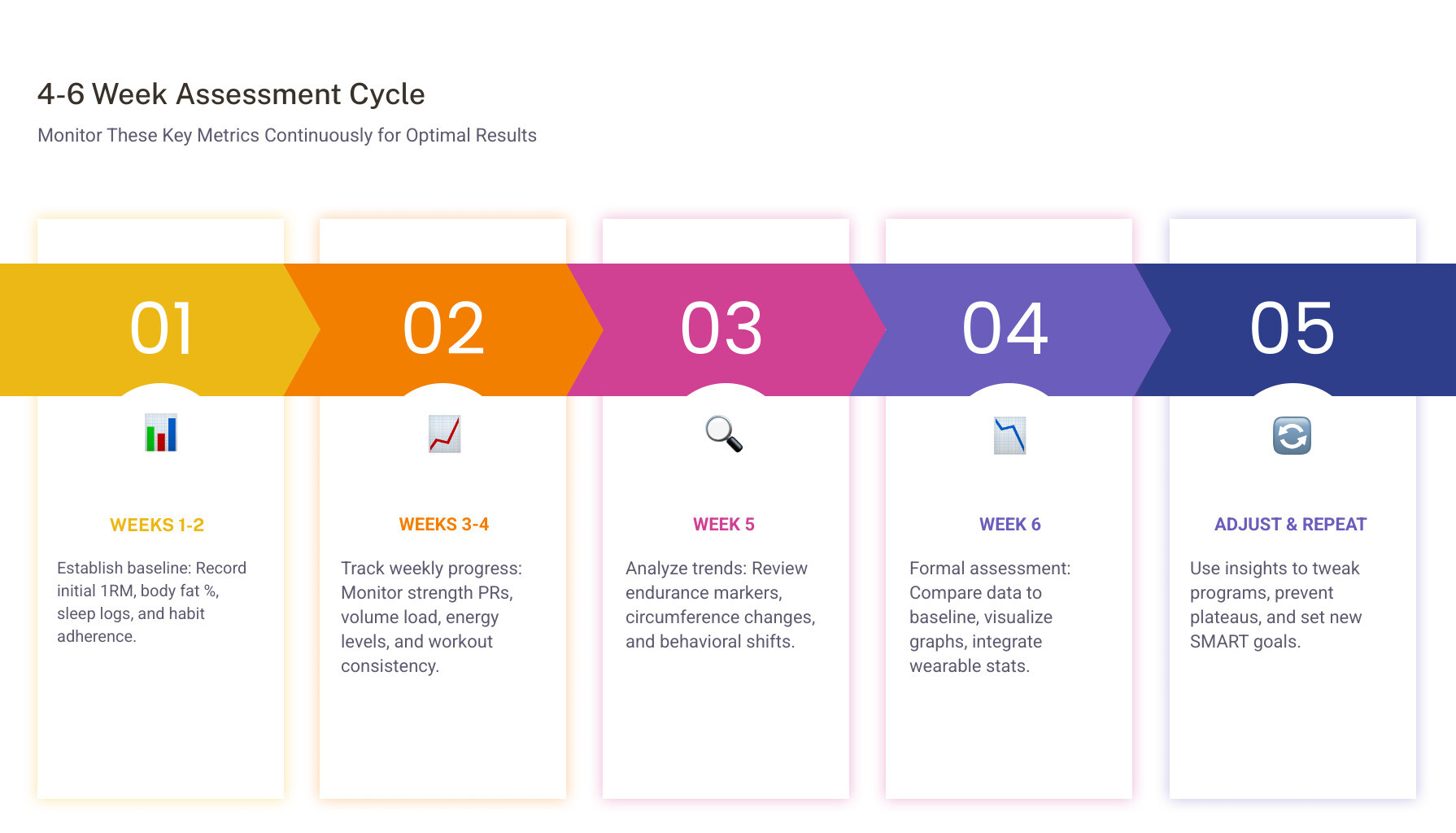
Basic online coaching progress metrics vocab:
- fitness progress data tracking
- objective fitness progress tracking
- personalized progress tracking coach
Why Online Coaching Progress Metrics are Essential in 2026

In May 2026, the online fitness landscape is more competitive than ever. If you aren’t providing tangible, data-backed evidence of your impact, you’re at a significant disadvantage. Tracking client progress isn’t just about recording numbers; it’s about the psychology of success. When a client sees a graph trending upward, their motivation skyrockets. This visual proof is a major driver of retention—clients stay when they can see they are winning.
At Primedy Health, we believe you should Stop Guessing And Start Measuring Your Success. Relying on “how you feel” or a quick look in the mirror is subjective and often misleading. Objective data removes the emotion from the coaching process. If a client hits a plateau, the data tells us exactly where the breakdown is happening—is it adherence, recovery, or the program itself?
Effective Progress Tracking establishes you as a professional authority. It moves the coaching relationship from a casual interaction to a results-oriented partnership. Furthermore, in an era where clients are more budget-conscious, providing a clear Return on Investment (ROI) through detailed progress reports justifies your professional rates and builds long-term trust.
Key Quantitative and Qualitative Metrics for Success

Measuring success requires a balanced approach. While it’s tempting to focus solely on the scale, a holistic view of online coaching progress metrics provides the “complete story.” We start by establishing a baseline through comprehensive assessments and setting SMART (Specific, Measurable, Achievable, Relevant, Time-bound) goals.
To keep the process manageable, we recommend that clients learn How To Track Your Workout Results Without Losing Your Mind. Data visualization tools—like the graphs found in modern coaching software—transform raw numbers into a narrative that clients can actually understand and get excited about.
Quantitative Online Coaching Progress Metrics for Physical Results
Quantitative data provides the hard evidence of physical transformation. We focus on strength milestones, body composition shifts, and cardiovascular improvements. It is time to Stop Using Napkins To Track Your Fitness Data and move into a centralized digital system.
| Strength Markers | Endurance Markers |
|---|---|
| 1-Rep Max (1RM) | 1-Mile Run Time |
| Total Training Volume (Sets x Reps x Weight) | Resting Heart Rate (RHR) |
| Power Output (Watts) | Heart Rate Variability (HRV) |
| Exercise Velocity | VO2 Max Estimates |
Tracking volume load allows us to see if a client is doing more work over time, even if the weight on the bar stays the same. For our athletes in Frederick and Mount Airy, these numbers are the bread and butter of our programming.
Qualitative Online Coaching Progress Metrics for Behavioral Change
Physical changes are often the result of deep-seated behavioral shifts. This is where qualitative metrics come in. You can Crush Your Goals With Personalized Health Coaching Plans And Progress Logs that track how a client actually feels.
Key qualitative markers include:
- Sleep Quality: Using a 1-10 scale or wearable data to monitor recovery.
- Energy Levels: Identifying if a program is too taxing for a client’s current lifestyle.
- Mindset Shifts: Tracking confidence scores and self-efficacy.
- Habit Adherence: Simple “Yes/No” tracking for daily tasks like hydration or protein intake.
- 360-Degree Feedback: For executive coaching, gathering peer observations on leadership behavior changes.
- Personality Assessments: Using tools like DISC or MBTI to tailor communication styles to the client’s psychological profile.
Evaluating Software: Features for Automated Tracking
The right software turns a mountain of data into actionable insights without burying the coach in administrative work. When we look at Customized Virtual Programming, we look for platforms that offer real-time syncing and automated reporting.
If you want to Get A Coach Who Actually Tracks Your Progress, you need to ensure they are using tools that provide an essential checklist for tracking:
- Automated Nudges: Systems that remind clients to log data if they’ve been inactive for 48 hours.
- Photo Food Journals: Moving beyond tedious calorie counting to visual habit tracking.
- Custom Habit Triggers: Linking new behaviors to existing routines.
Fitness-Focused Platform Capabilities
For strength and conditioning, platforms like TrueCoach and Trainerize lead the pack. These tools offer integrated workout histories, allowing a coach to see every rep a client has performed over the last year. TrueCoach is particularly strong with its automated PR detection—it flags when a client hits a new personal record, which is a massive win for motivation. FITR excels in hybrid coaching environments, making it easy to manage both in-person sessions in Carroll County and remote clients simultaneously.
Executive and Life Coaching Tool Functionality
For non-fitness coaching, the requirements shift toward behavioral feedback. Tools like Coachmetrix and Simply.Coach focus on stakeholder feedback integration and OKR (Objectives and Key Results) tracking. The GDD Framework (Good, Difficult, Different) is a popular qualitative tool here, prompting clients to reflect on what went well, what was a struggle, and what they will do differently next week.
Business KPIs: Measuring Growth and Retention
As a coaching business owner, your own online coaching progress metrics are just as vital as your clients’. To scale, you must understand your numbers.
- Customer Acquisition Cost (CAC): Calculated as (Total Sales and Marketing Costs) / (Number of New Customers). In 2026, the focus is on marketing efficiency rather than just high spend.
- Customer Lifetime Value (CLV): This is the total revenue you can expect from a single client. Improving your service and retention directly boosts this number.
- Churn Rate: The percentage of clients who leave each month. Keeping this low is the “holy grail” of coaching.
- Net Promoter Score (NPS): A simple survey asking: “How likely are you to recommend us to a friend?” (0-10 scale). Promoters (9-10) minus Detractors (0-6) gives you your score.
Tracking these KPIs helps you find The Complete Guide To Finding Online Personal Trainers that are actually running a sustainable business. High-quality data also provides the best marketing material: testimonials backed by hard numbers (e.g., “Client lost 4% body fat and added 40lbs to their squat in 12 weeks”).
Overcoming Common Challenges in Remote Tracking
Remote coaching presents unique hurdles, primarily around accountability and data consistency. Many clients suffer from “progress blindness,” where they feel stuck despite making gains. This is why Virtual 1 On 1 Training must be anchored in data visualization.
Common challenges include:
- Client Resistance: Some clients find logging “tedious.” We solve this by using wearable integrations (Apple Watch, WHOOP) that pull data automatically.
- Data Fragmentation: Having metrics in three different apps. We use centralized platforms like Coach Catalyst to keep everything in one dashboard.
- Admin Burden: Coaches spending hours on spreadsheets. Automation is the answer—let the software handle the graphs while you handle the coaching.
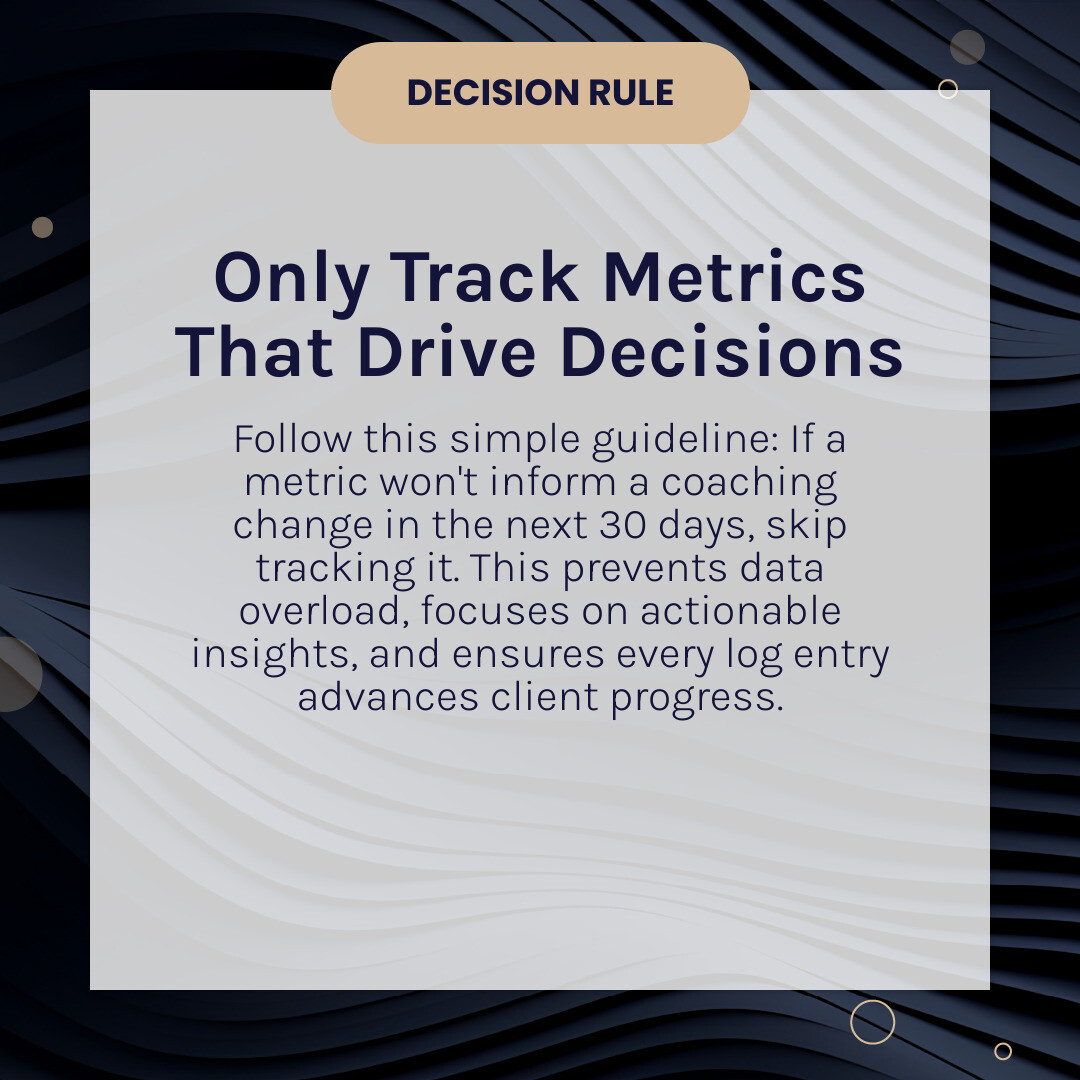
To keep things simple, we follow the “Decision Rule”: only track a metric if the data will actually change a coaching decision in the next 30 days.
Frequently Asked Questions about Coaching Metrics
How frequently should client progress be assessed?
In the fitness industry, a full assessment (measurements, photos, and performance tests) is typically recommended every 4 to 6 weeks. However, daily habits and workout performance should be monitored continuously to catch plateaus before they become frustrating.
What are the best tools for automating progress tracking?
TrueCoach and Trainerize are the gold standards for fitness. For life and executive coaching, Coachmetrix and Simply.Coach offer better frameworks for qualitative growth. Coach Catalyst is excellent for habit-based coaching and automated client communication.
How do you use tracking data to adjust programs?
We look for trends over a 3-week period. If strength is declining and RPE (Rate of Perceived Exertion) is consistently at a 9 or 10, it’s a sign the client needs a deload week. If body weight is stalled but measurements are dropping, we know the client is losing fat and gaining muscle—meaning the program is working perfectly!
Conclusion
At Primedy Health, we don’t believe in “guesswork coaching.” Whether you are training with us in person in Mount Airy or through our remote programs, our approach is always data-driven. By leveraging the right online coaching progress metrics, we ensure that every rep and every meal brings you closer to a sustainable transformation.
Ready to stop spinning your wheels? Start your journey with Customized Virtual Programming today and experience the difference that professional accountability and objective tracking can make.