
Is the 5×5 Workout Over 40 Still Worth It?
The 5×5 workout over 40 is not only safe — it’s one of the most effective strength programs for adults who want to build muscle, protect their joints, and slow age-related decline.
Here’s a quick answer if you’re short on time:
- Yes, it works after 40. Research shows older adults can make strength gains nearly identical (in relative terms) to younger lifters.
- Yes, it needs some tweaks. Slower progression, longer rest periods, and smarter warm-ups make all the difference.
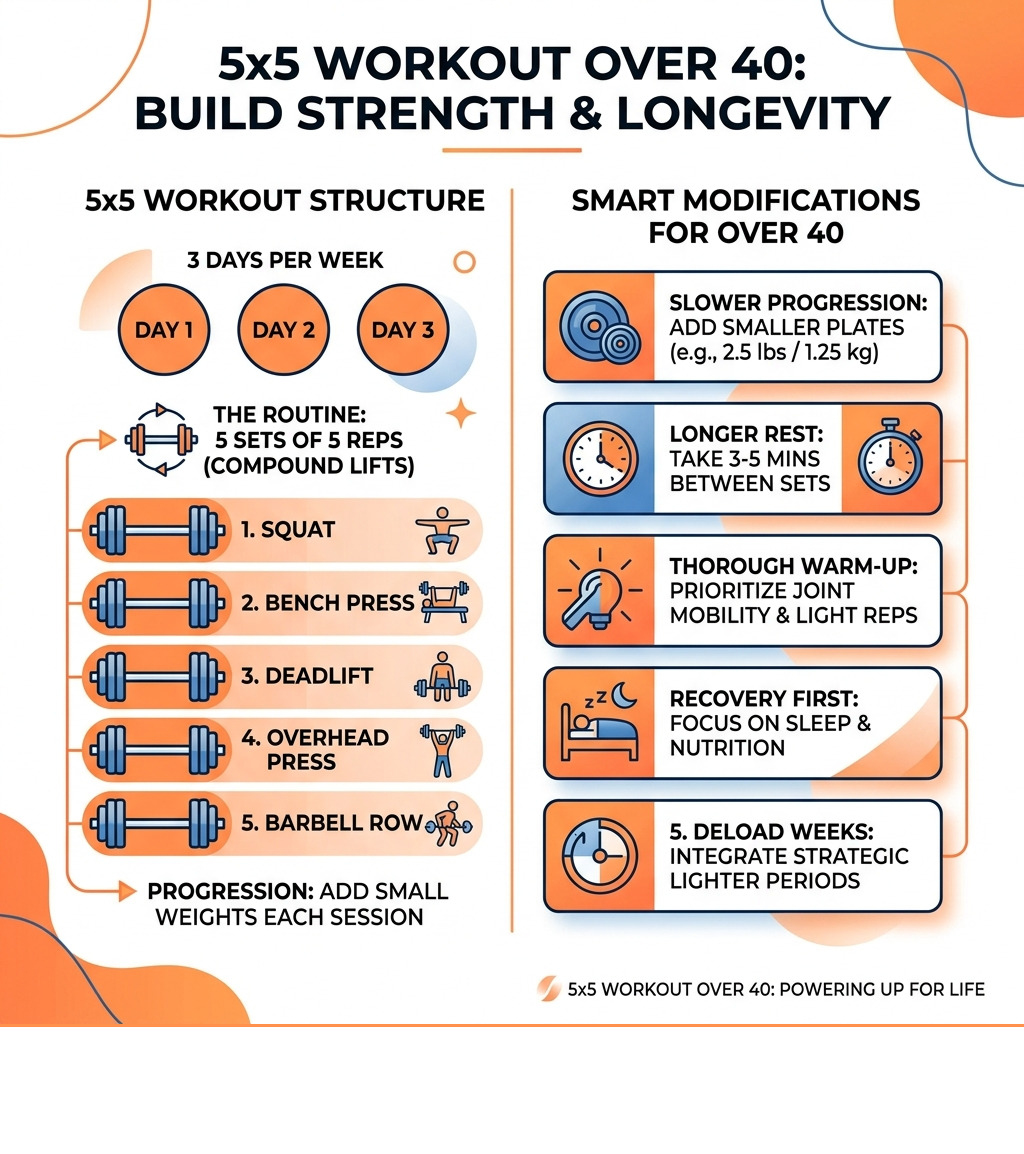
- The core program: 3 days per week, 5 sets of 5 reps on compound lifts — squat, bench press, deadlift, overhead press, and barbell row.
- Start lighter than you think. Begin with the empty bar or 60-70% of your max, and add small increments each session.
- Recovery is non-negotiable. Sleep, protein, and deload weeks matter far more after 40 than they did at 25.
Here’s the problem most people hit after 40: life gets busy, joints feel different, and the training advice online is built for 22-year-olds.
Adults lose 3-8% of muscle mass per decade after age 30. That’s not a scare stat — it’s a reason to act. The good news is that the fix is simple, proven, and time-efficient.
The 5×5 method has been around since the 1950s. Bodybuilding legend Reg Park used it to build one of the greatest physiques of his era. Today, programs like StrongLifts 5×5 have made it accessible to everyday lifters. Workouts typically take 30 to 90 minutes, three times a week — realistic even for a packed schedule.
One real-world example worth noting: a 46-year-old lifter who had previously undergone shoulder surgery progressed his 5×5 squat from 20kg all the way to 100kg in just 12 weeks on the StrongLifts program. That kind of result doesn’t happen by accident — it happens with the right structure and smart modifications.
This guide is your roadmap for doing exactly that.
Why the 5×5 Workout Over 40 is the Ultimate Longevity Tool
As we navigate the landscape of fitness in April 2026, the conversation around aging has shifted from “slowing down” to “powering up.” The primary enemy we face is sarcopenia—the age-related loss of skeletal muscle mass and strength. By the time we hit 40, this process is already underway, but the 5×5 workout over 40 acts as a powerful brake.
Beyond muscle, the 5×5 method is a cornerstone for bone density. Weight-bearing compound exercises like squats and deadlifts place a healthy load on the skeletal system, signaling the body to reinforce bone mineral density. This is crucial for avoiding osteoporosis and maintaining functional independence as we age.
From a metabolic standpoint, more muscle means a higher resting metabolic rate. This helps combat the “middle-age spread” by improving insulin sensitivity and hormonal health. For men, heavy lifting is a natural way to provide testosterone support, which often begins to dip in our fourth decade.
Furthermore, the Scientific research on building strength and power confirms that the 5×5 rep range provides the perfect balance: it’s heavy enough to build serious strength through mechanical tension, but the volume is sufficient to trigger hypertrophy (muscle growth). By focusing on joint stability and functional movements, we avoid many common Workout Mistakes After 30 that lead to burnout or injury.
Core Principles and Exercises for Mature Lifters
The 5×5 program is elegantly simple. It revolves around two alternating workouts (A and B) performed three times a week.
- Workout A: Squat, Bench Press, Barbell Row
- Workout B: Squat, Overhead Press, Deadlift (Note: Deadlifts are typically done for 1 set of 5 to manage fatigue).

These are compound movements, meaning they use multiple joints and muscle groups simultaneously. This efficiency is why the program is so effective; you’re not wasting time on bicep curls when you could be stimulating your entire posterior chain. For those of us in the Frederick or Mount Airy, MD area, following a StrongLifts 5×5 Program for Lifters Over 40 provides the neural adaptations necessary to move efficiently and safely.
Starting Weights for a 5×5 Workout Over 40
The biggest mistake we see at Primedy Health is “ego lifting.” If you haven’t touched a barbell in years, your tendons and ligaments need time to adapt, even if your muscles remember the weight.
We recommend starting with the empty Olympic bar (45 lbs) for the squat, bench, and overhead press. For the deadlift, start at 95 lbs, and for the row, 65 lbs. If you have recent experience, you might start at 50-60% of your one-rep max (1RM). The goal is linear progression: adding 5 lbs to the bar every session. This slow, steady climb ensures you build a customized strength training plan that respects your current fitness level.
Proper Form to Avoid Injury
In your 40s, a “tweak” can set you back weeks. Form is everything.
- Neutral Spine: Whether squatting or deadlifting, keep your back flat. Do not round your lumbar spine.
- Core Bracing: Imagine someone is about to punch you in the stomach. Tighten your midsection before every rep.
- Bar Path: Keep the bar over your mid-foot. A vertical bar path is the most efficient and safest route.
- Controlled Tempo: Avoid “bouncing” weights. Control the descent and drive up with power.
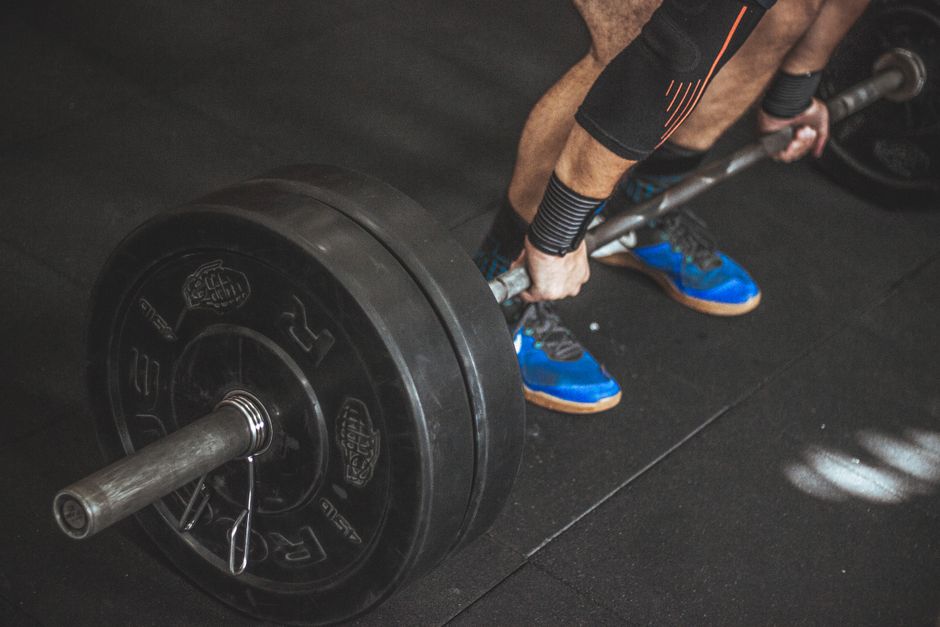
Mastering these Foundations is the difference between thriving and surviving.
Essential Modifications for Recovery and Injury Prevention
While the standard 5×5 is great, the “over 40” version requires a few strategic pivots. Our recovery capacity isn’t what it was at 20, and we need to program accordingly.
| Feature | Standard 5×5 | Modified 5×5 (Over 40) |
|---|---|---|
| Progression | Add 5lb every workout | Add 5lb every 2nd workout or weekly |
| Volume | Always 5 sets of 5 | Switch to 3 sets of 5 if recovery stalls |
| Increments | 5lb plates | 1.25lb to 2.5lb fractional plates |
| Deloads | When you fail a lift | Pre-emptive every 4–6 weeks |
Using fractional plates is a game-changer. Adding just 2.5 lbs total to the bar (1.25 lbs per side) allows for a much longer runway of progress before hitting a plateau. You can see more about these necessary variations for older lifters to ensure long-term adherence.
Managing Rest and Deloading
Rest periods between sets should be 3 to 5 minutes for heavy sets. This allows your Central Nervous System (CNS) to recover so you can complete all reps with perfect form.
Don’t wait until you’re exhausted to take a break. We suggest a “deload” week every 4 to 6 weeks. During this week, you still lift, but you reduce the weights by 20-30%. This gives your joints and nervous system a chance to catch up. Learning how to track your results helps you spot when a deload is necessary before an injury occurs.
Incorporating Mobility and Accessory Work
The 5×5 is a “meat and potatoes” program, but we need some “vegetables” (mobility work) to keep the joints greased. Spend 10 minutes before your session on dynamic warm-ups: leg swings, arm circles, and “cat-cow” stretches.
Post-workout, focus on accessory movements that fix common desk-job posture issues. Face pulls and band pull-aparts are excellent for shoulder health.
If you find yourself struggling with specific joint pain, our Personal Training coaches in Mount Airy can help tailor these movements to your needs.
Optimizing Nutrition and Lifestyle for Strength Gains
You can’t out-train a poor diet, especially after 40. Protein synthesis becomes less efficient as we age, a phenomenon called “anabolic resistance.” To counter this, aim for 0.8 to 1 gram of protein per pound of lean body mass.
- Protein: Chicken, lean beef, Greek yogurt, and whey protein are staples.
- Sleep: This is where the actual muscle building happens. Aim for 7-9 hours. If you’re only getting 5 hours of sleep, your 5×5 progress will stall regardless of how hard you lift.
- Hydration: Dehydrated muscles are weaker and more prone to cramps.
Working with in-person fitness coaching can help you dial in these lifestyle factors that are often more important than the workout itself.
Advanced Strategies: When to Move Beyond Basic 5×5
Linear progression (adding weight every time) eventually ends. For some, this happens at 12 weeks; for others, it might be 6 months. When you can no longer add weight without failing reps for three sessions in a row, it’s time to look at intermediate programming.
Options include:
- The 3×5 Method: Reducing sets to manage total fatigue.
- 5×5 Ultra: An upper/lower split that allows for more recovery between sessions by not doing full-body every time.
- Madcow 5×5: A weekly progression rather than a session-by-session progression.
For those who prefer training at home in Carroll County, Virtual 1-on-1 Training can provide the transition plan you need when the “honeymoon phase” of beginner gains ends.
Programming a 5×5 Workout Over 40 for Women
Women over 40 face unique challenges, particularly regarding hormonal shifts during perimenopause and menopause. Strength training is the #1 tool for maintaining bone mineral density during this time.
Women may find that upper-body lifts (Bench and Overhead Press) stall sooner than lower-body lifts. Adding a bit more volume (like 3 sets of 8 for accessory work) or using even smaller fractional plates can help maintain consistent progress tracking. The goal remains the same: get strong to stay capable.
Frequently Asked Questions about 5×5 Training After 40
Is 5×5 better than 5/3/1 for men over 40?
It depends on your experience. 5×5 is simpler and allows for faster gains for beginners. 5/3/1 is an intermediate program that uses a slower, monthly progression. If you are just starting (or restarting), 5×5 is usually the better choice for the first 3-6 months.
How long until I stall on 5×5?
Most lifters hit their first real “wall” between 8 and 16 weeks. When you stall, don’t panic. Perform a “reset” by dropping the weight 10% and building back up. This often allows you to smash through your previous plateau.
What equipment do I need for a home 5×5 setup?
To do the program safely, you need:
- A Power Rack (with safety pins)
- An Olympic Barbell (45 lbs)
- Enough weight plates to grow into
- A sturdy flat bench
Conclusion
At Primedy Health, we believe that 40 isn’t a deadline—it’s a prime time to build a foundation of “Old Man Strength” (or “Old Woman Strength”) that will serve you for the next forty years. The 5×5 workout over 40 is a sustainable, objective way to track your progress and ensure you are moving toward a healthier, more capable version of yourself.
Whether you’re looking for a community in Frederick, MD, or prefer the convenience of online coaching, we are here to help you navigate these lifts safely. Don’t let another decade of muscle loss pass you by. Start your journey with professional Health Club Training today and see how strong you can truly become.