

What Is a 5×5 Strength Workout — and Does It Actually Work?
A 5×5 strength workout is one of the most proven training methods for building raw strength: five sets of five reps on heavy compound barbell exercises, performed three times per week.
Here’s the core of how it works:
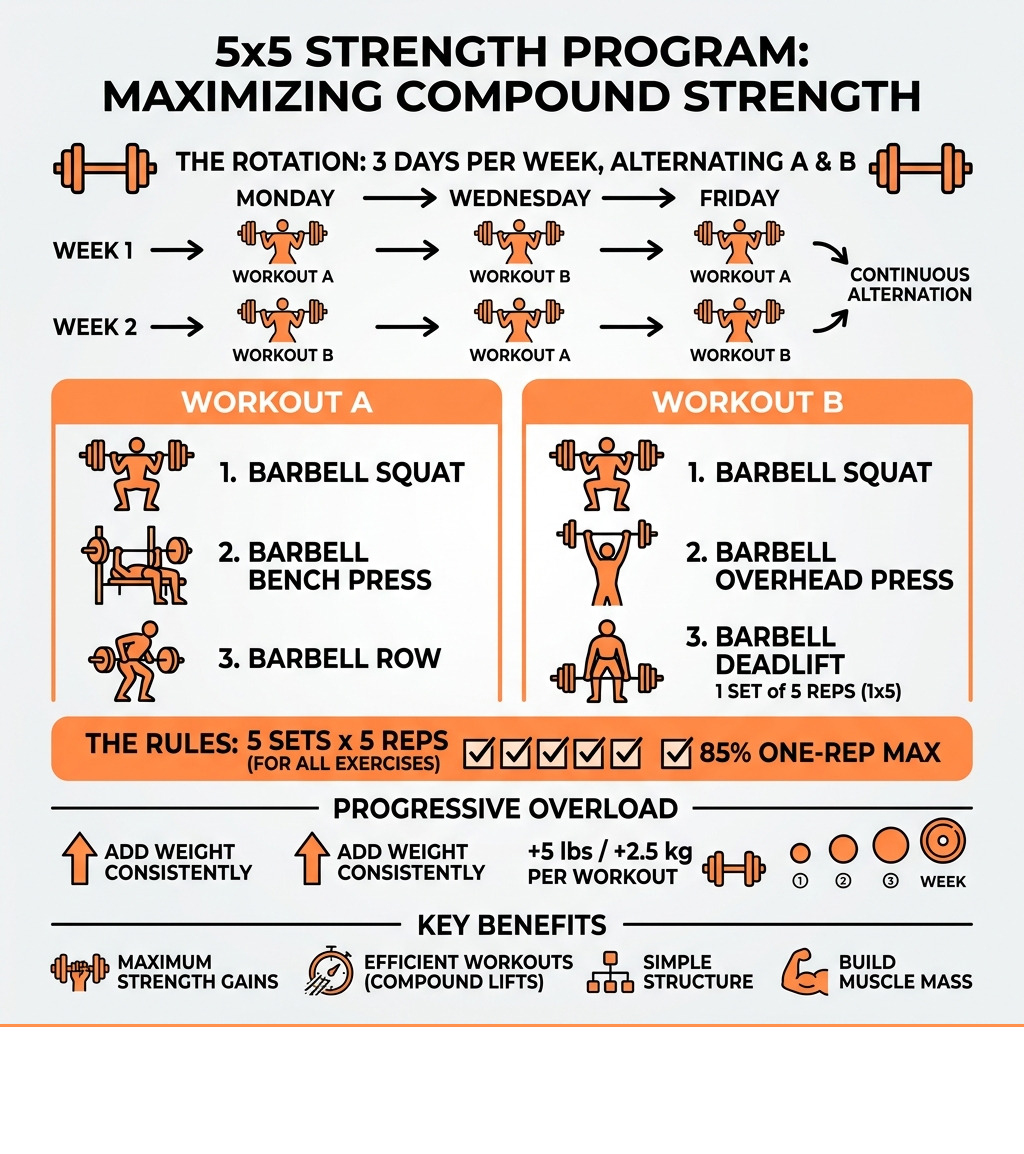
- 5 sets × 5 reps of compound lifts like squats, deadlifts, bench press, overhead press, and barbell rows
- Train 3 days per week — for example, Monday, Wednesday, and Friday
- Alternate between two workouts (Workout A and Workout B) each session
- Add weight consistently — even small increases compound into major strength gains over months
- Use roughly 85% of your one-rep max as your working weight
The program is deliberately simple. No complicated periodization. No dozens of exercises. Just a handful of big movements, done consistently, with a little more weight each time.
That simplicity is exactly why it works so well — especially if you’re in your 30s, 40s, or 50s and tired of programs that are either too complicated to follow or too easy to produce real results.
Research backs this up. Loads in the five-rep range produce strength and muscle gains comparable to traditional higher-rep hypertrophy training — and heavy compound lifts like squats and deadlifts also improve athletic performance in areas like jumping and sprinting.
Starting with just the bar and adding weight conservatively each session can lead to a 130-pound increase in your squat in as little as six months. That’s not a gimmick — that’s progressive overload working exactly as it should.
The rest of this guide breaks down everything you need to implement 5×5 correctly: structure, exercise selection, progression, recovery, and how to push through plateaus.
The Core Principles of a 5×5 Strength Workout
At its heart, the 5×5 strength workout is a masterclass in efficiency. We aren’t here to chase a “pump” or spend three hours on isolation machines. We are here to move heavy metal. The program’s roots stretch back over 65 years, popularized by legends like Reg Park (Arnold Schwarzenegger’s mentor) and later refined by Bill Starr, a legendary strength coach for collegiate and professional football teams.

The magic of 5×5 lies in three scientific pillars:
- Neural Adaptation: Before your muscles even grow larger, your nervous system becomes more efficient at “firing” the muscle fibers you already have. This is why you get significantly stronger in the first few weeks without necessarily looking different in the mirror.
- Mechanical Tension: By lifting heavy loads (roughly 85% of your one-rep max), you create significant tension in the muscle fibers, which is the primary driver for both strength and hypertrophy.
- Specificity: You get better at what you practice. By squatting and pressing frequently, you master the “skill” of lifting.
According to research, Master the 5×5 Workout to Build Strength, Muscle, and Power, heavy loads of five repetitions or lower lead to substantial gains in muscle tissue that are comparable to traditional 8–12 rep bodybuilding ranges, but with superior strength outcomes.
5×5 Strength vs. Traditional Hypertrophy
| Metric | 5×5 Strength Program | 3×10 Hypertrophy Program |
|---|---|---|
| Primary Goal | Raw Strength & Power | Muscle Size (Sarcoplasmic) |
| Intensity | High (80-85% 1RM) | Moderate (60-75% 1RM) |
| Rest Periods | 3–5 Minutes | 60–90 Seconds |
| Neural Demand | Very High | Moderate |
| Bone Density | Significant Increase | Moderate Increase |
Beyond just muscle, this style of training is phenomenal for bone density and functional athletic performance. Whether you’re a runner looking to improve your sprint speed or a parent who wants to pick up their kids without a back tweak, the compound nature of these lifts builds a resilient “armored” body.
Structuring Your Weekly Training Schedule
We often see people make the mistake of thinking “more is better.” In the 5×5 strength workout, “better is better.” Because we are working with heavy weights that tax the central nervous system (CNS), recovery is just as important as the lifting itself.
The standard structure is a three-day-per-week split with at least 48 hours of recovery between sessions. This allows your tissues to repair and your CNS to reset. At Primedy Health, we often help clients integrate these Pre-designed Programs into their busy lives in Mount Airy, MD, ensuring the schedule is sustainable for the long haul.
A typical two-week rotation looks like this:
- Week 1: Workout A (Mon), Workout B (Wed), Workout A (Fri)
- Week 2: Workout B (Mon), Workout A (Wed), Workout B (Fri)
Exercise Selection for the 5×5 Strength Workout
The beauty of 5×5 is its focus on the “Big Five.” These movements utilize the entire kinetic chain and require significant work from your stabilizer muscles.
- The Squat: The king of all exercises. It trains more muscle than any other movement and provides the foundation for the entire program. You will squat every single session.
- The Bench Press: The primary upper-body “push” that builds the chest, shoulders, and triceps.
- The Barbell Row: An essential “pull” to balance out the bench press and build a thick, strong back.
- The Overhead Press: A standing press that requires immense core stability and shoulder power.
- The Deadlift: Unlike the other lifts, we only perform one set of five reps (1×5) for deadlifts. Why? Because heavy deadlifts are incredibly taxing on the nervous system and lower back. Doing 5×5 deadlifts after 5×5 squats is a recipe for burnout.
If you feel like your current routine is missing these foundational pillars, Your Muscles Called and They Want These Customized Strength Training Plans can help you get back on track with a plan tailored to your specific biomechanics.
Managing Rest Periods and Warmups
In April 2026, we still see the same mistake: people rushing their sets. If you only rest 30 seconds, you aren’t doing a strength workout; you’re doing cardio with a barbell.
- Rest Periods: For easy sets, 90 seconds is fine. As the weight gets challenging, move to 3 minutes. On your heaviest, “grind” sets, don’t be afraid to take 5 minutes. You need your ATP (energy) stores to replenish so you can complete all five reps with perfect form.
- Warmups: Never jump straight into your working weight. We recommend a dynamic warmup followed by “pyramid” sets with the bar. Start with the empty bar for 2 sets of 5, then gradually add weight until you reach your target.
To stay on top of your numbers without getting overwhelmed, check out our guide on How to Track Your Workout Results Without Losing Your Mind. We recommend using the RPE (Rate of Perceived Exertion) scale, aiming for a 7 or 8 out of 10. You should feel like you could have done 1 or 2 more reps, but not many more.

Progression, Starting Weights, and Plateaus
The engine that drives the 5×5 strength workout is linear progression. For beginners, we recommend starting light—sometimes with just the empty 45-pound barbell. This might feel “too easy” for the first two weeks, but it allows you to master form and build momentum.
The rule is simple: if you hit all 5 sets of 5 reps, add 5 pounds to the bar next time (or 10 pounds for deadlifts). As noted in 5×5 Workout: What It Is and How You Can Benefit, this conservative approach prevents early burnout. Adding just 5 pounds a week to your squat results in a massive 130-pound increase over six months.
For those who have moved past the “newbie” phase, we utilize Progress Tracking and micro-loading (adding 1 or 2 pounds using small plates) to keep the needle moving. You can truly Build Muscle and Strength at the Same Time – T NATION by BIOTEST if you respect the process of incremental gains.
Troubleshooting Your 5×5 Strength Workout Progress
Eventually, everyone hits a wall. A plateau isn’t a failure; it’s just a sign that your body needs a change in stimulus or more recovery.
- The Deload: If you fail to hit your 5×5 for three consecutive workouts at the same weight, it’s time to deload. Drop the weight by 10-20% and work your way back up. This “one step back, two steps forward” approach is a staple in professional strength circles.
- Form Check: Often, plateaus happen because your form is breaking down as the weight gets heavy. This is where Everything You Need to Know About In-Person Fitness Coaching becomes invaluable. A coach can spot a hip shift or a rounded back that you can’t see yourself.
- Life Stress: If you aren’t sleeping or you’re skipping meals, your strength will suffer. We see many Workout Mistakes After 30 that revolve around trying to train like a 19-year-old while having the responsibilities of a 40-year-old.
Optimizing Recovery and Nutrition for Heavy Lifting
You don’t get strong in the gym; you get strong recovering from the gym. To support a 5×5 strength workout, your body needs fuel. This isn’t the time for a restrictive, low-calorie crash diet.
- Caloric Surplus: To build muscle and strength, you generally need to be in a slight caloric surplus. Focus on whole foods: lean proteins, complex carbs, and healthy fats.
- Protein Synthesis: Aim for roughly 0.8 to 1 gram of protein per pound of body weight to repair the micro-tears created during heavy lifting.
- Sleep: This is your primary recovery tool. Aim for 7-9 hours of high-quality sleep. This is when growth hormone is released and your CNS recovers.
Can you do cardio? Absolutely. In fact, light cardio (walking, easy cycling) can act as active recovery by increasing blood flow to sore muscles. Just avoid high-intensity interval training (HIIT) on your “off” days, as it can interfere with the recovery needed for your heavy squats. For more on balancing these elements, browse our Exercise Category for expert tips.
According to 5×5 Workout: Simple and Effective Way to Build Muscle Fast, the simplicity of the program is its greatest strength, but it requires a disciplined approach to the “other 23 hours” of the day.
Frequently Asked Questions about 5×5 Training
Can I perform a 5×5 workout with dumbbells?
While you can do 5×5 with dumbbells, it isn’t quite the same. Barbells allow for much heavier loading and easier incremental progression (it’s hard to find 52.5-pound dumbbells, but easy to add small plates to a bar). Additionally, dumbbells are limited by your grip strength and the difficulty of getting heavy weights into position. If you’re stuck at home with only dumbbells, we can help you adapt the program through our Personal Training services, but the barbell remains the gold standard for raw strength.
How does 5×5 compare to a 3×5 program?
Programs like Starting Strength use 3×5 (three sets of five). The main difference is volume. 5×5 provides more total work, which can lead to more hypertrophy (muscle growth) in the beginning. However, as the weights get extremely heavy, some lifters find 5×5 too exhausting and switch to 3×5 to manage fatigue. StrongFirst and the 5×5 Method highlights that both are effective, but 5×5 is often the better starting point for building a massive strength base.
Is the 5×5 program safe for older adults?
Yes! In fact, heavy resistance training is one of the best ways to combat sarcopenia (muscle loss) and osteoporosis (bone loss) as we age. The key is professional supervision to ensure form is perfect. We offer Group Training sessions in Carroll County and Frederick that focus on these compound movements in a safe, supportive environment.
Conclusion
The 5×5 strength workout has stood the test of time because it ignores the “fluff” and focuses on what actually moves the needle: heavy weights, compound movements, and consistent progression. Whether you are in Mount Airy, MD, or training with us online from across the country, the principles remain the same.
Building a stronger version of yourself doesn’t require a complex 6-day split or dozens of fancy machines. It requires a barbell, a rack, and the willingness to add five pounds to the bar. At Primedy Health, we specialize in making these high-level strength principles accessible for “real lives”—people with jobs, families, and busy schedules who still want to be the strongest version of themselves.
Ready to start your journey? Explore our Health Club Training options today and let’s get to work. Your future, stronger self will thank you.