
Why Starting an At Home Free Weight Workout Is Easier Than You Think
The best at home free weight workout uses dumbbells or kettlebells to build real strength — no gym required.
Here’s a quick snapshot to get you started:
| Goal | Equipment | Frequency | Key Exercises |
|---|---|---|---|
| Build muscle | Dumbbells (10-35 lbs) | 3x per week | Squats, rows, presses |
| Fat loss | Light-medium dumbbells | 3-4x per week | Full-body circuits |
| Improve running | Dumbbells + bodyweight | 2-3x per week | Lunges, deadlifts, calf raises |
| Total beginner | One pair of dumbbells | 3x per week | Glute bridges, floor press, rows |
If you’ve ever skipped the gym because life got in the way — a packed schedule, a long commute, or just the mental weight of it all — you’re not alone.
The good news? You don’t need a gym to train effectively.
A single pair of dumbbells, a small patch of floor space, and a solid plan can deliver serious results. Research-backed programs using dumbbells alone have racked up over 10 million reads — because they work.
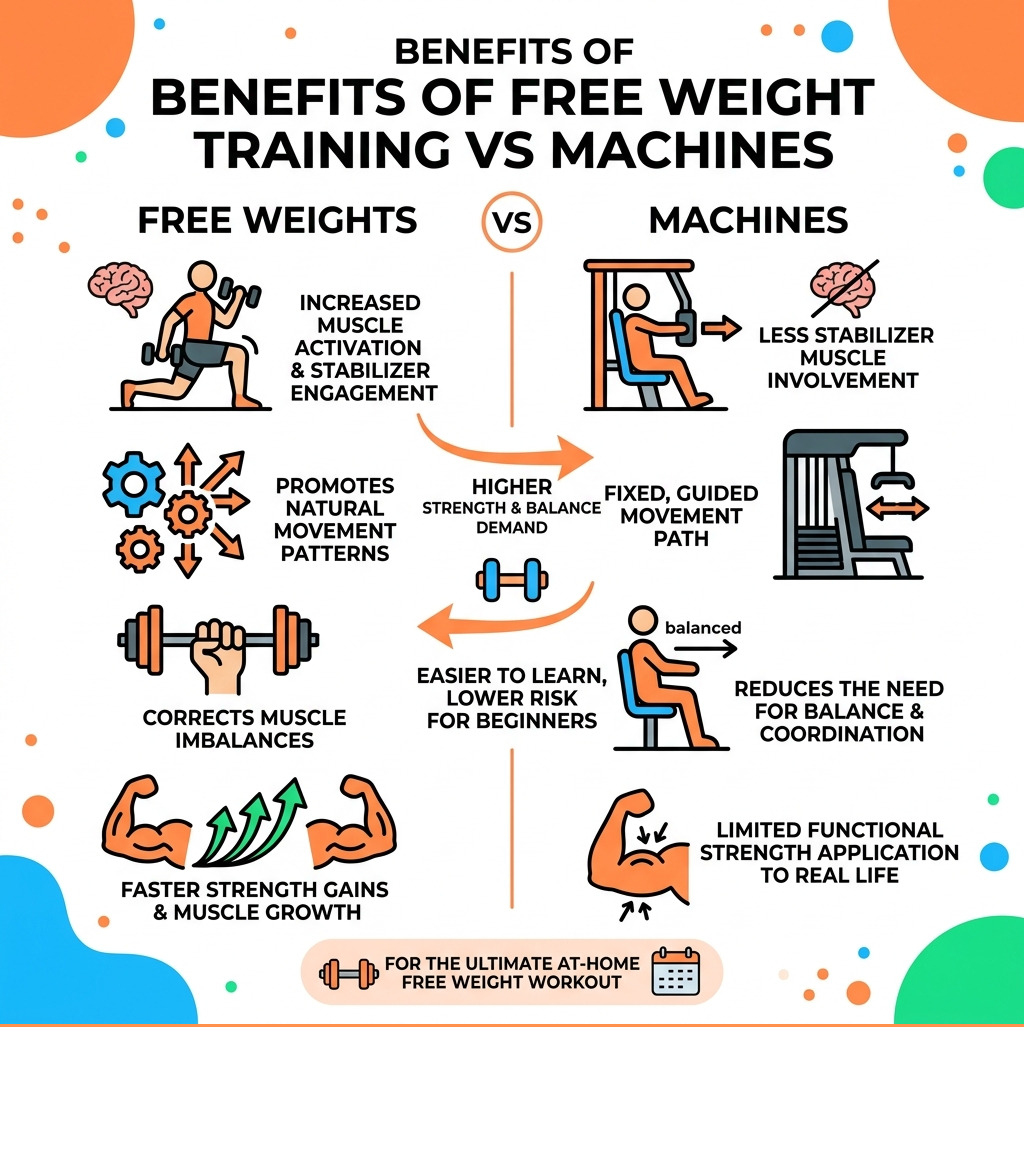
Free weights aren’t just a “gym substitute.” They actually have real advantages over machines. They build the stabilizer muscles your body needs for everyday life. They let you move in multiple directions. And they fix muscle imbalances that machines quietly ignore.
Whether you’re coming off a long break, stuck in an all-or-nothing cycle, or just want a more sustainable way to train, this guide gives you everything you need to start — and stick with — a free weight routine at home.
Why an At Home Free Weight Workout Beats the Gym

In April 2026, the trend is clear: more of our neighbors in Mount Airy and Frederick are ditching the commute for the convenience of the living room. But is an at home free weight workout actually as good as those fancy machines at the big-box gym?
The short answer is: it’s often better.
When you use a machine, the path of motion is fixed. The machine does the balancing for you. When you pick up a pair of dumbbells at home, your body has to work twice as hard to stabilize the weight. This builds what we call “functional strength”—the kind of strength that helps you carry a sleeping toddler or lug a heavy bag of mulch from the car without throwing your back out.
Benefits of Free Weights Over Machines
Free weights offer several scientific advantages that machines simply can’t match:
- Inter-muscular Coordination: Because free weights aren’t on a track, your muscles have to work together to keep the weight steady. This leads to greater overall muscle activation.
- Fixing Imbalances: Machines often allow your stronger side to “bully” the weaker side. With dumbbells, each arm or leg has to carry its own load, naturally correcting muscle imbalances.
- Calorie Burn: Because you’re engaging more stabilizer muscles to maintain your posture, you’re burning more energy per rep compared to sitting in a guided machine.
- Multi-planar Movement: Life doesn’t happen in a straight line. Free weights allow you to move side-to-side, rotate, and hinge in ways that mimic real-world activity.
For a deeper dive into how these movements translate to real-world power, check out this At-Home Dumbbell Workout (Strength + Endurance).
The Convenience of Training at Home
Let’s be honest: the best workout is the one you actually do. Training at home is incredibly time-saving. There’s no waiting for a squat rack, no “gym-bro” intimidation, and no need to worry about gym illnesses. It’s cost-effective, too. A solid set of dumbbells costs less than a few months of a premium gym membership.
At Primedy Health, we specialize in helping people bridge the gap between “I should work out” and “I am working out” through Everything You Need to Know About In-Person Fitness Coaching and virtual support, ensuring your home setup is just as effective as any commercial gym.
Essential Equipment and Choosing Your Starting Weights
You don’t need a basement full of iron to see results. In fact, most of our clients in Carroll County start with just a few key items.
| Level | Recommended Dumbbell Weight (Women) | Recommended Dumbbell Weight (Men) |
|---|---|---|
| Beginner | 5 – 10 lbs | 10 – 20 lbs |
| Intermediate | 12 – 20 lbs | 25 – 40 lbs |
| Advanced | 25+ lbs | 45+ lbs |
How to Select the Right Load
Choosing the right weight can feel like guesswork, but there’s a simple rule: the last two reps of your set should feel difficult, but not impossible. If you can breeze through 12 reps without breaking a sweat, it’s time to go heavier.
We often recommend the 1×20 method for those just starting out. This involves performing one set of 20 reps to near failure. It’s an incredibly time-efficient way to build a base of strength and endurance without needing a massive rack of weights. If you can hit 20 reps with perfect form, increase the weight for your next session.
If you’re looking for a structured start, our Foundations program is designed to teach you exactly how to handle these loads safely.
Safety Precautions for an At Home Free Weight Workout
Safety first—especially when you don’t have a spotter.
- Clear the Space: Ensure you have enough room to lunge in all directions without hitting the coffee table.
- Neutral Spine: Whether you are squatting or rowing, keep your back flat. Imagine a straight line from your head to your tailbone.
- Core Engagement: Think about “bracing” your midsection as if someone is about to poke you in the stomach. This protects your lower back.
- Listen to Your Body: If a movement causes sharp pain, stop. There is a big difference between “muscle burn” and “joint pain.”
The Best Exercises for Total Body Strength
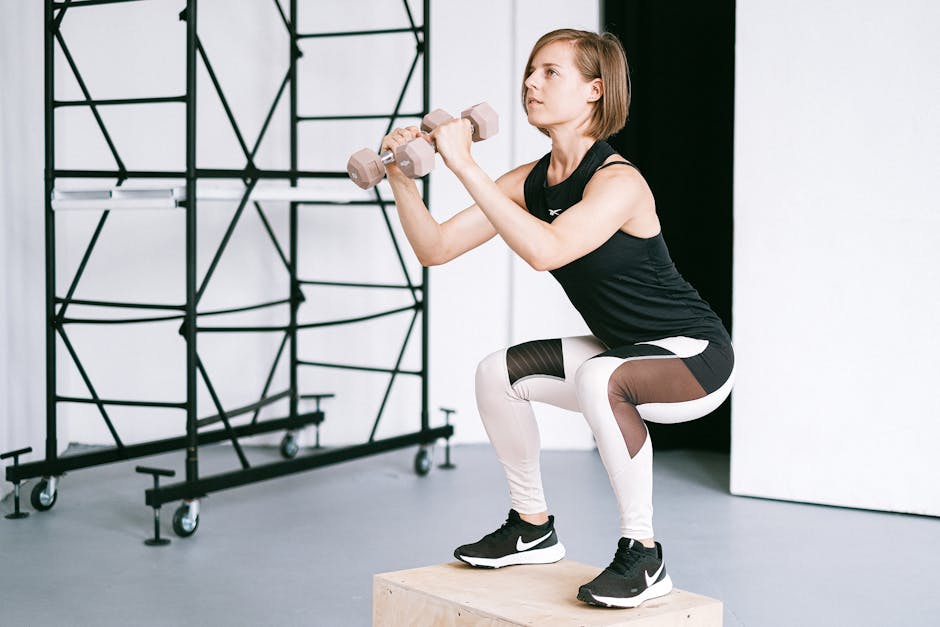
To get the most “bang for your buck,” focus on compound movements. These are exercises that use more than one joint and multiple muscle groups at once. They are the secret sauce of any effective at home free weight workout.
You can find a great visual guide for these moves in this 30-Minute Full Body Workout You Can Do at Home.
Lower Body Fundamentals
- Goblet Squats: Hold one dumbbell against your chest like a “goblet.” Keep your chest up and sit back into your heels. This is the king of leg exercises and is much safer for beginners than a barbell back squat.
- Lunges: These target your glutes and improve balance. You can do them stationary, walking, or even reverse lunges to be easier on the knees.
- Bulgarian Split Squats: Place one foot behind you on a chair or couch. These are notoriously tough but are arguably the best exercise for building glute strength and correcting leg imbalances.
- Weighted Glute Bridges: Lie on your back with your knees bent, place a weight on your hips, and lift. This targets the posterior chain without stressing the spine.
Upper Body and Core Essentials
- Dumbbell Rows: Lean over a sturdy surface (like a bench or the side of your bed) and pull the weight toward your hip. This builds a strong back and improves posture.
- Floor Press: If you don’t have a bench, lie on the floor. This limits your range of motion slightly, which actually protects your shoulders while still torching your chest and triceps.
- Overhead Press: Stand tall and press the weights from your shoulders toward the ceiling. This builds strong deltoids and core stability.
- Bicycle Crunches: According to research, this is one of the most effective ways to engage your obliques and entire abdominal wall.
Sample Routines: From Beginner to Advanced
Consistency is the name of the game. We recommend a 3-day full-body split for most beginners. This allows for 48 hours of recovery between sessions, which is when the actual muscle building happens.
Structuring Your Beginner At Home Free Weight Workout
For the first 4-8 weeks, keep it simple.
- Frequency: 3 days per week (e.g., Monday, Wednesday, Friday).
- Structure: 2 sets of 10-12 reps for each exercise.
- Rest: 60 seconds between sets.
- Routine:
- Goblet Squats
- Dumbbell Rows
- Lunges
- Floor Press
- Glute Bridges
- Plank (30 seconds)
If you prefer a guided approach, our Pre-designed Programs offer step-by-step instructions tailored to different goals.
Progressing Your At Home Free Weight Workout for Muscle Growth
Once you can complete the beginner routine easily, it’s time to turn up the heat. You can do this by:
- Increasing Volume: Moving from 2 sets to 3 or 4 sets.
- Tempo Variations: Instead of rushing, take 3 seconds to lower the weight. This “eccentric” phase causes more muscle micro-tears, leading to more growth.
- EMOM Training: “Every Minute on the Minute.” Set a timer for 20 minutes. At the start of every minute, do 10 reps of an exercise, then rest for the remainder of that minute. It’s a fantastic way to build cardiovascular endurance alongside strength.
For those in the Frederick area looking for something more hands-on, Personal Training or Group Training can provide the extra push needed to break through a plateau.
Mastering Progressive Overload and Recovery
The biggest mistake people make with an at home free weight workout is doing the exact same thing every week. If you lift 10 lbs for 10 reps every Tuesday for a year, your body has no reason to change.
This is where progressive overload comes in. You must continually challenge your muscles by adding weight, adding reps, or decreasing rest time.
How to Track Your Results
You don’t need a fancy spreadsheet, but you do need a log. Whether it’s a notebook or a mobile app, record your weights and reps. This turns your fitness journey into data, making it much easier to stay motivated. Check out our guide on How to Track Your Workout Results Without Losing Your Mind for some stress-free tips.
We also offer Progress Tracking tools for our members to ensure they are always moving toward their goals.
Recovery and Nutrition Tips
You don’t get stronger at the gym (or in your living room); you get stronger while you sleep.
- The 48-Hour Rule: Avoid training the same muscle group two days in a row.
- Protein is King: Aim for a palm-sized portion of protein with every meal to help repair muscle tissue.
- Hydration: Even mild dehydration can sap your strength by 10% or more.
- Caloric Balance: If your goal is fat loss, you need a slight deficit. If you want to build significant muscle, you may need a small caloric surplus.
Frequently Asked Questions about Home Training
How often should I do an at home free weight workout?
For most people, 3 to 4 times per week is the “sweet spot.” This provides enough stimulus to see results while allowing plenty of time for recovery. If you are also a runner or athlete, 2 days of strength training can be enough to see significant performance gains.
Can I build significant muscle with only dumbbells?
Absolutely. Your muscles don’t know the difference between a $5,000 cable machine and a $50 dumbbell. They only respond to tension and fatigue. By using heavy-enough weights and applying progressive overload, you can build a high-level physique at home.
What are the most common mistakes to avoid?
The most common “gains-killers” are:
- Using Momentum: If you have to swing your body to lift the weight, it’s too heavy.
- Skipping the Warm-up: A 5-minute dynamic warm-up (jumping jacks, arm circles, bodyweight squats) is essential to prevent injury.
- Ignoring the “Hard” Exercises: It’s tempting to skip split squats or rows because they are difficult, but those are exactly the moves that yield the best results.
For those who want to ensure their form is perfect, our Virtual 1-on-1 Training or Customized Virtual Programming can provide real-time feedback from the comfort of your home.
Conclusion
Starting an at home free weight workout is one of the best investments you can make in your long-term health. It’s flexible, effective, and fits into even the busiest Maryland lifestyle. Whether you are in Mount Airy, Frederick, or Carroll County, you have the power to transform your fitness without ever leaving your zip code.
At Primedy Health, we believe fitness should be sustainable and coach-led. We don’t just give you a list of exercises; we provide the support and structure you need to succeed for the long haul. If you’re ready to stop guessing and start progressing, we’re here to help.
Start your journey with our Health Club Training today and see how Your Muscles Called and They Want These Customized Strength Training Plans.