

Why a Barbell Strength Training Program Delivers Results That Last
A barbell strength training program is one of the most effective ways to build real, lasting strength — and it works for beginners and experienced lifters alike.
Here’s what you need to know at a glance:
- What it is: A structured training plan built around compound barbell lifts — squat, deadlift, bench press, and overhead press
- Who it’s for: Anyone looking to build strength, muscle, and long-term health — regardless of age or experience level
- How often: 3–4 days per week is the sweet spot for most people
- Key principle: Add weight progressively over time (progressive overload) — this is what drives results
- What you need: A barbell, a power rack, a flat bench, and weight plates
- Time per session: As little as 30–45 minutes per workout
If you’re a busy adult who’s tried and abandoned programs before, the barbell is worth your attention. Unlike machines or dumbbells, a barbell lets you load heavy and train multiple muscle groups at once — giving you more return on every hour you invest.
Research published in Frontiers of Physiology (December 2017) confirms that multi-joint barbell movements produce greater strength increases than single-joint exercises at equal training volumes. And the benefits go well beyond looking better — strength training with a barbell is linked to lower risk of type II diabetes, cardiovascular disease, and certain cancers.
The simple truth? A barbell, a rack, and a plan is all most people need to transform their health.
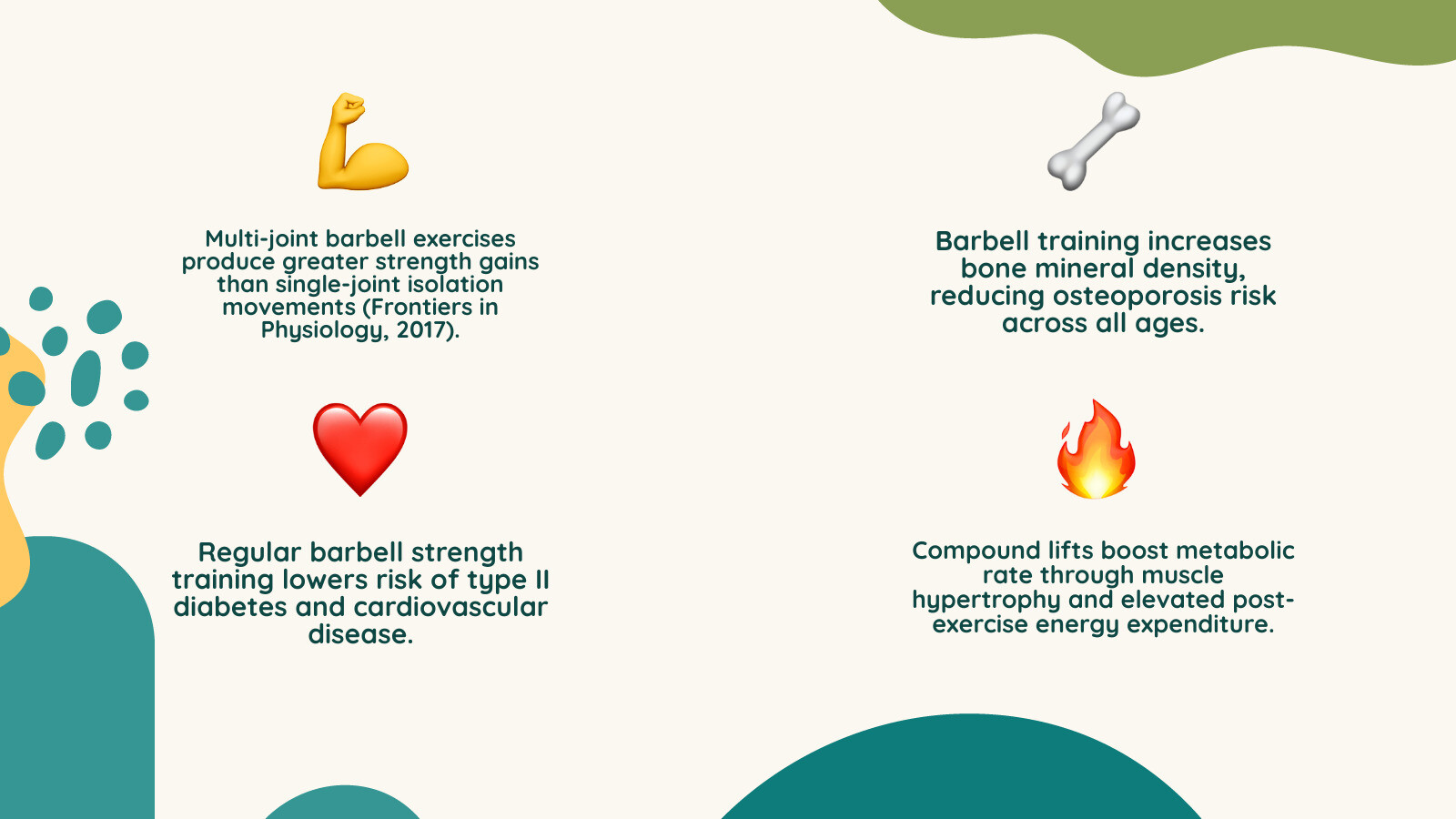
Barbell strength training program word guide:
The Science and Benefits of a Barbell Strength Training Program
When we talk about a barbell strength training program, we aren’t just talking about getting “big muscles.” We are talking about a systemic upgrade to your biology. The barbell is a unique tool because it allows for infinite progressive overload, meaning you can start with a 15lb technique bar and eventually move hundreds of pounds.
The primary advantage lies in “multi-joint” or compound movements. Unlike a leg extension machine that only works your quads, a barbell squat recruits your glutes, hamstrings, quads, lower back, and core. This massive recruitment of muscle tissue creates a significant hormonal and metabolic response.
Beyond muscle, the impact on bone density is profound. As we age, our bones naturally become more brittle. However, the axial loading (weight placed on the spine and hips) from squats and overhead presses signals the body to deposit more minerals into the bone matrix. This makes a barbell strength training program a primary defense against osteoporosis. Furthermore, these movements improve cardiovascular health by strengthening the heart muscle and improving insulin sensitivity, which is vital for type II diabetes prevention.
Physical Adaptations for All Ages
One of the most common myths we hear in Mount Airy and Frederick is that lifting heavy is only for the young. In reality, older adults may benefit the most. Sarcopenia—the age-related loss of muscle mass—can be drastically slowed or even reversed with consistent resistance training.
By following a structured strength plan, you improve your neuromuscular efficiency. This is essentially your brain’s ability to “talk” to your muscles. In the first few weeks of a program, you’ll notice you’re getting much stronger even before your muscles look bigger. That’s your nervous system learning how to recruit more muscle fibers simultaneously.
Mental and Longevity Benefits
Strength is a “force multiplier” for life. When you are stronger, every other physical task—carrying groceries, playing with grandkids, or hiking in Carroll County—becomes easier. This creates a “buffer” against injury. If you have the strength to deadlift 200 pounds, picking up a 40-pound bag of mulch is unlikely to strain your back.
There is also a significant mental resilience factor. There is something uniquely empowering about standing under a heavy bar and successfully moving it. This confidence translates into better sleep quality and reduced anxiety. For those concerned about their knees or joints, a properly executed squat actually strengthens the connective tissues around the joint, providing better stability and long-term health.
Mastering the Big Four: Fundamental Barbell Exercises
To build a solid foundation, you don’t need fifty different exercises. You need to master the “Big Four.” These movements cover every major muscle group in the body.

Squat and Deadlift: The Lower Body Powerhouses
The Squat is often called the king of exercises. It builds the glutes, quads, and core. To perform it correctly, we teach our members to sit back as if sitting in a chair, keeping the chest up and the heels planted.
The Deadlift is the ultimate test of total-body strength. It focuses on the posterior chain—your hamstrings, glutes, and back. The key is the “hip hinge.” Instead of squatting the weight up, you push your hips back, keep a flat spine, and “pull” the bar up your shins. It is a functional movement we use every time we pick something up from the floor. Mastering this is the best way to ensure long-term back health through a properly designed program.
Bench Press and Overhead Press: Building Upper Body Strength
The Bench Press is the gold standard for chest, shoulders, and triceps development. Proper form involves retracting your scapula (squeezing your shoulder blades together) to create a stable base on the bench. We recommend a 45-degree elbow angle to protect the shoulder joints from unnecessary strain.
The Overhead Press (or Standing Press) is perhaps the most underrated upper body movement. It requires immense core stability and shoulder health. Unlike the bench press, you are standing, which means your entire body must stay rigid to move the bar from your collarbone to a full lockout overhead. It is a true “full-body” upper body lift.
Structuring Your Barbell Strength Training Program for Success
Randomly lifting weights might work for a week or two, but long-term gains require a customized plan. The structure of your program depends on your experience level and goals.
| Program Type | Best For | Structure | Key Benefit |
|---|---|---|---|
| 5×5 Linear Progression | Beginners | 3 days/week, Full Body | Rapid strength gains every session |
| 5/3/1 Periodization | Intermediates | 4 days/week, Split | Sustainable long-term progress |
| Boring But Big | Hypertrophy | 4 days/week, High Volume | Significant muscle size increases |
| Conjugate Method | Advanced | 4 days/week, Varied | Breaking through elite plateaus |
Progressive Overload and Autoregulation in a Barbell Strength Training Program
The heart of any barbell strength training program is progressive overload. If you lift the same weight for the same reps forever, you will never get stronger. For beginners, this usually means adding 2.5 to 5 pounds to the bar every single workout.
However, we all have days where we didn’t sleep well or stress is high. This is where Autoregulation and RPE (Rate of Perceived Exertion) come in. Instead of a fixed number, you might aim for a weight that feels like an “8 out of 10” in difficulty. This allows you to train hard on good days and back off on bad days, preventing burnout. Our personal training services often utilize these methods to keep our Maryland clients progressing safely.
Popular Program Structures: From 5×5 to Conjugate
There are several “battle-tested” templates you can follow:
- 5×5 (StrongLifts/Starting Strength): Simple and effective. You do 5 sets of 5 reps. It’s the fastest way for a novice to get strong.
- 5/3/1 (Jim Wendler): A slower, more methodical approach. It uses percentages of your “training max” to ensure you never burn out.
- Boring But Big (BBB): A variation of 5/3/1 that adds 5 sets of 10 reps for extra volume, perfect for building muscle size.
- Conjugate (Westside): This method uses “Max Effort” and “Dynamic Effort” days to build both absolute strength and explosive power. While famous for world records, its principles of accessory work are great for fixing weaknesses.
Essential Equipment and Recovery for Lifters
One of the best things about a barbell strength training program is the minimal equipment needed. You don’t need fancy machines with pulleys and cables.

The Essentials:
- Olympic Barbell: A standard 45lb (20kg) bar designed to hold hundreds of pounds.
- Power Rack: Essential for safety. The “safeties” or pins will catch the bar if you fail a rep during a squat or bench press.
- Weight Plates: A mix of 45, 25, 10, 5, and 2.5lb plates.
- Flat Bench: For bench pressing and various accessory movements.
- Fractional Plates: These allow you to add as little as 0.5 or 1lb, which is vital for progressing on upper body lifts like the overhead press.
Nutrition and Recovery Protocols
You don’t get strong in the gym; you get strong recovering from the gym. Training provides the stimulus, but recovery provides the results.
- Protein Synthesis: Aim for roughly 0.8g to 1g of protein per pound of body weight to repair muscle tissue.
- Sleep Hygiene: 7–9 hours of quality sleep is non-negotiable. This is when your growth hormone peaks and your nervous system resets.
- Hydration: Even slight dehydration can drop your strength by 10% or more.
- Active Rest: On off days, go for a walk in Frederick or do some light mobility work. This keeps blood flowing to the muscles without adding more stress.
For more hands-on help with your recovery and wellness, our team provides integrated coaching to ensure your lifestyle supports your lifting.
Frequently Asked Questions about Barbell Training
Is a barbell strength training program suitable for women and older adults?
Absolutely. In fact, women often see more dramatic health improvements than men because strength training helps balance hormones and protects against the bone density loss that can occur later in life. The beauty of the barbell is its scalability. If a 45lb bar is too heavy, we start with a lighter technique bar. The physiological response—stronger muscles, denser bones, and better metabolic health—is universal.
Research shows that while individual responses vary (some may gain 60% strength while others gain less on the same program), everyone who follows a structured plan improves their baseline health.
How often should I train with barbells per week?
For most of our clients in Mount Airy, 3 days per week on a full-body routine is the perfect balance. This allows for 48 hours of recovery between sessions. If you prefer a “split” (Upper body one day, Lower body the next), 4 days per week works well. Consistency is far more important than intensity. It is better to train 3 days a week for a year than 6 days a week for a month and quit.
Can I build muscle with only a barbell?
Yes. Some of the most impressive physiques in history were built with nothing but a barbell and hard work. By focusing on compound movements, you create significant mechanical tension and metabolic stress—the two primary drivers of hypertrophy (muscle growth). While “isolation” moves (like curls) are fun, the barbell row, bench press, and deadlift will build 90% of your mass.
Conclusion
At Primedy Health, we believe that strength is the foundation of a high-quality life. A barbell strength training program isn’t about ego or “gym culture”-it’s about building a body that is resilient, capable, and healthy for the long haul. Whether you are training in your garage or looking for expert guidance in Mount Airy, MD, the principles remain the same: show up, follow the plan, and add a little weight to the bar.
Ready to see what your body is truly capable of? Start your journey with our health club training and let us help you build a stronger future, one rep at a time.
External Resources for Local Lifters:
- National Strength and Conditioning Association
- American College of Sports Medicine
- Centers for Disease Control and Prevention Physical Activity Basics
- MedlinePlus Exercise and Physical Fitness
- USA Weightlifting
- NIH Osteoporosis and Related Bone Diseases Resource Center
- President’s Council on Sports, Fitness & Nutrition