

What Does Online Personal Training Actually Cost in 2026?
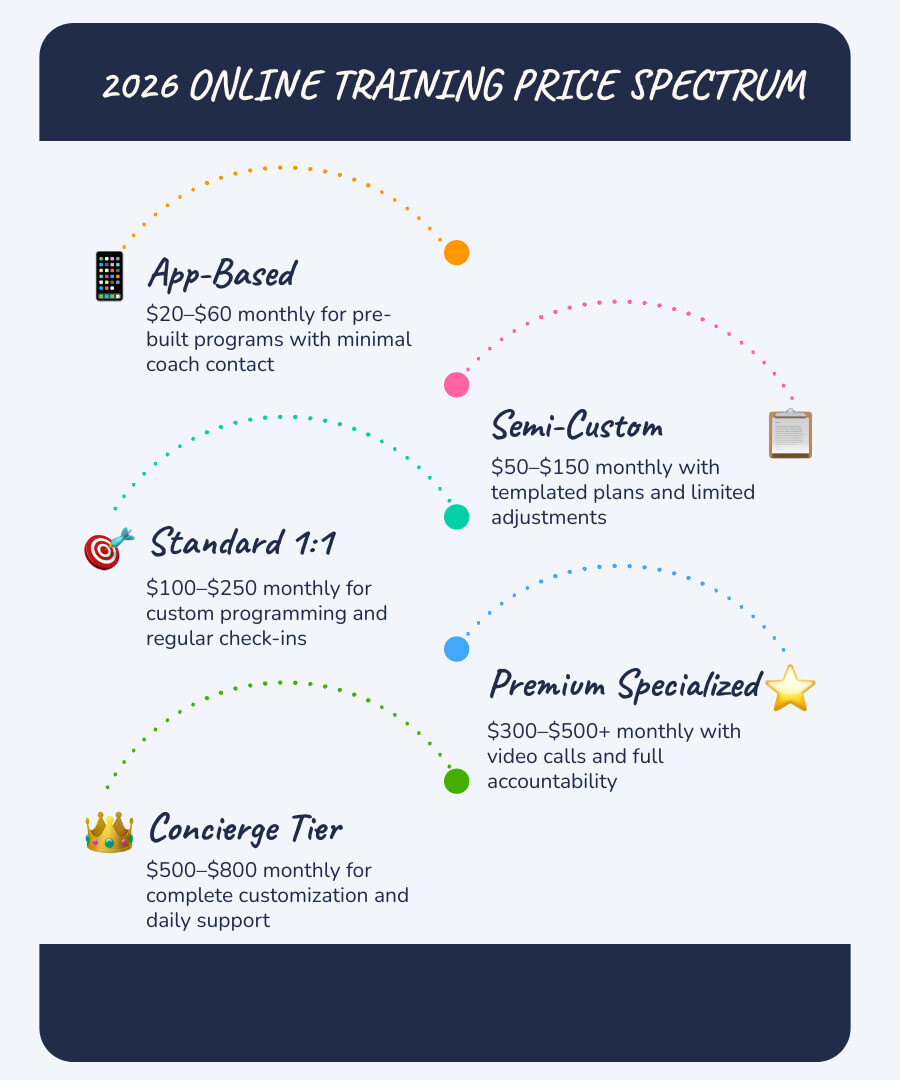
The average cost for online personal training in 2026 ranges from about $20 to $500+ per month, depending on how much support, customization, and coach access you need.
Here’s a quick breakdown by coaching model:
| Coaching Model | Monthly Cost Range | What You Typically Get |
|---|---|---|
| App-Based / DIY | $20 – $60 | Pre-built programs, minimal coach contact |
| Semi-Custom | $50 – $150 | Templated plans with some adjustments |
| Standard 1:1 | $100 – $250 | Custom programming, regular check-ins |
| Premium / Specialized | $300 – $497+ | Full customization, video calls, nutrition, accountability |
Compare that to in-person training, which can run $600–$800 per month for just two sessions per week. Online coaching delivers a lot of the same value at a fraction of the price.
But not all online programs are created equal. A $50/month app and a $300/month coach are completely different products. The price gap usually comes down to how much of a real human is actually in your corner.
If you’re a busy adult who’s tried the all-or-nothing approach before and burned out, the right tier isn’t always the cheapest — it’s the one that gives you enough structure and accountability to actually stay consistent.
The sections below break down exactly what you get at each price point, what drives costs up or down, and how to find the best value for your specific situation.
Discover more about average cost for online personal training:
Understanding the Average Cost for Online Personal Training in 2026
As we navigate through 2026, the digital fitness landscape has matured significantly. We’ve moved past the era of simple PDF workout plans sent via email. Today, the average cost for online personal training is tied directly to the sophistication of the digital dashboard and the depth of the coach-client relationship.

To help you find where you fit, let’s look at the four primary tiers of service currently dominating the market:
- App-Based / DIY Coaching ($20–$60/month): This is largely automated. You get access to a library of workouts and perhaps a generic macro calculator. It’s great for self-starters, but research shows that roughly 83% of users in this tier fall off within the first 90 days because there is no one checking in when they miss a Monday morning session.
- Semi-Custom Programming ($50–$150/month): Here, a coach might tweak a template to fit your equipment (like if you’re training in your garage in Mount Airy or a local gym in Frederick). You get a bit more “human” touch, usually through monthly email check-ins.
- Standard 1:1 Coaching ($100–$300/month): This is the “sweet spot” for most. You receive a fully customized plan and the coach monitors your data. At Primedy Health, we believe this is where real change starts because the plan is built around your life, not a generic “fitness person’s” life.
- Premium Specialized Tiers ($300–$500+/month): This is concierge-level service. It often includes weekly video calls, daily messaging, and specialized focuses like hormonal optimization or metabolic repair.
Why the average cost for online personal training offers better ROI
When you look at the numbers, virtual training isn’t just “cheaper”—it’s often a better investment. Why? Because of scalability and objectivity. In a traditional gym setting, you pay for the trainer’s time (and the gym’s rent). Online, you pay for the trainer’s expertise and the systems they use to keep you on track.
According to 2026 rates, a single in-person session can cost $50 to $100. If you go twice a week, you’ve spent $400–$800 a month and you still have 28 other days where you’re on your own. Virtual coaching covers you for all 30 days of the month.
At Primedy Health, we advocate that your next coach should be online and objective. By removing the “performance” aspect of an in-person session, we can focus on the data—your sleep, your stress, and your actual strength gains. This leads to much higher long-term adherence because the program evolves as your life does.
Key Factors That Influence Virtual Coaching Rates
If you’ve been searching for a coach, you’ve probably noticed that one person charges $100 while another charges $400 for what looks like the same thing. What gives? Several invisible factors drive the average cost for online personal training up or down.
- Experience and Credentials: A trainer with a Personal Fitness Trainer Certificate from Carroll Community College or an NCCA-accredited certification (like NASM or ACE) has a higher baseline of knowledge. Veteran trainers with 10–15 years of experience often charge 30–50% more because they’ve seen every roadblock imaginable and know how to navigate them.
- Communication Frequency: This is the biggest price driver. A coach who responds to texts within 4 hours and does weekly video calls will always cost more than one who only responds to an email once a week. Research suggests that clients with unlimited messaging support report 3.2x higher adherence rates.
- Technology and Tracking: High-value coaches don’t use spreadsheets. They use professional platforms to track your metrics. When you get a coach who actually tracks your progress, you’re paying for the software and the time the coach spends analyzing that data to make adjustments.
Evaluating the average cost for online personal training for specialized needs
Generic “get fit” plans are a dime a dozen. However, if you have specific physiological needs, the price will—and should—reflect that specialized expertise.
For example, women over 40 navigating menopause or individuals needing metabolic repair often require more than just “eat less, move more.” Specialized coaching in these niches typically ranges from $300 to $700 per month. This isn’t just a workout; it’s hormonal optimization and sustainable fitness coaching that accounts for muscle mass loss (which can be 3-8% per decade after 30) and metabolic adaptation.
When dealing with complex goals, you need a coach who understands health coaching metrics beyond just the number on the scale. You’re paying for a specialist who can read between the lines of your biofeedback to ensure you aren’t overtraining or crashing your metabolism.
Online vs. In-Person: A 2026 Price Comparison
To understand the value of the average cost for online personal training, we have to look at what’s happening in local Maryland gyms. Whether you’re in Mount Airy, Frederick, or Westminster, the overhead of a brick-and-mortar facility is a major factor in what you pay.
- In-Person Training: Usually ranges from $60 to $120 per hour. If you want a trainer to watch you lift three times a week, you’re looking at a monthly bill of $720 to $1,440.
- Virtual 1:1 Training: Often ranges from $150 to $400 per month. This includes your programming for the entire week, not just the hours you’re standing in front of the coach.
Many trainers are now moving toward hybrid models. This might look like one in-person session a month to check form, with the rest of the programming delivered virtually. This can be a great way to save money while still getting that “hands-on” feel.
The “hidden” cost of in-person training is often forgotten: the commute time, the gas, and the gym membership fee you usually have to pay on top of the trainer’s rate. Online training eliminates these, making the virtual 1 on 1 training model significantly more efficient for busy Maryland professionals.
What You Get at Every Price Point
Budgeting for fitness is about matching your needs to the right service level. Here is what the average cost for online personal training actually buys you in 2026:
$20–$60 per month: The “DIY App” Tier
- What it is: A high-quality app with video demonstrations.
- What’s included: Access to a library of workouts, generic nutrition targets, and automated progress tracking.
- Who it’s for: Experienced gym-goers who just want a plan to follow and don’t need a coach to hold their hand.
$100–$250 per month: The “Standard 1:1” Tier
- What it is: A real relationship with a certified coach.
- What’s included: Customized virtual programming tailored to your specific goals and equipment. You’ll usually get weekly text or app-based check-ins and monthly adjustments to your plan.
- Who it’s for: The majority of people who need a plan that works for their “real life” and a coach to keep them honest.
$300–$500+ per month: The “Premium Concierge” Tier
- What it is: High-touch, high-accountability coaching.
- What’s included: Everything in the standard tier plus weekly video calls, form review via video, custom meal planning (not just macros), and integration of wearable data (Oura, Whoop, Apple Watch).
- Who it’s for: People with high-stakes goals, complex health histories, or those who know they will only succeed if they have a high level of personal accountability. This is the tier where you stop guessing and start measuring your success with extreme precision.
Frequently Asked Questions about Virtual Training Costs
Are there hidden costs in online personal training?
While the average cost for online personal training is generally transparent, there are a few things to keep in mind.
- Equipment: Unless your coach specializes in bodyweight-only routines, you may need to invest in some home equipment or a local gym membership.
- Platform Fees: Most coaches include the cost of the training app in their monthly fee, but some may ask you to subscribe to a specific tracking tool.
- Supplements: Be wary of coaches who make their “affordable” rates look better by requiring you to buy hundreds of dollars in proprietary supplements each month. At Primedy Health, we focus on whole foods and evidence-based movement first.
How does trainer certification affect the price?
Certification is the “floor” of professional fitness. A coach who has invested in ISSA or NASM certifications is signaling that they follow industry safety and efficacy standards. Specialized credentials—like those in pre/post-natal fitness or corrective exercise—allow trainers to charge a premium because they are managing higher-risk scenarios. Think of it like a general practitioner vs. a specialist surgeon; the specialist’s time is more expensive because their knowledge is more concentrated.
Is a higher price tag a guarantee of better results?
Not necessarily, but there is a strong correlation between “skin in the game” and success. When you invest $300 a month, you are statistically more likely to do the workouts than if you’re paying $20. However, the best results come from “coach-client chemistry.” You can read the complete guide to finding online personal trainers to learn how to vet a coach’s personality and philosophy before you pay. Look for objective metrics and testimonials from people who live lives similar to yours.
Conclusion
Finding the right average cost for online personal training isn’t about finding the lowest price—it’s about finding the best value for your lifestyle. In 2026, we have more tools than ever to make fitness accessible, objective, and sustainable.
Whether you are in Mount Airy, Frederick, or training with us virtually from across the country, our goal at Primedy Health remains the same: to provide structured, data-driven coaching that fits into your real life. We don’t believe in “quick fixes” or “8-week shreds.” We believe in measuring progress, adjusting for reality, and building a body that lasts.
Ready to see what a truly personalized plan looks like? Start your customized virtual programming today and let’s get to work on a version of you that’s stronger, healthier, and more consistent than ever.