

Why Understanding Coaching Differences Can Change How You Grow
Understanding coaching differences is the first step to choosing the right kind of support — and the wrong choice can cost you time, money, and momentum.
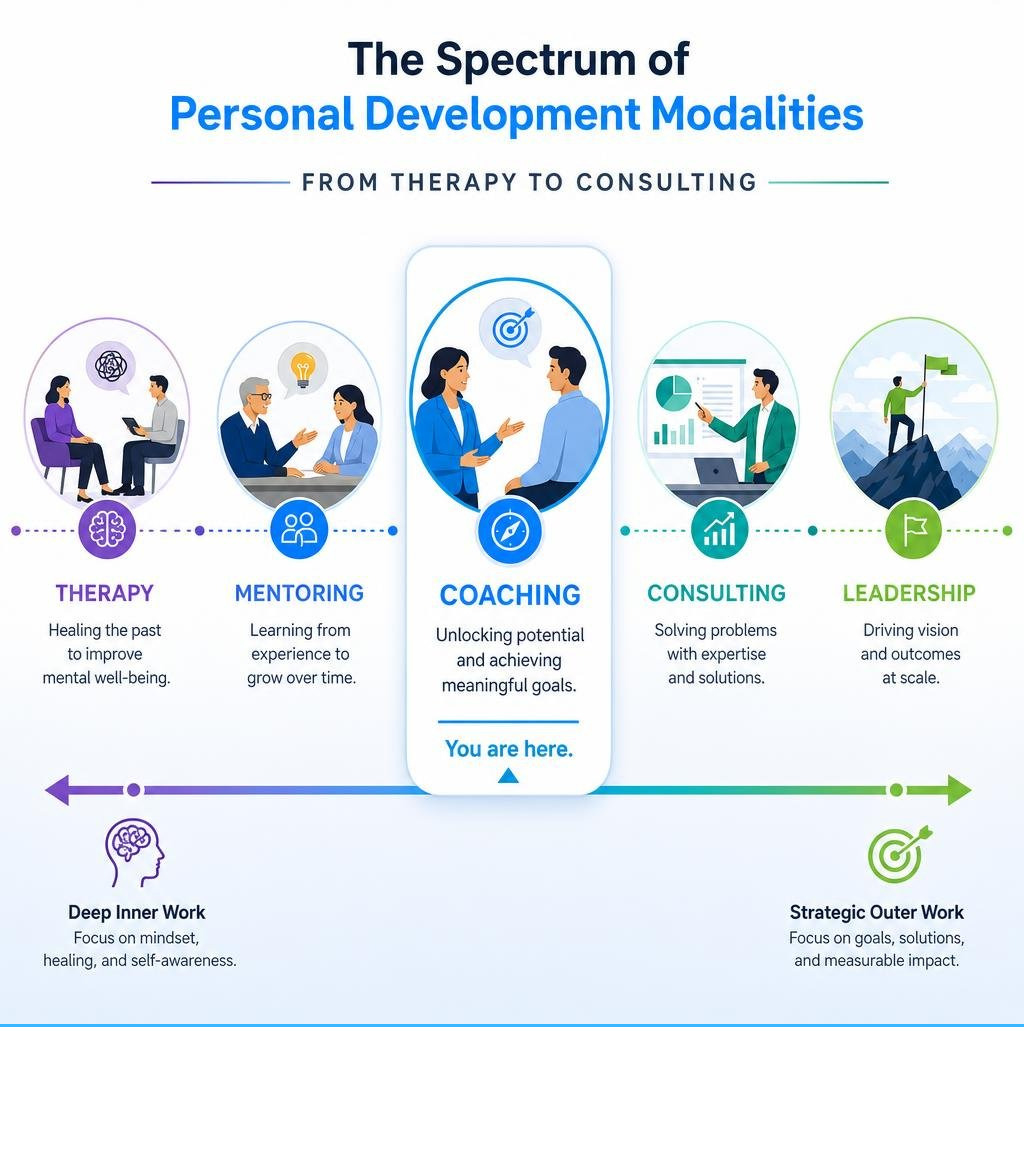
Here is a quick breakdown of the key differences:
| Modality | Primary Focus | Direction | Timeframe |
|---|---|---|---|
| Coaching | Goal-setting and behavioral change | Client-driven questions | Short-term (6–12 months) |
| Mentoring | Career guidance and wisdom transfer | Mentor shares experience | Long-term (years) |
| Therapy | Psychological healing | Clinician-led treatment | Varies by condition |
| Consulting | Expert analysis and solutions | Consultant delivers answers | Project-based (weeks) |
| Leadership | Institutional direction and outcomes | Leader decides and directs | Ongoing role |
These five approaches can look similar on the surface. But they operate on very different principles, serve different needs, and require different kinds of relationships.
Many people — including experienced professionals — use these terms interchangeably. That confusion is understandable. But it matters. Choosing a coach when you need a therapist, or a mentor when you need a consultant, means the right solution never reaches the right problem.
This guide breaks down every major coaching difference so you can make a smarter, faster decision about where to invest your energy.
Defining the Core: What is Professional Coaching?

To understand how professional coaching differs from other modalities, we first need to define what it actually is. The International Coaching Federation (ICF) defines coaching as partnering with clients in a thought-provoking and creative process that inspires them to maximize their personal and professional potential.
At its core, coaching is a process of self-directed learning. A professional coach does not step into your life to tell you what to do, hand you a generic blueprint, or fix your past. Instead, we use active listening, powerful questioning, and structured reflection to help you uncover your own solutions.
In a true coaching relationship, the client holds the agenda. The coach acts as a facilitator of change, helping you cultivate self-awareness and take personal responsibility for your progress. This makes coaching highly action-oriented and future-focused. Whether you are working with an executive coach to improve your leadership metrics or an online fitness coach to build sustainable physical habits, the underlying engine is the same: self-discovery paired with consistent accountability.
Historical Roots and Theoretical Influences
The distinctions we see today did not appear overnight. Professional coaching has been heavily shaped by its historical roots in psychotherapy, supervision, humanistic psychology, and behavioral change theories.
In the mid-20th century, humanistic psychologists like Carl Rogers championed the idea that individuals possess the internal resources needed for growth. This belief laid the groundwork for the modern coaching philosophy: the client is naturally creative, resourceful, and whole. Over the decades, coaching integrated goal-setting frameworks, cognitive-behavioral principles, and systemic supervision practices to transition from a corporate novelty to a scientifically backed discipline. To explore this evolution in detail, you can read the academic research on coaching history.
Understanding Key Coaching Differences Across Professional Disciplines
When we look at the landscape of personal and professional development, the boundaries between roles can easily blur. However, the operational differences are stark when you analyze their power dynamics, relationship structures, confidentiality levels, and stakeholder involvement.
To clarify these distinctions, let’s look at how these disciplines compare across key operational dimensions:
| Dimension | Coaching | Mentoring | Therapy | Consulting | Leadership |
|---|---|---|---|---|---|
| Power Dynamic | Lateral (Equal partners) | Semi-vertical (Experienced guide) | Clinical (Expert-client) | Expert-driven | Vertical (Hierarchical) |
| Primary Tool | Inquiry & reflection | Advice & storytelling | Clinical intervention | Analysis & blueprints | Direction & alignment |
| Confidentiality | High (Near-absolute) | Variable (Often internal) | Strict (Legal/HIPAA) | Contractual | Limited by role |
| Stakeholders | Often sponsored by organization | Primarily personal | Focused solely on client | Focused on business outcomes | Entire organization |
For a deeper dive into how these professional mandates function in corporate settings, check out this definitive guide to executive coaching vs mentoring.
Structural and Relationship-Based Coaching Differences
One of the most critical coaching differences lies in the power dynamic of the relationship. True coaching relies on a lateral power distribution. The coach and client stand on equal footing. The coach does not act as a superior or an all-knowing authority; instead, they co-construct the path forward with the client.
In contrast, mentoring and traditional leadership operate on a vertical hierarchy. A mentor is typically a senior figure who serves as a role model, utilizing advice-giving and personal storytelling to guide a less-experienced mentee. A leader or manager is responsible for organizational outcomes, which naturally introduces performance evaluation and supervisory authority into the dynamic.
When you work with an external, objective coach, you remove these hierarchical pressures. This objectivity allows for a level of vulnerability and radical honesty that is rarely possible with a boss or an internal mentor. You can explore how this dynamic changes the game in our article on objective online coaching benefits.
Operational and Methodological Coaching Differences
Methodologically, coaches do not hand you the answers. While a consultant is hired to analyze a problem and deliver a specific strategic recommendation, a coach uses a question-based methodology to help you design your own strategy.
Professional coaching also relies on diagnostic assessments and structured tracking to measure success. In business coaching, this might involve 360-degree feedback tools. In health and fitness coaching, it means tracking physical benchmarks, sleep quality, and movement patterns.
Without this data, you are just guessing. We believe that real transformation requires clear, unvarnished metrics. If you want to see how we build this into our physical training programs, read about the importance of tracking progress.
Coaching vs. Therapy: Navigating the Boundaries of Mental Health
Perhaps the most vital distinction to make is the boundary between coaching and psychotherapy. While both are highly transformative, person-centered modalities, they serve entirely different human needs.
The easiest way to understand this is through a neurological lens. Coaching operates primarily in the prefrontal cortex—the region of the brain responsible for executive function, goal setting, future planning, and conscious behavioral change.
Therapy, particularly trauma-informed care, often deals with subcortical regions of the brain (the amygdala, hippocampus, and brainstem). When an individual has unresolved trauma or deep nervous system dysregulation, their body remains in a state of survival (fight, flight, or freeze). In this state, the prefrontal cortex is offline. Behavioral goal-setting and accountability structures cannot take hold on a dysregulated nervous system.
Therapy focuses on psychological healing, resolving past wounds, and establishing baseline emotional stability. Coaching is designed for individuals who are already psychologically well-functioning and want to build toward future goals. To help you determine which support system fits your current state, review these therapy vs coaching readiness markers.
Scope of Practice and Licensing
The therapeutic field is strictly regulated by state licensing boards to protect public safety. Therapists must hold advanced degrees, complete thousands of hours of supervised clinical work, and adhere to strict legal frameworks to diagnose and treat mental health conditions.
The coaching industry, on the other hand, is currently unregulated. Anyone can call themselves a coach without formal training. This makes professional credentials and ethical boundaries incredibly important. An ethical coach knows their scope of practice and will immediately refer a client to a licensed clinician if symptoms of clinical anxiety, depression, or trauma arise.
For those interested in the professional standards of the wellness space, you can learn more about what goes into becoming a certified health coach.
Choosing the Right Path: When to Coach, Mentor, Consult, or Lead
Deciding which intervention you need depends entirely on the specific gap you are trying to bridge:
- Choose Coaching when you are functioning well but feel stuck, want to change repeating behavioral patterns, or need structured accountability to reach a high-stakes goal.
- Choose Mentoring when you need early career direction, industry-specific wisdom, or access to an established professional network.
- Choose Consulting when you have a technical or strategic business problem that requires expert analysis and immediate, actionable blueprints.
- Choose Leadership when you need to align a team, establish a shared vision, and drive collective execution toward organizational objectives.
To see how these styles play out in real-world leadership scenarios, check out this breakdown of leadership vs coaching styles.
Group Coaching vs. Individual Coaching
Once you decide that coaching is the correct path, you must choose the delivery format. Both individual (1-on-1) and group coaching offer unique advantages and limitations.
Group coaching leverages collective intelligence. Participants learn not only from the coach but also from the experiences, struggles, and breakthroughs of their peers. It provides a built-in community, which can lower the emotional barrier to change and make the journey feel less isolating. It is also a highly scalable and cost-effective option.
Individual coaching, however, offers unmatched personalization and deep psychological safety. In a 1-on-1 container, the coach can tailor every single prompt, physical movement, or strategic pivot to your exact lifestyle, biometric data, and psychological profile.
At Primedy Health, we utilize both approaches to help our clients build lasting physical strength and vitality. If you are curious about how we structure our local programs in Maryland, explore our in-person fitness coaching options.
Frequently Asked Questions about Coaching Differences
What is the main difference between coaching and mentoring?
The primary difference lies in the relationship dynamic, methodology, and timeframe. Mentoring is typically a long-term, relationship-driven process where a more experienced guide shares advice, personal stories, and career wisdom to help a mentee grow.
Coaching is generally a structured, short-term engagement (typically 6 to 12 months) focused on specific behavioral changes or performance goals. Instead of giving advice, a coach uses powerful questioning to help the client discover their own solutions. You can read more about these distinct leadership pathways in this guide on Coaching vs Mentoring: Key Differences for Leaders.
Can a manager or leader act as a formal coach?
While a manager can use a “coaching approach”—incorporating active listening and open-ended questions into their management style—they cannot act as a truly formal coach.
The vertical power dynamic and the manager’s role in performance evaluation make complete psychological safety difficult to achieve. Employees are naturally hesitant to share deep self-reflections or admit struggles to the person who decides their promotions, salary, or continued employment. For true, objective developmental coaching, an external professional is usually required.
How do sports coaching and business coaching differ?
Sports coaching relies heavily on active instruction, direct feedback, and shadowing. A sports coach stands on the sidelines, observes physical execution in real-time, and tells the athlete exactly how to adjust their form or strategy to win.
In business or health coaching, the coach remains in the background. We do not run onto the field to make the play for you. Instead, we facilitate your self-reflection and help you develop the internal awareness needed to self-correct during your daily life.
However, if you are looking for direct, hands-on sports instruction right here in our local Maryland community, you can check out Mount Airy MD track and field coaching for excellent local athletic options.
Conclusion
Navigating the landscape of personal growth becomes simple once you understand the core coaching differences. Whether you are looking to scale your business, heal your past, or transform your physical health, choosing the right modality is the secret to sustainable progress.
At Primedy Health, we bring professional coaching principles to physical strength and health. Based in Mount Airy, Maryland, and serving the Frederick and Carroll County communities, we don’t believe in generic, one-size-fits-all workout plans. We provide structured, sustainable, coach-led programs backed by objective progress tracking designed for real lives.
If you are ready to experience the difference that professional, objective coaching can make in your strength, energy, and daily life, explore our Primedy Health Coaching Services today. Let’s build something lasting together.