

The Strength Program That Actually Works for Real Life
5×5 strength training is one of the most proven methods for building serious strength — fast.
Here’s the quick version:
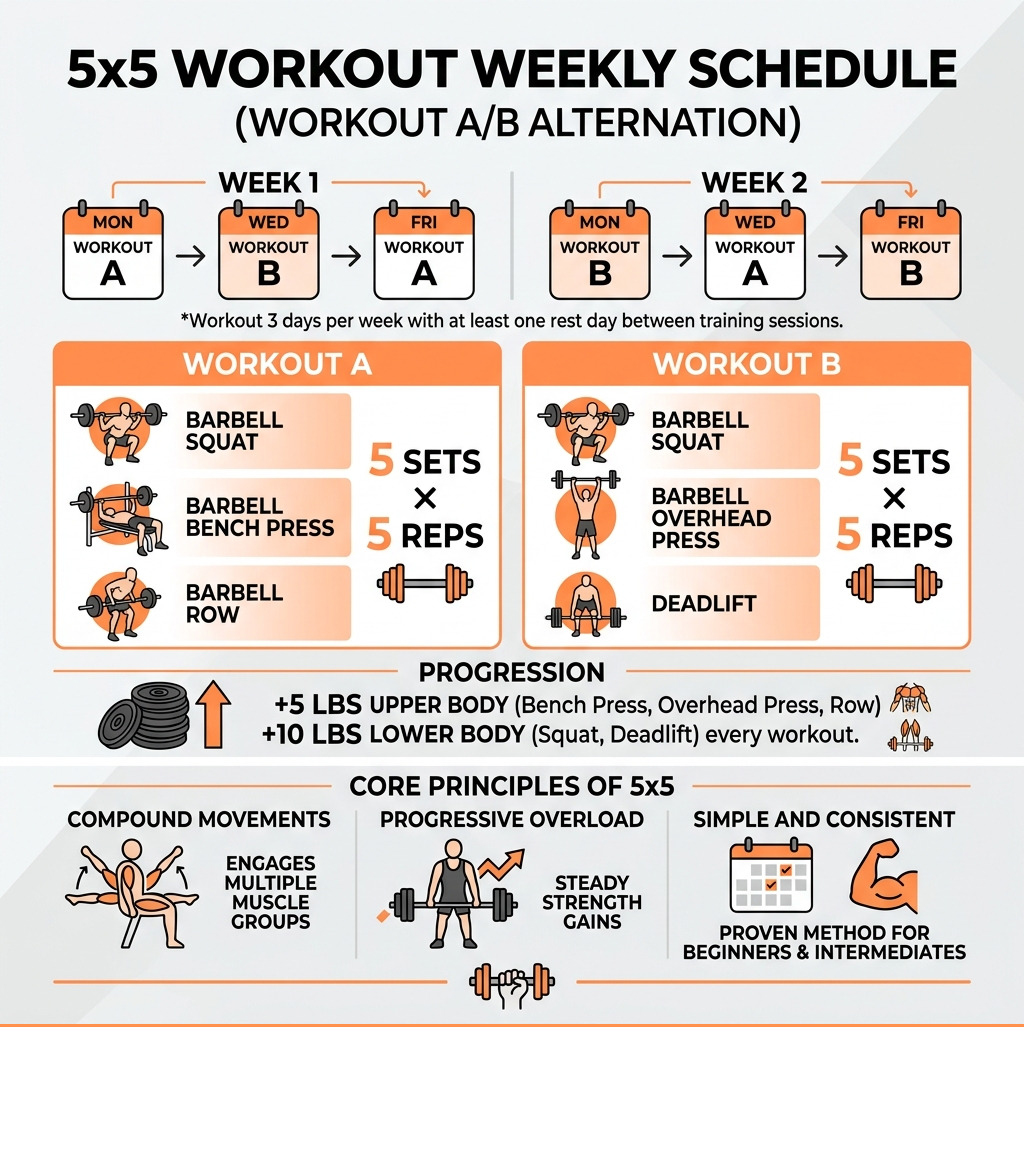
- What it is: 5 sets of 5 reps on compound barbell exercises, 3 days per week
- Core exercises: Squat, Bench Press, Barbell Row, Overhead Press, Deadlift
- How you progress: Add weight every workout (5 lbs on upper body, 10 lbs on lower body)
- Who it’s for: Beginners and intermediate lifters who want real, measurable strength gains
- How long it takes: Most people see strength gains within 2-3 weeks; significant results by 12 weeks
- Time per session: 45-60 minutes
That’s it. No complicated programming. No endless exercise rotations. Just five movements, consistent effort, and steady progress.
If you’ve ever started a fitness routine with full motivation, only to burn out three weeks later — you’re not alone. Most programs are either too complex, too time-consuming, or built for people who live in the gym.
5×5 is different. It’s built on two ideas that actually work: compound movements (exercises that train multiple muscle groups at once) and progressive overload (adding a little more weight each session). Together, these two principles drive strength gains that beginners and intermediates can see in weeks, not months.
The program has been around since the 1950s, refined by legendary strength coaches like Reg Park, Bill Starr, and others. In April 2026, it remains one of the most recommended starting points in strength training — not because it’s trendy, but because it works reliably, even for people with busy schedules and limited gym time.
The beauty of 5×5 is its simplicity. There’s nothing to figure out. You show up, lift, add weight, repeat.
The Core Principles of 5×5 Strength Training

At its heart, 5×5 strength training is a minimalist framework designed to maximize your “bang for your buck.” While many modern routines distract you with dozens of isolation movements like bicep curls or leg extensions, 5×5 focuses entirely on five multi-joint, compound exercises.
The set and rep scheme is exactly what the name suggests: five sets of five repetitions for each exercise. This adds up to 25 total reps per movement. This specific volume is widely considered the “sweet spot” for several reasons. It is high enough to provide the mechanical tension needed for muscle growth (hypertrophy) but low enough that you can handle relatively heavy weights to trigger neural adaptations—teaching your brain how to recruit more muscle fibers simultaneously.
The frequency is equally important. You train just 3 days per week (for example, Monday, Wednesday, and Friday), with at least one full day of rest between sessions. This schedule respects the reality that your muscles don’t grow while you’re lifting; they grow while you’re recovering. For those of us in Mount Airy or Frederick balancing work and family, this 3-day split is incredibly sustainable. If you want to dive deeper into the mechanics of these lifts, check out How to Get Stronger with These Barbell Strength Workouts.
Why 5×5 Strength Training is Ideal for Beginners
If you are new to the barbell, 5×5 is your best friend. The high frequency of the main lifts—especially the squat, which you perform every single workout—acts as “practice.” Strength is a skill, and by performing these movements three times a week, you’re constantly refining your technique.
The most exciting part for beginners is linear progression. Because you start with relatively light weights, you can add 5 to 10 pounds to the bar every single session. Research shows that beginners can see average strength gains of 30-50% on their main lifts within just 12 weeks. It’s not uncommon to see a squat go from 135 lbs to 230 lbs in a matter of months. For those who feel intimidated by the gym environment, our Virtual 1-on-1 Training can help you master these basics from the comfort of your home.
Common Mistakes in 5×5 Strength Training
Even a simple program can go off the rails if you let your ego take the driver’s seat. The most frequent mistake we see is “ego lifting”—starting with weights that are too heavy. If you start at your maximum capacity, you’ll hit a wall within two weeks. The 5×5 method works best when you start light (often with just the empty 45lb bar) and build momentum.
Other pitfalls include:
- Skipping Rest: As the weights get heavy, you need 3–5 minutes of rest between sets to allow your ATP (energy) stores to replenish.
- Poor Form: Sacrificing depth on a squat just to add more weight is a recipe for injury, not strength.
- Overtraining: Adding extra “beach work” or daily cardio can interfere with the recovery needed for the heavy lifting.
To stay on track, we recommend Progress Tracking to ensure your numbers are moving in the right direction without compromising safety.
The 5×5 Workout Structure: Workout A vs. Workout B

The program alternates between two full-body workouts. You never do the same workout two days in a row. This ensures that while you are hitting your whole body, you aren’t overtaxing specific muscle groups every single session.
| Exercise | Workout A | Workout B |
|---|---|---|
| Squat | 5 Sets of 5 Reps | 5 Sets of 5 Reps |
| Pressing | Bench Press (5×5) | Overhead Press (5×5) |
| Pulling | Barbell Row (5×5) | Deadlift (1 Set of 5) |
You’ll notice the Deadlift is the exception to the rule, performed for only 1 set of 5 reps. Why? Because heavy deadlifts are incredibly taxing on the Central Nervous System (CNS). Since you are already squatting 5×5 every workout, one heavy set of deadlifts is more than enough to drive progress without burning you out.
Exercise Technique and Safety Tips
Safety is paramount when moving heavy iron. For all these lifts, maintaining a neutral spine and proper bracing (creating internal pressure in your core) is non-negotiable.
- Squats: Aim for “below parallel” depth, where the hip crease drops below the top of the knee. This ensures full glute and hamstring engagement.
- Bench Press: Keep your shoulder blades retracted (tucked back) to protect your rotator cuffs. A slight arch in the lower back is natural and safe, provided your glutes stay on the bench.
- Barbell Rows: Focus on pulling with your elbows and keeping your torso relatively stationary to avoid using momentum.
If you’re unsure about your form, our Personal Training in Carroll County provides the expert eyes you need to lift with confidence.
Equipment Essentials for Success
One of the reasons 5×5 is so accessible is the minimal equipment required. You don’t need fancy machines; you just need the basics:
- Power Rack: Essential for safety, especially for squats and overhead presses.
- Olympic Barbell: A standard 45lb (20kg) bar.
- Weight Plates: A mix of 45, 25, 10, 5, and 2.5lb plates.
- Flat Bench: For the bench press.
- Lifting Shoes: Hard-soled shoes (like Chuck Taylors or dedicated lifters) provide a stable base, unlike squishy running shoes.
For those training at home in Frederick or Mount Airy, we offer Pre-designed Programs that help you make the most of whatever equipment you have available.
Mastering Progression and Overcoming Plateaus
The magic of 5×5 strength training isn’t in the first workout; it’s in the twentieth. You start with weights that feel “laughably light.” This is intentional. It allows your joints, tendons, and ligaments to adapt along with your muscles.
The standard progression is:
- Add 5 lbs to the Squat, Bench, Row, and Overhead Press each workout.
- Add 10 lbs to the Deadlift (until it gets heavy, then drop to 5lb increments).
Consistent logging is vital. You need to know exactly what you lifted last time to know what to lift today. Learn How to Track Your Workout Results Without Losing Your Mind to keep your data organized.
Handling Failed Sets and Deloads
Eventually, the “newbie gains” will slow down, and you will miss a rep. Maybe on your fourth set of Overhead Press, you only get 4 reps instead of 5. Don’t panic.
We follow the Three-Strike Rule:
- If you fail to get 5×5 at a certain weight, try it again next workout.
- If you fail three workouts in a row at that same weight, it’s time to deload.
- Reduce the weight by 10% and work your way back up.
This reset allows fatigue to dissipate while you build more muscle mass at a slightly lower intensity. For more complex sticking points, Customized Virtual Programming can provide the specific adjustments needed to break through.
Nutrition and Recovery for Maximum Gains
You cannot build a skyscraper without enough bricks. To see the 30-50% strength increases possible with 5×5, you must support your body.
- Calories: Most lifters need a slight caloric surplus (200-300 calories above maintenance).
- Protein: Aim for 1.6g to 2.2g of protein per kilogram of body weight to support muscle repair.
- Sleep: This is your primary recovery tool. Aim for 7-9 hours of high-quality sleep.
- Hydration: Drink 3-4 liters of water daily, especially as your workouts get more intense.
If your progress stalls, it’s often a recovery issue rather than a program issue. Having an objective perspective helps, which is Why Your Next Coach Should Be Online and Objective.
Frequently Asked Questions
How long should I stay on a 5×5 program?
Most lifters can run a 5×5 program for 3 to 6 months before the linear progression ends. You’ll know it’s time to switch when you’ve deloaded the same lift 2-3 times and still can’t move past the plateau. Common benchmarks for switching to an intermediate program (like Madcow 5×5) include squatting 1.5x your body weight or benching 1x your body weight.
Can I add cardio or accessory exercises to 5×5?
Yes, but be strategic. Low-intensity cardio (like walking or light cycling) on rest days is great for active recovery. You can add 2-3 sets of chin-ups or dips at the end of your workouts for extra arm and back development. However, avoid high-intensity interval training (HIIT) on the days before heavy squats, as it can cause an “interference effect” that stunts your strength gains.
What is the difference between 5×5 and 3×5 programs?
Programs like Starting Strength use a 3×5 (3 sets of 5 reps) model. The main difference is volume vs. intensity. 5×5 provides more total volume, which is excellent for building foundational muscle mass. 3×5 allows you to lift slightly heavier weights for longer because there is less accumulated fatigue per session. Many lifters actually transition from 5×5 to 3×5 as they get stronger to keep the weight on the bar moving up.
Conclusion
5×5 strength training remains the “King” because it strips away the fluff and focuses on what actually moves the needle: heavy compound lifts and consistent progression. It’s a sustainable, objective way to transform your physical capability, whether you’re a busy parent in Mount Airy or an athlete in Frederick.
At Primedy Health, we specialize in making these high-impact programs work for “real lives.” We provide the structure, the tracking, and the expert coaching—both in-person and online—to ensure you never have to guess if you’re doing it right. Strength training isn’t just about the gym; it’s about making everyday life feel easier.
Ready to see what your body is truly capable of? Everything You Need to Know About In-Person Fitness Coaching can help you decide if a hands-on approach is right for you.
Start your sustainable strength journey today and let us help you build a foundation that lasts a lifetime.