
Why Most Home Workouts Fail — and What Structured Programs Do Differently
Home gym strength programs give you a clear, repeatable system for building muscle and strength without a commercial gym membership. But with so many options out there, choosing the right one is genuinely confusing.
Here’s a quick comparison of the most common types to help you decide fast:
| Program Type | Best For | Equipment Needed | Weekly Days |
|---|---|---|---|
| Bodyweight full body | Complete beginners | None | 2-3 |
| Dumbbell full body | Beginners to early intermediate | Dumbbells (+ optional bench) | 3 |
| Upper/Lower split | Intermediate lifters | Dumbbells or barbell | 4 |
| Barbell-based (e.g. 5/3/1, GZCLP) | Intermediate to advanced | Barbell, rack, bench | 3-4 |
| Bands + bodyweight | Limited space or budget | Resistance bands | 2-3 |
If you’re in your 30s, 40s, or 50s and you’ve tried building a workout habit before — only to lose momentum after a few weeks — you’re not alone. The problem usually isn’t effort or motivation. It’s the absence of a structured plan.
Random workouts don’t build strength reliably. They skip progressive overload. They leave muscle groups undertrained. And without a clear roadmap, it’s easy to stall out or give up entirely.
The good news: the research is clear. Strength training as little as two to three times per week, with proper progression, is enough to build real muscle and improve your health. You don’t need a fancy gym. You need a program that matches your goals, your schedule, and the equipment you actually have.
This guide compares the best home gym strength programs available in 2026 — from beginner-friendly bodyweight plans to structured barbell progressions — so you can find the one that fits your life and start making consistent progress.
Home gym strength programs word roundup:
How to Choose the Right Home Gym Strength Programs
The best program is not the one with the coolest name, toughest finisher, or most complicated spreadsheet. It is the one you can follow consistently for months.
When we help people choose among home gym strength programs, we look at five things first:
- Goal: strength, muscle gain, fat loss, general health, or longevity
- Experience: beginner, intermediate, or advanced
- Equipment: bodyweight, bands, dumbbells, or full barbell setup
- Schedule: 2, 3, or 4 training days per week
- Recovery: sleep, stress, soreness, and real-life chaos
A good plan should also train the major movement patterns regularly:
- Squat
- Hinge
- Push
- Pull
- Carry or core bracing
And most importantly, it needs progressive overload baked in. That means you are gradually doing more over time through weight, reps, sets, tempo, or improved control. No progression, no real roadmap. Just sweaty guessing.
Match home gym strength programs to your goal
Different goals need slightly different programming.
- For pure strength, prioritize lower rep compound lifts and longer rest periods.
- For muscle gain, use moderate reps, enough weekly volume, and steady progression.
- For fat loss, the training can look similar to muscle-building plans, but nutrition drives the calorie deficit.
- For general health and longevity, simple full-body training done consistently works extremely well.
Public health guidance supports strength training at least twice per week, and this matters for more than appearance. Regular strength work can help reduce heart and circulatory disease risk while also supporting balance and mental wellbeing. In other words, lifting a dumbbell in your spare room is not just a vanity project.
Choose by equipment and space
Your program should fit what you own now, not what your dream garage gym might look like next year.
- Bodyweight only: best for total beginners, travel, or very small spaces
- Dumbbells: the best starting point for most home trainees
- Bands: useful for rows, presses, pulldowns, and assistance
- Bench: helpful, but optional at first
- Barbell and rack: ideal if strength is your main sport and you have room to progress load
A tiny apartment corner can handle goblet squats, floor presses, split squats, rows, push-ups, and carries. A garage setup opens the door to heavier squats, presses, and deadlifts. Both can work. The difference is mostly load ceiling and exercise specificity.
Pick a schedule you can actually sustain
Research and coaching experience both point to a simple truth: 2 to 4 workouts per week is the sweet spot for most adults.
- 2 days: great for busy beginners
- 3 days: ideal for most people using full-body training
- 4 days: strong option for intermediates using upper/lower splits
Missed a workout? Do not turn one missed Tuesday into a dramatic training funeral. Just continue with the next session. Adherence beats perfection every time.
Best Home Gym Strength Programs by Experience Level

A beginner and an advanced lifter should not run the same plan. One needs skill practice and simple progression. The other needs smarter volume management and deloads.
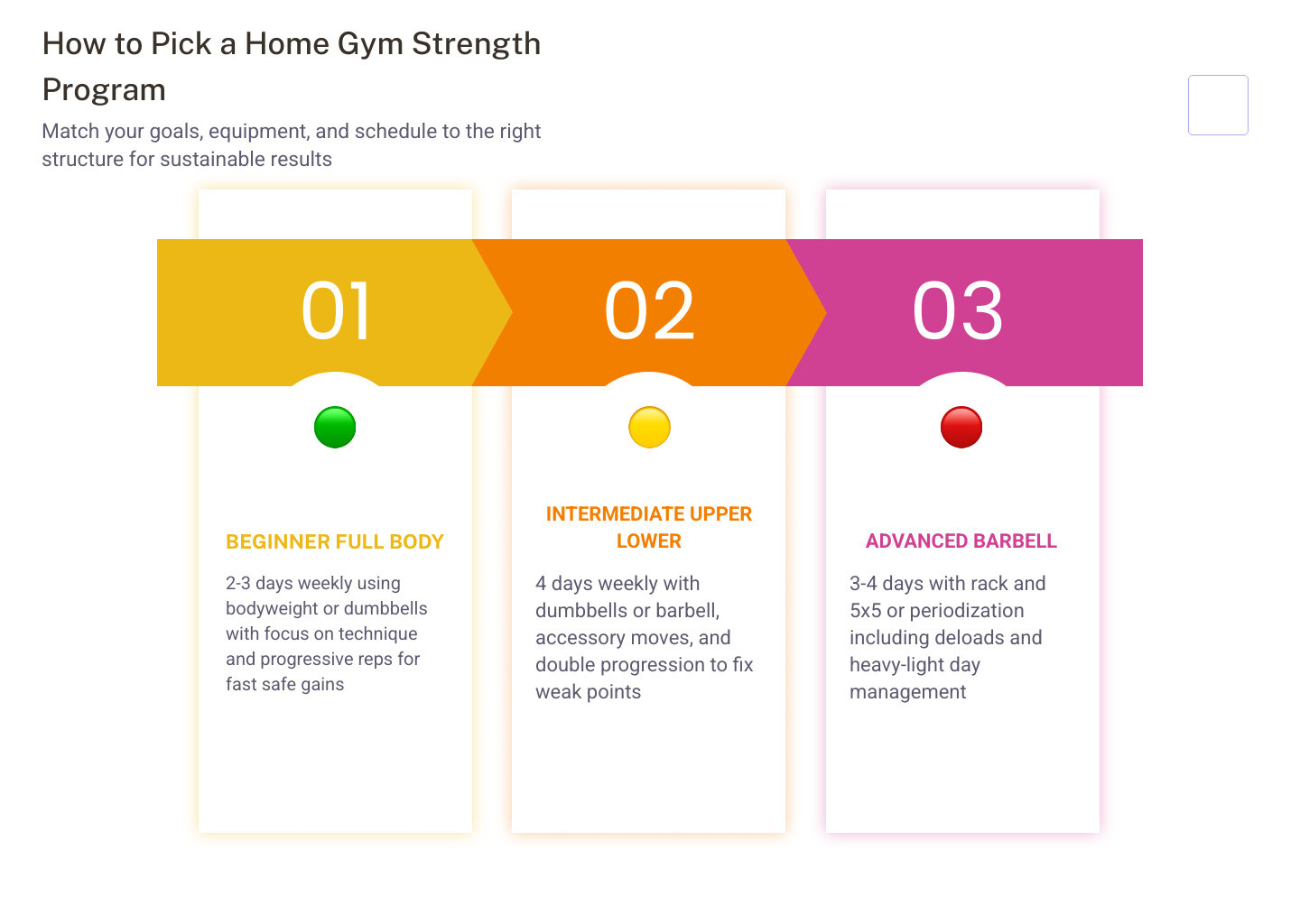
Best beginner home gym strength programs for fast, safe progress
Beginners do best with full-body programs 2 to 3 times per week. Each session should include the basics:
- Squat pattern
- Push pattern
- Pull pattern
- Hinge pattern
- Carry or core
Think goblet squats, push-ups, one-arm rows, Romanian deadlifts, and farmer carries.
Keep the focus on technique first. Use light to moderate weights, move with control, and leave a couple of reps in reserve rather than grinding every set into oblivion. Recording your lifts and comparing them to reliable demos can help a lot when training alone.
A simple beginner split looks like this:
- Monday: full body A
- Wednesday: full body B
- Friday: full body A
For a deeper beginner-friendly approach, see our guide on beginner strength training at home.
Best home gym strength programs for intermediate lifters
Once you have mastered basic form and can progress week to week, an upper/lower split often makes more sense.
Why it works:
- More total weekly volume
- Better recovery between similar lifts
- More room for accessory work
- Easier weak-point training
A classic 4-day setup:
- Monday: upper
- Tuesday: lower
- Thursday: upper
- Friday: lower
This level benefits from double progression. Example: use 3 sets of 6 to 10 reps, and once you hit 10 reps on all sets with good form, increase the load next time. It is simple, effective, and much less exciting than “muscle confusion,” which is good because your muscles are not toddlers needing enrichment toys.
For more structure, read our step-by-step guide to strength training programming.
Best advanced home gym strength programs when progress slows
Advanced lifters usually need more than “just add weight every workout.”
At this stage, useful tools include:
- Periodization
- Heavy and light days
- Planned deloads every 4 to 7 weeks
- Set targets by movement pattern
- Exercise rotation when equipment limits load
A 5×5 phase can still be valuable for compound lifts, especially when strength is the priority. But advanced home lifters also need to manage fatigue and load ceilings carefully, especially if they only have dumbbells at home.
Our guide to compound strength progression and 5×5 training covers this in more detail.
Home Gym Strength Programs for Minimal Equipment That Still Build Muscle
Minimal equipment does not mean minimal results. If you train hard, progress logically, and recover well, you can build a lot of muscle with very little gear.
Dumbbell-only home gym strength programs
For most people, adjustable dumbbells are the best home training investment. They cover nearly every major movement pattern and make progressive overload much easier.
A dumbbell-only plan usually works best as a 3-day full-body routine over 8 to 12 weeks. Core lifts might include:
- Goblet squat or split squat
- Dumbbell Romanian deadlift
- Floor press or bench press
- One-arm row
- Overhead press
- Loaded carry
- Curl, lateral raise, or triceps extension as accessories
Progression is straightforward:
- Add reps within a target range
- Add load when all sets hit the top of the range
- If dumbbells are maxed out, slow the lowering phase or add pauses
- Add a set only if recovery still looks good
Bench optional, not mandatory. Floor presses, supported rows, and split squats can carry a lot of your progress. For more ideas, see our guide to customized strength training plans.
Resistance band and bodyweight home gym strength programs
Bands and bodyweight are excellent for beginners, joint-friendly training, and low-space setups.
Useful exercises include:
- Band rows
- Band chest presses
- Band pulldowns
- Push-ups
- Glute bridges
- Reverse lunges
- Split squats
- Planks and dead bugs
- Carries with household items
If load is limited, increase challenge with:
- Slower tempo
- Pauses
- Higher reps
- Shorter rest periods
- Unilateral variations
Even household items can work early on. Water jugs, backpacks, and shopping bags are not glamorous, but your muscles do not care whether the resistance comes from a premium dumbbell or a backpack full of books.
When a barbell home setup makes sense
A barbell setup makes the most sense when:
- Strength is your main goal
- You have enough space
- You want long-term load progression
- You enjoy the main barbell lifts
At minimum, a useful setup includes:
- Rack
- Barbell
- Plates
- Bench
- Safeties
This gives you access to squats, presses, deadlifts, rows, and bench work with much more loading potential than dumbbells alone. If that is your direction, our guide to barbell strength workouts is a good next read.
Sample 4-Week, 8-Week, and 12-Week Home Strength Plans

Here is a simple comparison:
| Plan Length | Best For | Weekly Schedule | Main Progression |
|---|---|---|---|
| 4 weeks | Beginners learning basics | 3 full-body days | Add reps, improve form |
| 8 weeks | Most home lifters | 3 full-body or 4 upper/lower | Add reps, then load |
| 12 weeks | Long-term progression | 3 to 4 days | Volume, load, tempo, deloads |
A simple 4-week starter plan for beginners
Train 3 non-consecutive days per week.
Workout A:
- Goblet squat: 3 x 8-12
- Push-up or floor press: 3 x 8-12
- One-arm row: 3 x 8-12
- Glute bridge or RDL: 3 x 10-12
- Carry or plank: 3 rounds
Workout B:
- Split squat: 3 x 8-10 each side
- Overhead press: 3 x 8-10
- Band row or dumbbell row: 3 x 10-12
- Hip hinge variation: 3 x 8-12
- Dead bug or side plank: 3 rounds
Rules:
- Rest at least one full day between sessions
- Start with weights you can control
- Add reps before adding weight
- Swap movements if equipment is limited
An 8-week muscle-and-strength plan for most home lifters
Weeks 1-4:
- 3 sets of 8-12 on main lifts
- Practice full range of motion
- Stop 1 to 3 reps short of failure
Weeks 5-8:
- Move to 4 sets of 6-10 on main lifts
- Add load where possible
- Keep accessories at 8-15 reps
This can be run as 3 full-body sessions or 4 upper/lower days. Add active recovery on off days with walking or mobility work. Protein intake matters here too. A practical target for many lifters is roughly 1.6 to 2.2 grams of protein per kilogram of bodyweight, alongside enough calories to support the goal.
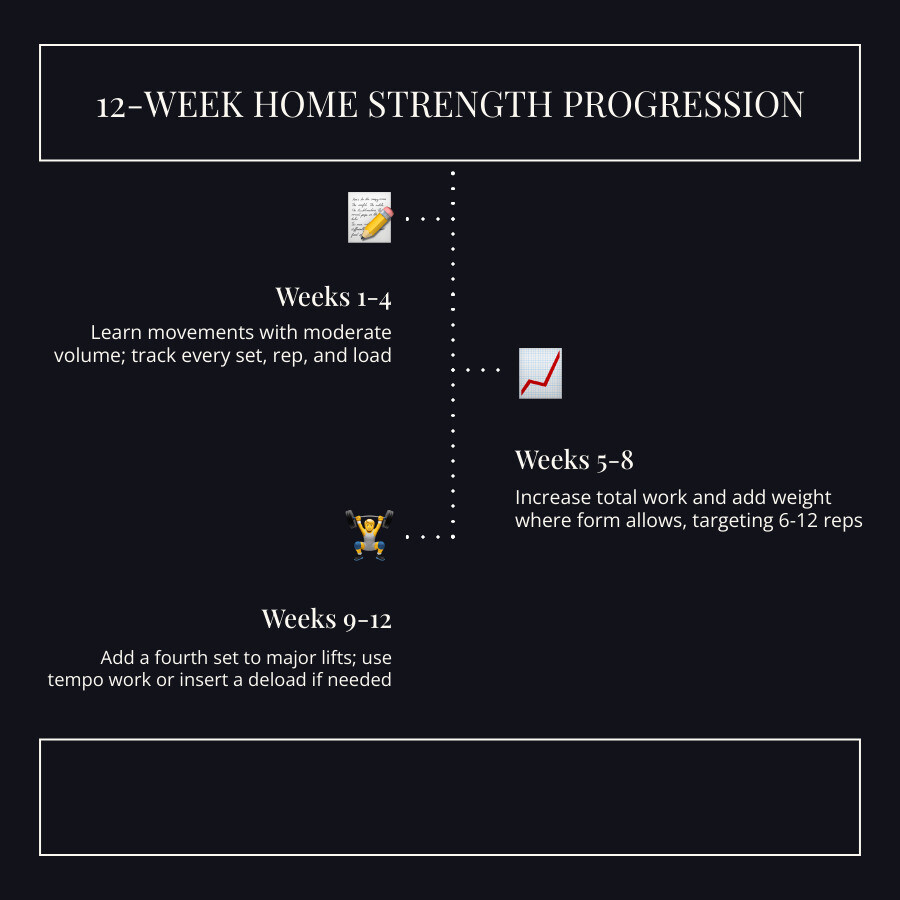
A 12-week progression framework for long-term results
Weeks 1-4:
- Learn the movements
- Keep volume moderate
- Track every set, rep, and load
Weeks 5-8:
- Increase total work slightly
- Add weight where form allows
- Use rep targets like 6-10 or 8-12
Weeks 9-12:
- Add a fourth set to major lifts if recovery is solid
- Use tempo work when equipment gets too light
- Insert a lighter deload week if performance dips
Track these metrics:
- Loads used
- Reps achieved
- Bodyweight if relevant
- Sleep
- Session energy
- Joint discomfort
What Makes Structured Programs More Effective Than Random Home Workouts
Why structured plans outperform DIY workouts
Structured plans win because they organize the basics correctly:
- Exercise order puts demanding lifts first
- Weekly volume is balanced
- Push and pull work stay more even
- Progression rules are built in
- Recovery is planned
- You spend less mental energy deciding what to do
That last point matters. Decision fatigue is real. If every workout begins with “What should I do today?” you are already making training harder than it needs to be.
A structured plan also helps avoid common mistakes like overtraining chest and arms while accidentally ignoring hamstrings, upper back, and actual leg strength.
Training frequency, nutrition, and recovery for real strength gains
Most people do best with:
- Minimum: 2 strength sessions per week
- Sweet spot: 3 to 4 sessions per week
- Recovery: at least one day between hard sessions for the same muscle groups
For food and recovery, keep it simple:
- Protein: enough to support repair and growth
- Calories: deficit for fat loss, maintenance or surplus for muscle gain
- Sleep: 7 to 9 hours
- Hydration: consistently adequate
- Rest days: use for walking, mobility, or actual rest
Results come from consistency plus progressive overload. Not from one perfect week followed by two weeks of soreness, excuses, and “I’ll restart Monday.”
Ways to get support for home strength training
Support can make the difference between stopping at week three and still progressing at month six.
Helpful support tools include:
- Training logs
- Video demos
- Form feedback
- App-based tracking
- Accountability check-ins
Research also suggests mobile apps can help people stay more physically active, which is one reason digital coaching and progress tracking can work so well. At Primedy Health, we build coach-led programs with objective tracking and real-life flexibility, whether you train in person or online. Learn more about our training services.
Frequently Asked Questions About Home Gym Strength Programs
How should beginners start strength training at home safely?
Start with a 5-minute warm-up, then use controlled reps on basic movements. Breathe steadily, do not hold your breath, and avoid rushing. Begin with light weights and focus on technique before intensity.
A few practical rules:
- Warm up before every session
- Use slow, controlled movement
- Record your form occasionally
- Stop a little short of failure at first
- Increase challenge gradually
If something feels sharp, unstable, or clearly wrong, stop and adjust. Mild effort is good. Weird pain is not a badge of honor.
How often should you train for strength in a home gym?
At least twice per week is a good minimum. Three full-body days per week is ideal for many beginners and intermediates. A 4-day upper/lower split works well once recovery, skill, and schedule allow it.
Good recovery signs:
- Performance is stable or improving
- Soreness fades within a day or two
- Sleep is decent
- Motivation is not crashing
Are home gym programs as effective as gym-based programs?
Yes, if the same training principles are applied.
Strength and muscle gains come from:
- Sufficient resistance
- Progressive overload
- Enough weekly volume
- Good technique
- Recovery and nutrition
A commercial gym offers more equipment variety and heavier loading options. A home setup often wins on consistency, convenience, and fewer skipped sessions. For many adults, that consistency advantage is huge. The best program is the one that actually happens.
For outside perspective on choosing formats and equipment tiers, this guide on best training programs for home gyms is also useful, and beginners who want a dumbbell-focused progression can compare approaches in this 12-week beginner dumbbell workout plan.
Conclusion: Build a Program You Can Follow for Years
The best home gym strength programs are not the most extreme. They are the most sustainable.
If your plan matches your goals, equipment, and schedule, you can build impressive strength at home with bodyweight, dumbbells, bands, or a full barbell setup. The big rocks stay the same: train consistently, progress gradually, recover well, and track what you do.
At Primedy Health, we help people in Mount Airy, Frederick, and Carroll County build structured strength routines that fit real life, not fantasy life. If you want support, accountability, and a program built around sustainable results, explore our training services.