
Why Objective Health Coaching Metrics Define Real Progress
objective health coaching metrics are the measurable, data-backed indicators used to track whether a health coaching program is actually working — for individuals and organizations alike.
Here are the core categories at a glance:
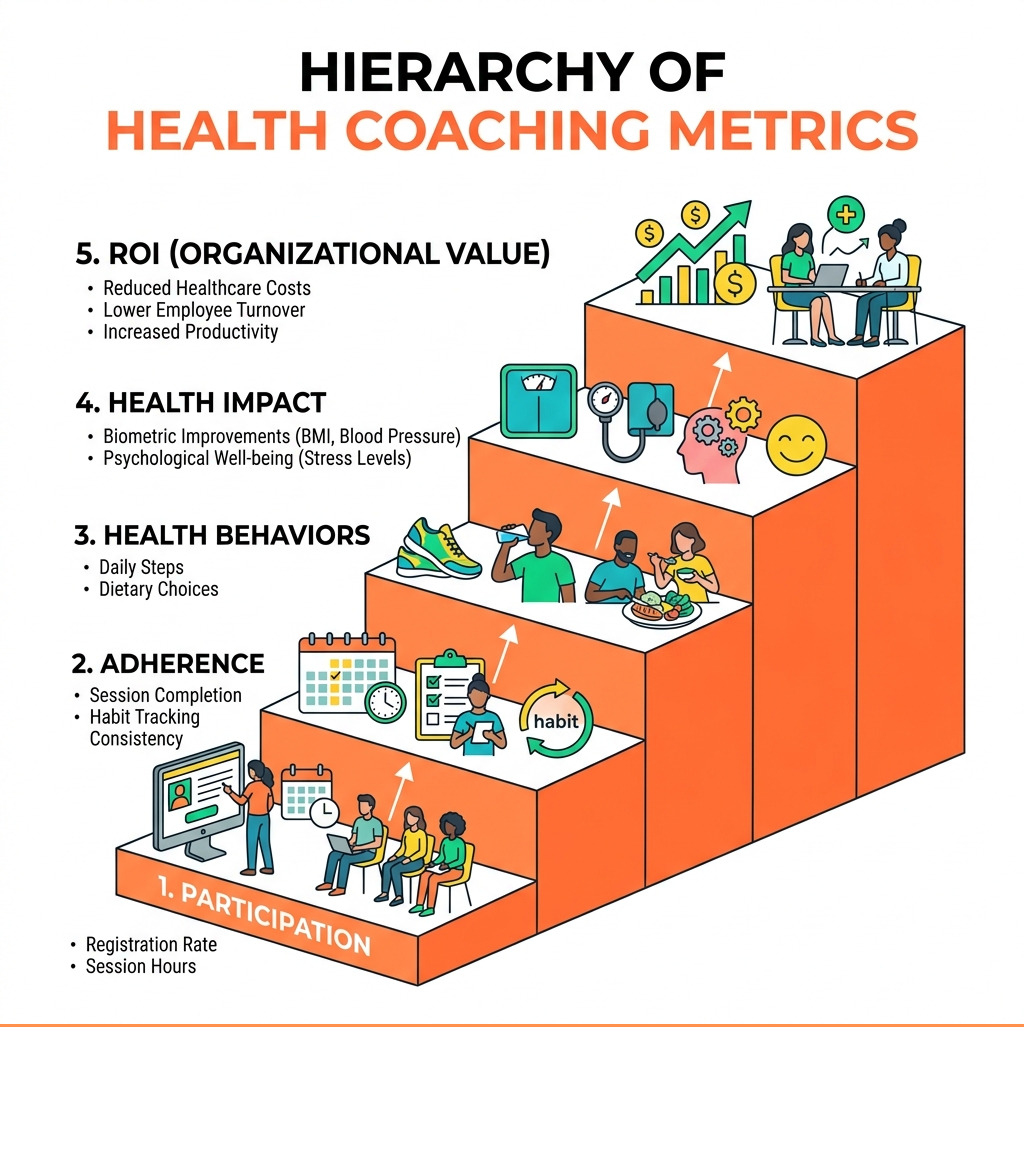
| Metric Category | What It Measures | Examples |
|---|---|---|
| Participation | Who shows up and how often | Registration rate, session hours |
| Adherence | Consistency with the plan | Session completion, habit tracking |
| Health Behaviors | Lifestyle changes | Steps per day, dietary choices |
| Physical Health | Biometric improvements | BMI, blood pressure, glucose |
| Psychological Outcomes | Mental well-being | Stress levels, self-efficacy, mood |
| Satisfaction | Program experience | Participant ratings, feedback |
| Organizational Value | Business impact | Healthcare costs, employee turnover |
Most people come to health coaching with goals that sound like “I want to feel better” or “I need to lose weight.” Those intentions are real — but without clear, measurable benchmarks, it’s nearly impossible to know if anything is actually changing.
The problem isn’t motivation. It’s measurement.
Without the right metrics, programs get cut, coaches can’t adjust their approach, and participants lose confidence when progress feels invisible. A meta-analysis found that structured wellness coaching led to statistically significant reductions in dietary fat intake and favorable BMI changes — but those results only become visible when you’re tracking the right things from the start.
This guide breaks down every major category of health coaching metrics — from participation rates to biometric data to organizational value — so you can build a program (or evaluate one) with confidence.
Core Categories of Objective Health Coaching Metrics
When we look at the success of a health coaching initiative, we have to move beyond “gut feelings.” Whether we are working with a single client in Mount Airy or managing a corporate wellness program across Carroll County, we categorize success into distinct, measurable buckets.
At Primedy Health, we believe that Progress Tracking is the heartbeat of any sustainable lifestyle change. To truly understand the impact of a program, we look at the 7 Core Metrics To Measure An Employee Health Coaching Initiative, starting with how people actually interact with the service.
Measuring Participation Breadth and Depth
Participation isn’t just a “yes or no” question. We divide it into two categories: breadth and depth.
- Participation Breadth: This is the registration rate. It tells us how many people signed up. If this number is low, we ask: Is the program being promoted frequently? Do people know it’s a subsidized benefit? In our experience, low breadth usually points to a communication gap rather than a lack of interest in Health Coaching.
- Participation Depth: This measures the “dose” of coaching. Are participants getting enough time with their coach to actually see a difference? If a participant only checks in for five minutes once a month, they aren’t reaching the depth required for behavioral change. We track total interaction hours and session frequency to ensure the “dosage” is therapeutic.
Adherence as a Predictor of Success
Adherence is the bridge between a good plan and a good result. In objective health coaching metrics, adherence measures how closely a participant follows the agreed-upon roadmap.
We look at:
- Session Consistency: Are they showing up for their Virtual 1-on-1 Training or in-person sessions?
- Behavioral Initiation: Did they actually start the new habit (e.g., walking 10 minutes a day) within the first week?
- Accountability Systems: Are they using the tracking tools provided?
If adherence is low, it’s often a sign that the goals weren’t “SMART” enough or that there’s a coach-client personality clash. Research shows that high-quality coaches who use motivational interviewing can significantly boost adherence by helping clients identify their own barriers before they become “stop signs.”
Evaluating Health Impacts and Behavioral Change
The ultimate goal of any health intervention is a healthier human. However, “health” is a broad term. To make it objective, we look at both what a person does (behavioral metrics) and what their body is (biometric metrics).

Physical Health vs. Behavioral Metrics
It is easy to get obsessed with the scale, but weight is often a lagging indicator. We prefer to track a mix of metrics to get a full picture of Personal Training success.
- Biometric Data: These are the hard numbers. We look at blood pressure, fasting glucose levels, and BMI alterations. A meta-analysis has shown that wellness guidance can lead to minor but statistically significant decreases in dietary fat consumption and favorable changes in BMI compared to doing nothing at all.
- Behavioral Metrics: These track habit formation. Are you hitting your step goals? Are you choosing nutrient-dense foods? For many of our members with Health Club Memberships, seeing their “habit streak” grow is more motivating than the number on the scale.
According to the Understanding Health Coaching: Definition, Origins, and Key Components research, health coaching is unique because it focuses on the “whole person,” including mental wellness and self-efficacy. Self-efficacy—the confidence in one’s ability to manage lifestyle choices—is a critical objective metric that we track through validated surveys.
Utilizing Objective Health Coaching Metrics for Stress Management
In April 2026, stress management has become a top priority for Maryland employers. We use Heart Rate Variability (HRV) as a primary objective metric for stress.
HRV is a reliable way to measure the autonomic nervous system’s response to stress. In recent Research on HRV in workplace interventions, researchers used a simplified HRV index (0-100 scale) to help participants understand their stress levels.
- Daily Resting HRV: Measured in the morning to track overall recovery.
- Momentary HRV: Measured during high-stress moments to trigger a mindfulness intervention.
By using these objective health coaching metrics, we can move a client from “feeling stressed” to “seeing the stress” on a graph, which makes the Consultation process much more effective.
Goal Setting Frameworks: Process vs. Outcome Goals
One of the biggest mistakes in health coaching is only tracking outcome goals. If your only metric is “lose 20 pounds,” you might feel like a failure for the first 10 weeks while your body is actually making massive internal adjustments.
Applying SMART Goals as Objective Health Coaching Metrics
To keep morale high, we use SMART Goals: The Health Coaching Cheat Code to break down big visions into manageable steps.
- Specific: “I will walk after lunch” vs. “I will be more active.”
- Measurable: “I will walk for 15 minutes.”
- Achievable: If you haven’t exercised in years, 15 minutes is better than 60.
- Relevant: Does this help your blood pressure?
- Time-bound: “I will do this Monday through Friday for the next 3 weeks.”
By focusing on these controllable behaviors, we boost client autonomy and resilience. When progress on the scale is slow, these process goals keep the momentum going.
Tracking Subjective Outcomes with Objective Scales
How do you measure “energy” or “mood” objectively? We use 1-10 scales. While the data is self-reported, it becomes an objective metric when tracked over time.
For example, a client might start their Customized Virtual Programming rating their afternoon energy as a 3/10. After four weeks of improved hydration and sleep hygiene, that rating might climb to a 7/10. This numerical shift provides concrete evidence of impact that a standard blood test might miss.
As noted in Coaching Metrics: How to Know When You’re Making an Impact, framing these changes as “experiments” helps reduce shame and encourages participants to stay honest with their data.
Organizational Value: VOI, Productivity, and Performance
For our corporate partners in Frederick and Mount Airy, the question is often: “What is the return on investment?” While ROI is important, the industry is shifting toward Value-on-Investment (VOI).
ROI vs. VOI Frameworks
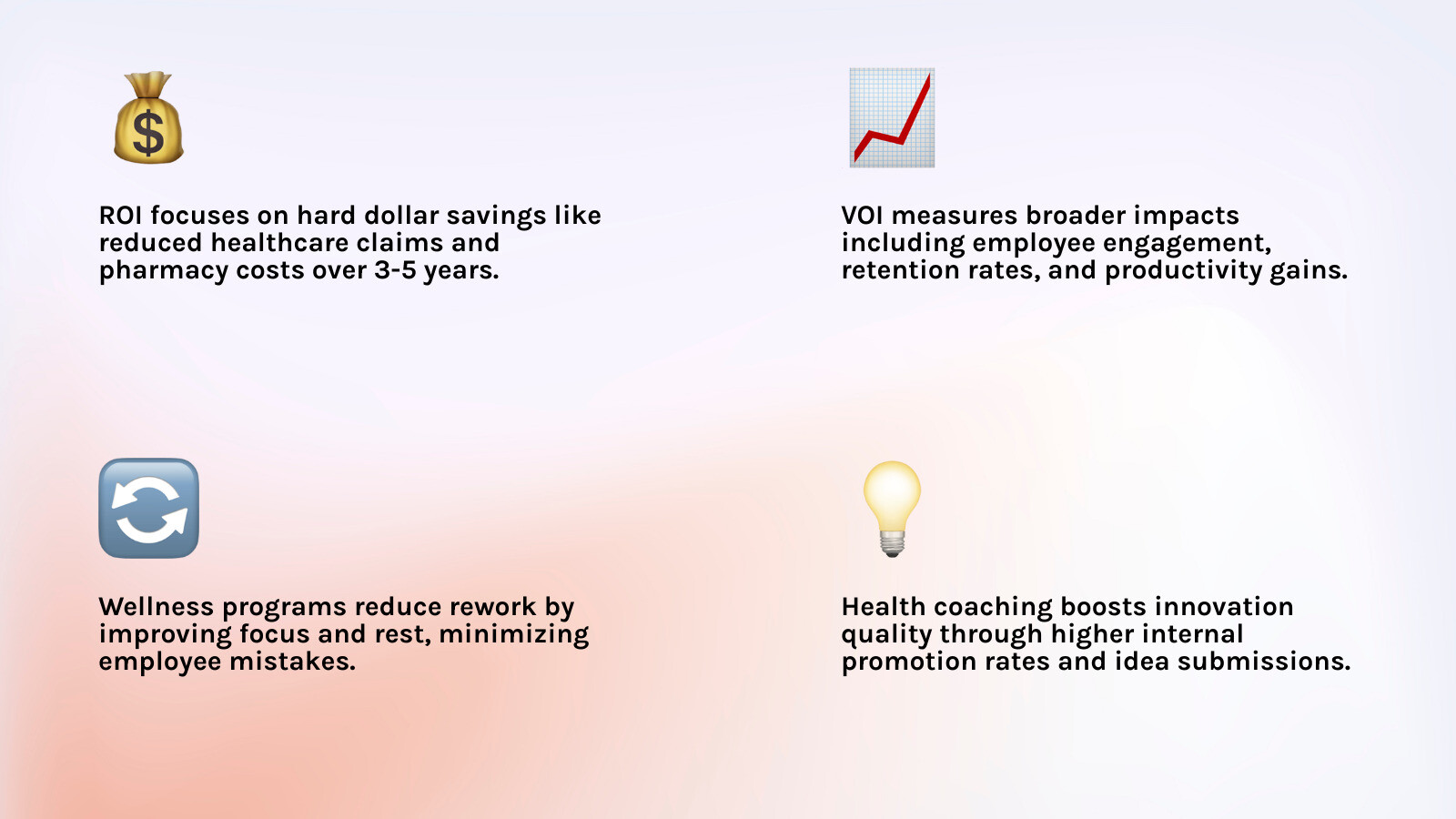
| Feature | Return on Investment (ROI) | Value-on-Investment (VOI) |
|---|---|---|
| Primary Focus | Hard dollar savings | Broader organizational impact |
| Metrics | Healthcare claims, pharmacy costs | Engagement, retention, productivity |
| Timeline | Usually 3-5 years | Immediate to long-term |
| Goal | Cost reduction | Culture and performance enhancement |
VOI is an indexed approach that assesses the financial impact of improved culture, reduced turnover, and higher employee engagement. According to Defining Metrics & KPIs to Measure the Effectiveness of Coaching, top organizations use coaching to harness leadership capabilities, which shows up in metrics like internal promotion rates and innovation quality.
Participant Satisfaction and Engagement
We measure satisfaction from two perspectives:
- The Employee: Did they achieve their personal goals? Was the coach easy to work with?
- The Coordinator: Was the program easy to implement? Were participants responsive to communication?
It is vital to distinguish between program dissatisfaction (e.g., the app is glitchy) and coach dissatisfaction (e.g., a personality clash). One is a technical fix; the other requires a new coach-client match.
Productivity and Performance Measures
While still in its infancy, tracking productivity is a key part of objective health coaching metrics. We look for:
- Rework Reduction: Are employees making fewer mistakes because they are better rested and more focused?
- Innovation Quality: Is there an increase in the number of new ideas submitted?
- Self-Reported Productivity: Using validated surveys to gauge how “on task” employees feel throughout the day.
Research suggests that wellness guidance can significantly reduce symptoms of anxiety and depression, which are leading causes of “presenteeism”—being at work but not actually being productive.
Frequently Asked Questions about Health Coaching Metrics
What is the difference between process and outcome goals?
An outcome goal is the “finish line” (e.g., “I want to lower my cholesterol by 20 points”). A process goal is the “training” (e.g., “I will eat one serving of oats every morning”). We track both, but process goals are better for daily motivation because they are entirely within your control.
How do you address low adherence in a coaching program?
First, we look at the coach-client fit. Sometimes a different communication style is all it takes. Second, we evaluate the “SMART-ness” of the goals. If a goal is too hard, adherence will always drop. Finally, we use tools like Virtual 1-on-1 Training to provide more frequent, bite-sized accountability.
Why is weight considered a poor metric for progress?
Weight is a “noisy” metric. It doesn’t distinguish between muscle gain and fat loss, and it fluctuates based on hydration, salt intake, and even stress. We prefer to use body composition, how clothes fit, and lab values (like those mentioned in the 2024 Carroll County Community Health Assessment) to get a more accurate picture of health.
Conclusion
At Primedy Health, we aren’t interested in “quick fixes” that disappear by the time the next Maryland winter rolls around. We are in the business of sustainable, data-driven results. By focusing on objective health coaching metrics, we take the guesswork out of wellness.
Whether you are an individual in Mount Airy looking for Customized Virtual Programming or a business owner in Carroll County wanting to improve your team’s VOI, the data doesn’t lie. When you measure what matters, you can change what happens.
Ready to see your own data? Let’s start tracking your progress today.