
Why a Progress Tracking Strength Program Is the Difference Between Results and Spinning Your Wheels
The best progress tracking strength programs in 2026, ranked by features and usability:
| App | Best For | Free Version | Standout Feature |
|---|---|---|---|
| Jefit | Data lovers | Yes (1,400+ exercises) | 1RM charts + muscle recovery breakdown |
| Hevy | Social accountability | Yes | Community feed + 4.9/5 stars |
| Strong | Simplicity | Yes | Intuitive UX + RPE tracking |
| StrengthLog | Advanced lifters | Yes (90% of features free) | RPE/RiR logging + PR tracking |
You’ve probably been here before: a few solid weeks in the gym, progress feels good, then life gets busy. You miss a few sessions. You come back, but you’re not sure where you left off. Were you doing 35 lbs or 40? Three sets or four?
That’s not a motivation problem. It’s a tracking problem.
Strength training works through a simple principle: your muscles only grow when you consistently give them more to adapt to. But without a record of where you’ve been, you can’t reliably push forward. You’re guessing — and guessing rarely leads to gains.
Research backs this up. Muscle growth requires progressive overload — gradually increasing the stress placed on your muscles over time. No tracking means no reliable overload. No overload means no growth.
The good news? You don’t need a complicated system. Whether you use an app, a spreadsheet, or a notebook, the act of logging your workouts consistently is one of the highest-leverage habits you can build.
This guide breaks down the best tools and methods available in 2026, so you can stop second-guessing and start building.
The Science of the Progress Tracking Strength Program
At its core, a progress tracking strength program is a systematic approach to fitness that relies on data rather than intuition. While “listening to your body” has its place, your body is often a liar that wants to stay on the couch. Data, however, tells the truth. To understand why we track, we have to look at the biological “why” of muscle growth.
Progressive Overload: The Engine of Growth
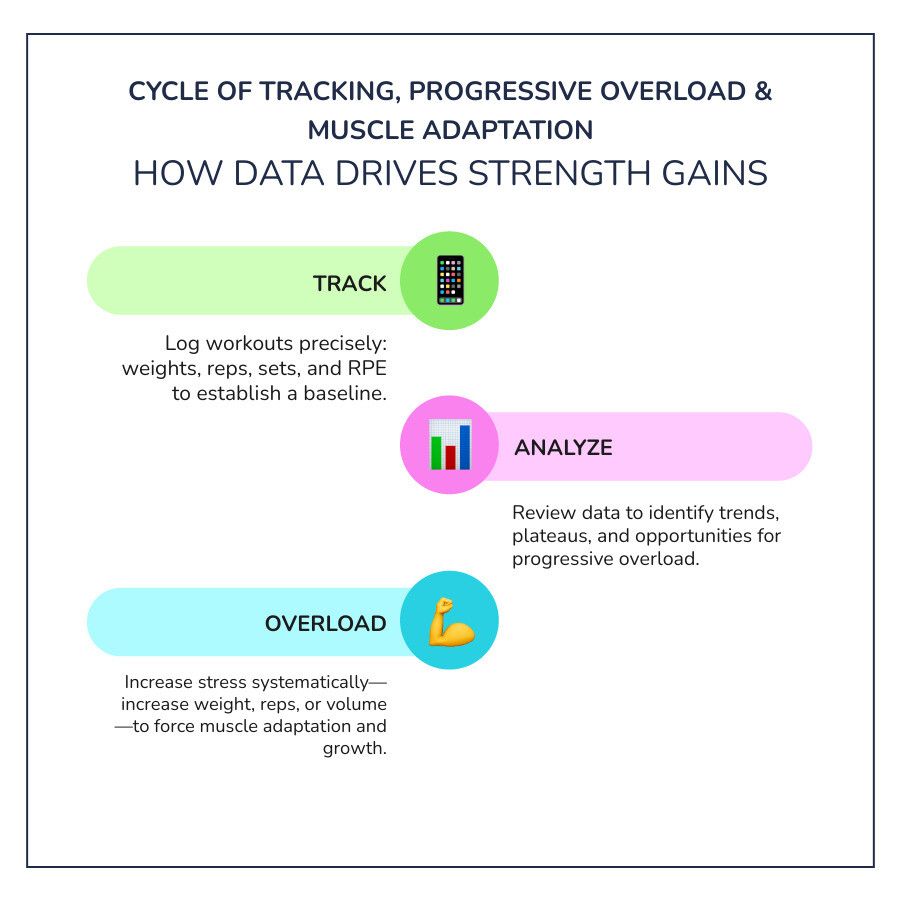
Muscle hypertrophy (growth) is an adaptation to stress. When you lift a weight that challenges you, you create microscopic tears in the muscle fibers. Your body repairs these fibers to be slightly thicker and stronger to handle that same stress in the future. If you lift the exact same 20-pound dumbbell for the exact same ten reps every Tuesday for three years, your body has no reason to change. It has already adapted.
To keep seeing results, you must implement progressive overload. This means systematically increasing the mechanical tension or metabolic stress placed on the muscle. Without a Progress Tracking system, it is nearly impossible to ensure you are actually doing more than you did last month.
Preventing the Dreaded Plateau
We’ve all seen that person at the gym in Frederick or Mount Airy who looks exactly the same year after year despite “working hard.” They are likely hitting a plateau because they aren’t monitoring their training volume. Training volume is the total amount of work done (Sets x Reps x Weight). By tracking this metric, we can spot when progress stalls and make surgical adjustments to the program before burnout sets in.
Implementing Progressive Overload in Your Progress Tracking Strength Program
Progressive overload isn’t just about adding more plates to the bar. In fact, if you tried to add weight every single session, you’d hit a wall (or an injury) very quickly. Here are the primary levers we use to keep the needle moving:
- Weight Increments: The most obvious method. Increasing the load by 2-5% each week is a standard goal. For beginners, starting with weights that are roughly 5-10% of their body weight is a safe entry point.
- Repetition Volume: If you can’t increase the weight, increase the reps. Moving from 8 reps to 10 reps with the same weight is a significant increase in total volume.
- Set Density: Adding an extra set (moving from 3 sets of 10 to 4 sets of 10) increases the total stimulus.
- Rest Interval Manipulation: Shortening your rest from 90 seconds to 60 seconds while maintaining the same weight and reps forces your muscles to recover faster, increasing metabolic stress.
- Range of Motion (ROM): Performing a squat deeper or a press more fully increases the “work” done by the muscle over a greater distance.
At Primedy Health, we focus on these Foundations to ensure our members in Carroll County are making sustainable gains that don’t compromise their joint health.
Specific Metrics to Monitor for Optimal Growth
If you want to train with scientific precision, you need to track more than just “chest day.” High-level tracking involves both objective and subjective data points:
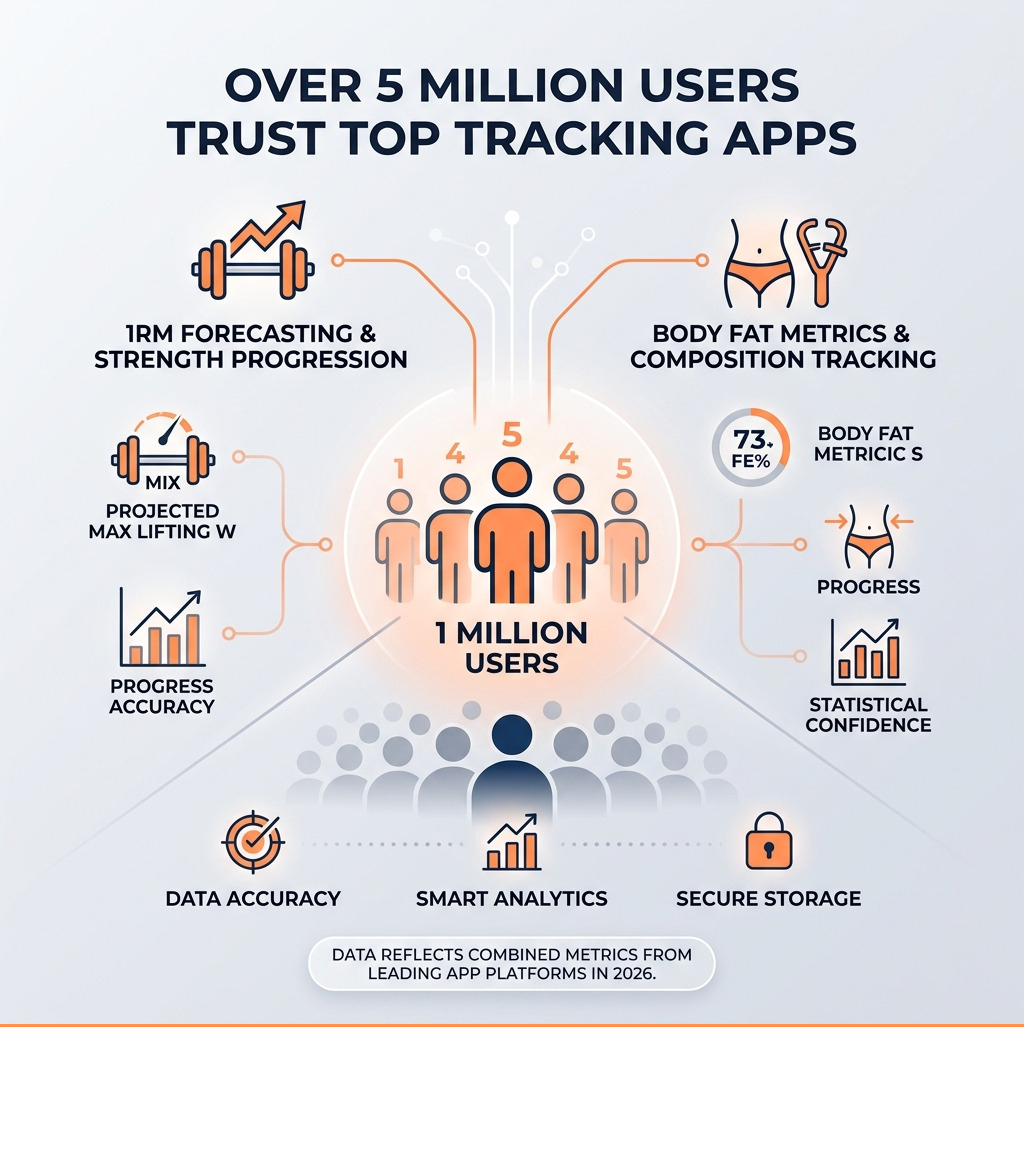
- One-Rep Max (1RM): This is the maximum weight you can lift for a single repetition. Most modern apps calculate an estimated 1RM based on your higher-rep sets, allowing you to track strength gains without the danger of actually testing a true 1RM every week.
- Rate of Perceived Exertion (RPE): This is a scale of 1 to 10 of how hard a set felt. A 10 is absolute failure; a 7 means you had a few more reps in the tank.
- Reps in Reserve (RiR): Similar to RPE, this tracks how many more reps you could have done. If you did 10 reps but felt you could have done 12, your RiR is 2.
- Volume Load: The math of your workout (Sets x Reps x Weight). Seeing this number trend upward over months is the ultimate proof of progress.
- Muscle Recovery Breakdown: Some advanced software, like Jefit, provides a visual map of which muscles are recovered and which need more rest. This helps prevent overtraining.
- Body Composition Data: Tracking body fat percentage and muscle measurements alongside strength ensures that the weight you’re gaining is actually muscle, not just extra fluff from the local bakery.
Essential Features of Modern Workout Tracking Software

In April 2026, we are spoiled for choice when it comes to digital tools. Gone are the days of carrying a sweaty, dog-eared notebook around the gym (unless you really like that “old school” vibe). A high-quality progress tracking strength program today should offer several non-negotiable features.
The Digital Toolbox
- Exercise Library: Top-tier apps like Jefit and StrengthLog offer databases of over 1,400 exercises. This is vital for finding alternatives when the squat rack is taken at your local Frederick gym.
- Custom Routine Builders: You should be able to build a plan that fits your specific equipment, whether you have a full commercial gym or just a pair of dumbbells at home.
- Cloud Synchronization: This is a major lesson from the tech world. If you lose your phone, you shouldn’t lose years of PR data. Apps like StrengthLog and Strong prioritize cloud backups so your history is always safe.
- Wearable Integration: Whether it’s an Apple Watch or WearOS, being able to log a set from your wrist without touching your phone keeps you focused.
- Automated Rest Timers: Consistency in rest is just as important as consistency in weight. An app that pings you when it’s time to lift again keeps the intensity high.
- Exercise Video Demonstrations: Especially for those following Pre-designed Programs, having a 10-second clip of proper form can prevent a week of back pain.
Optimizing Your Progress Tracking Strength Program with Analytics
The real power of digital tracking isn’t the logging—it’s the analysis. Modern software can crunch your numbers to show you things you’d never notice on your own.
- Visual Progress Charts: Seeing a line graph of your bench press over six months is incredibly motivating. It turns the “grind” into a game.
- 1RM Forecasting: Apps can predict when you’re ready to attempt a new personal record based on your recent training volume.
- Exercise History Logs: Being able to quickly tap an exercise and see what you lifted three weeks ago ensures you are always aiming to “beat the book.”
- Personal Record (PR) Notifications: There is a unique hit of dopamine when your phone vibrates to tell you that you just performed your “Heaviest Set Ever.”
Comparing Digital Logs vs. Traditional Notebooks
While we love technology, we know some people swear by the pen and paper. Here is how they stack up for a resident of Mount Airy looking to get fit:
| Feature | Digital App | Paper Journal |
|---|---|---|
| Entry Speed | Fast (with templates) | Moderate (manual writing) |
| Data Analysis | Automatic graphs/stats | Manual math required |
| Portability | High (on your phone) | Low (extra item to carry) |
| Calculations | Auto-calculates volume/1RM | You’re the calculator |
| Durability | Cloud-backed | Can be lost or damaged |
| Distraction | High (social media) | Zero |
For most people, the automatic calculations and data accessibility of an app make it the clear winner for long-term Personal Training success.
Overcoming Common Challenges in Strength Tracking
Even with the best progress tracking strength program, hurdles exist. Tracking is a skill, and like any skill, it takes practice to master.
Data Entry Fatigue
The most common reason people stop tracking is that it feels like “work.” If you find yourself forgetting to log, try “logging as you go.” Don’t wait until the end of the workout. Log your set during your rest period. It takes ten seconds and keeps your rest intervals consistent.
Over-Reliance on Numbers
Don’t become a slave to the spreadsheet. If your app says you should lift 200 lbs today, but you slept four hours and feel like you’re coming down with a cold, lower the weight. Objective data should inform your training, not dictate it to the point of injury. This is where subjective feedback, like RPE, is crucial.
Neglecting Form for “Numbers”
This is a classic mistake. In the quest to see the “Weight” column go up, lifters often sacrifice form. They start “ego lifting.” Remember: 100 lbs lifted with perfect form is better for muscle growth than 120 lbs lifted with momentum and “cheating.” If your form breaks down, that rep doesn’t count toward your progress.
Consistency Over Intensity
A Group Training environment can help with this. When you have coaches and peers watching your progress, you’re less likely to skip sessions or fudge your numbers. Consistency is the boring secret to the “overnight” transformations you see on social media.
Frequently Asked Questions about Strength Tracking
How fast should I increase weight in my program?
For most lifts, aim for an increase of 2-5% per week. However, the most important rule is to keep total weekly increases under 10%. This allows your tendons and ligaments—which strengthen slower than muscles—time to catch up, preventing overuse injuries.
What is the difference between RPE and RiR?
RPE (Rate of Perceived Exertion) measures how hard the effort was on a scale of 1-10. RiR (Reps in Reserve) measures how many more repetitions you could have physically completed before your form failed. They are two sides of the same coin: an RPE of 8 usually correlates to an RiR of 2.
Is a free tracking app sufficient for advanced lifters?
Yes! Many apps like StrengthLog offer 90% of their features for free, including unlimited logging and basic PR tracking. Advanced lifters might only need the “Premium” versions for deep-dive analytics, RPE/RiR specific logging, or specialized powerlifting programs.
Conclusion

In the end, a progress tracking strength program is about more than just numbers on a screen; it’s about building a sustainable relationship with your health. At Primedy Health, we believe that “what gets measured gets managed.” By taking the guesswork out of your training, you free up mental energy to focus on what matters: showing up and putting in the work.
Whether you are training in our Mount Airy facility or following our online coaching from Frederick or Carroll County, the goal remains the same. We use objective data to create programs that fit into real lives. You don’t need to be a professional athlete to benefit from data-driven fitness; you just need to want better results for the time you spend in the gym.
Stop spinning your wheels. Start tracking your gains. If you’re ready for a structured, coach-led approach that combines expert guidance with the best tracking technology, we’re here to help.
Join our Health Coaching program today and build a blueprint for your peak performance.