
Why Most People Never See Real Fitness Results (And How Data Changes That)
Fitness progress data tracking is the practice of systematically recording your workouts, body metrics, and health indicators so you can see what’s actually working — and fix what isn’t.
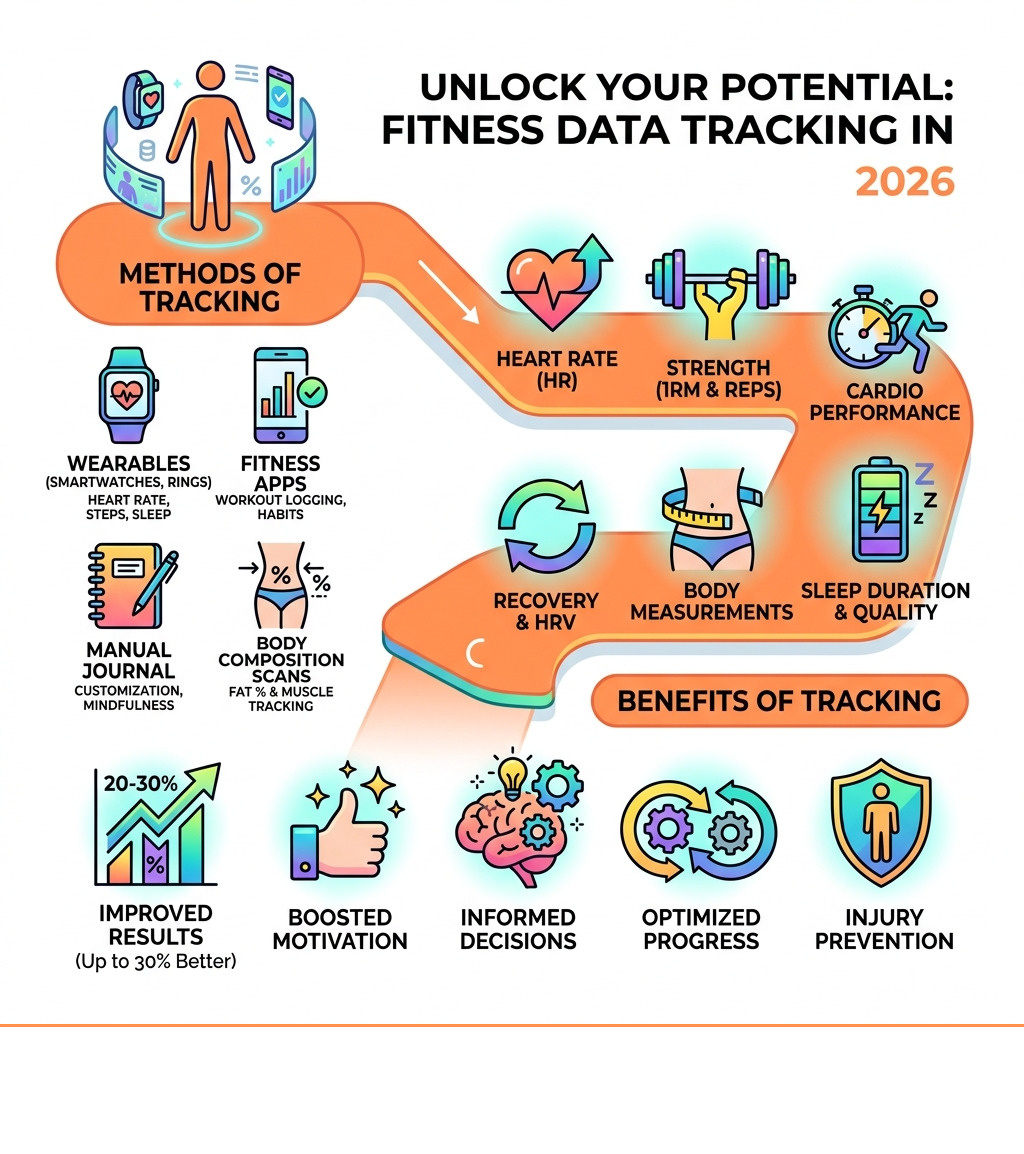
If you want the short answer on the best ways to track your fitness progress, here it is:
| Method | Best For | Effort Level |
|---|---|---|
| Fitness apps (e.g., workout loggers) | Strength, cardio, habit tracking | Low |
| Wearables (smartwatches, smart rings) | Heart rate, steps, sleep, recovery | Low |
| Manual journal or spreadsheet | Full customization, mindfulness | Medium |
| Remote coaching platform | Accountability + expert analysis | Low (coach does the heavy lifting) |
| Body composition scans | Fat loss and muscle gain tracking | Low (periodic) |
Here’s a hard truth: most people start a fitness routine with real motivation. Then life happens. Progress stalls. The routine falls apart.
Why? Usually because there’s no system in place to show what’s actually changing — or what needs to change.
Research consistently shows that people who track their fitness consistently see 20–30% better results than those who don’t. That’s not a small difference. That’s the gap between spinning your wheels for months and actually hitting your goals.
And yet, most people are still tracking on napkins. Or not at all.
The global fitness tracker market has grown from $11.6 billion to roughly $62 billion — because tracking works, and people know it. But having a wearable on your wrist or an app on your phone is only half the equation. What you do with the data is what matters.
This guide walks you through the best tools for fitness progress data tracking in 2026, how to set a real baseline, which metrics actually matter for your goals, and how to use your data without losing your mind over it.
Why fitness progress data tracking is the secret to 30% better results
We’ve all been there: you’ve been hitting the gym for three weeks, you feel “okay,” but you step on the scale and nothing has moved. Without fitness progress data tracking, this is the exact moment most people quit. They assume nothing is happening. But if they were tracking, they might see that while their weight is the same, their waist circumference dropped an inch, or they added 10 pounds to their goblet squat.
The importance of fitness tracking cannot be overstated. It moves fitness from the realm of “guessing” to the realm of “knowing.” When we track, we create a feedback loop that fuels motivation. Visual graphs showing a downward trend in body fat or an upward trend in strength provide a powerful psychological “win” that keeps us coming back.
According to research on behavior change with fitness technology, digital tools can significantly increase motivation for healthy behaviors, especially in sedentary adults. In fact, simply logging 30 minutes of activity a day can slash the risk of diabetes by 58%. With 42% of US adults currently dealing with obesity, these numbers aren’t just statistics—they are a roadmap to a longer, healthier life.
By celebrating milestones—whether it’s your 50th logged workout or a new personal best—you build accountability to yourself. At Primedy Health, we see it every day in Mount Airy: data turns a “chore” into a “game” you actually want to win.
Establishing your baseline: Performance and body composition metrics
Before you can track where you’re going, you have to know exactly where you are starting. You wouldn’t start a road trip without a GPS pin on your current location, right?
Establishing a baseline involves more than just stepping on a bathroom scale. In 2026, we have access to advanced progress tracking services that give us a “look under the hood.” This includes body composition analysis—distinguishing between how much of your weight is muscle, fat, and water.
Here are the metrics we recommend for your baseline:
- Waist Circumference: A key indicator of visceral fat and metabolic health.
- Body Fat Percentage: More useful than BMI for those engaging in strength training.
- Performance Tests: How many push-ups can you do? How fast is your timed mile? What is your max wall sit?
- Subjective Metrics: How is your sleep quality? What are your energy levels on a scale of 1–10?
Baseline Metrics Comparison
| Goal: Fat Loss | Goal: Muscle Gain | Goal: Endurance |
|---|---|---|
| Waist circumference | Lean muscle mass (kg/lb) | Resting heart rate |
| Body fat % | Strength 1RM (Estimated) | VO2 Max / Pace per mile |
| Daily step count | Muscle circumference (arms/chest) | Recovery time (HRV) |
The best tools for fitness progress data tracking in 2026
The market for fitness technology is exploding. By the end of 2025, the fitness app market is expected to reach $8.30 billion, and wearable shipments are projected to top 433 million units. But with so many options, what should you actually use?
For those who want a structured approach, pre-designed programs often come with built-in tracking features that allow you to follow a proven path while logging your data in real-time. In 2026, AI-powered workout analysis has become a game-changer. These tools can analyze your lifting tempo, range of motion, and even suggest when you should increase the weight based on your previous performance.
Remote coaching platforms have also bridged the gap for busy professionals in Frederick and Carroll County. These tools allow us to track your fitness progress remotely, providing the same level of accountability you’d get in person, but with the flexibility of a digital interface.

Digital vs. manual fitness progress data tracking
Despite the high-tech options, the “best” tool is the one you will actually use.
- Digital Tracking: Apps like MapMyFitness (which has over 90 million users!) are incredible for mapping routes and seeing global leaderboards. Other specialized apps are trusted by over 5 million users for their “think less, lift more” philosophy, focusing on supersets and RPE (Rate of Perceived Exertion).
- Manual Journaling: Never underestimate the power of a notebook. Writing down your sets and reps fosters a level of mindfulness that scrolling through an app sometimes can’t. It’s distraction-free and 100% customizable.
- Social Accountability: Tracking with a group or a friend can increase consistency. Whether it’s a local jogging group in Mount Airy or a digital community, sharing your data makes the journey less lonely.
If you find yourself overwhelmed by the choices, personal training can help you cut through the noise. A coach can tell you exactly which numbers matter for your specific body and goals.
Wearables and AI-powered performance analysis
Wearables have evolved far beyond simple step counters. In 2026, smart rings and watches provide AI-powered performance insights that were once reserved for elite athletes.
Key metrics to watch on your wearable:
- Heart Rate Variability (HRV): A primary indicator of how well your nervous system is recovering.
- Sleep Tracking: Analyzing REM and Deep Sleep cycles to optimize your training intensity for the next day.
- Active Minutes: Ensuring you’re hitting the baseline for cardiovascular health.
However, we must acknowledge the accuracy limitations. While wearables are excellent for tracking trends (e.g., “Is my resting heart rate lower this month than last?”), they are often less accurate for absolute calorie burn or specific sleep stage timing. Use them as a compass, not a precision laser.
Analyzing trends and celebrating non-scale victories
The real magic of fitness progress data tracking happens when you look at the data over 4, 8, or 12 weeks. Daily fluctuations in weight are normal—they’re usually just water, salt, or stress. Trends, however, don’t lie.
If your data shows a plateau, it’s not a failure; it’s information. It might mean it’s time to audit your habits, drop your calories slightly, or increase your movement. AI workout analysis can even help identify if your strength is plateauing because your volume (weight x reps x sets) hasn’t increased in three weeks.
But don’t get buried in the spreadsheets. Some of the most important data points aren’t numbers at all—they are “Non-Scale Victories” (NSVs).
The Non-Scale Victory Checklist
- [ ] Your jeans fit looser around the waist.
- [ ] You no longer hit the “3 p.m. wall” at work.
- [ ] You can carry all the groceries in one trip.
- [ ] Your mood is more stable throughout the day.
- [ ] You’re sleeping through the night and waking up refreshed.
- [ ] Your shirt sleeves feel a little snugger (hello, biceps!).
Avoiding obsession with fitness progress data tracking
While data is powerful, it can be a double-edged sword. Studies have linked overusing fitness tracking apps to increased stress or disordered eating behaviors in some individuals. Fitness should enhance your life, not become a source of anxiety.
To maintain a healthy relationship with your data:
- Monthly Weigh-ins: If daily weighing stresses you out, switch to once a month. It’s enough to see the trend without the daily noise.
- Habit Stacking: Attach your tracking to something you already do. Log your workout while you drink your post-workout protein shake.
- Focus on Consistency: A “perfect” log for one week is less valuable than an “okay” log for six months.
- Use Tools Sparingly: Use your tracker for reminders (like hydration) rather than obsessing over hitting exactly 10,000 steps every single day.
Frequently Asked Questions about fitness tracking
How accurate are wearable fitness trackers in 2026?
Modern wearables are highly reliable for heart rate and step counts. They are excellent for identifying long-term trends. However, they are still estimates when it comes to “calories burned” or “sleep stages.” Use the data to compare your own progress over time rather than comparing your “calories burned” to a friend’s.
What should I do if my data shows a weight loss plateau?
First, don’t panic! Check your other metrics. Are your measurements still going down? Is your strength going up? If everything has truly stalled for more than two weeks, it’s time to audit. You might need to increase your daily movement (NEAT), slightly adjust your caloric intake, or ensure you aren’t “under-recovering.”
How often should I take progress photos?
We recommend taking progress photos every 4–6 weeks. To get the most accurate comparison, use the same lighting, the same time of day (morning is best), the same outfit, and the same poses. These photos often show body recomposition—fat loss and muscle gain—that the scale completely misses.
Conclusion
Stop using napkins, scraps of paper, or your “best guess” to manage your health. In 2026, we have the tools to be precise, and that precision leads to the results you’ve been working so hard for.
Whether you are in Mount Airy, Frederick, or anywhere in Maryland, the key to a sustainable transformation is combining objective data with expert guidance. At Primedy Health, we specialize in taking that data and turning it into a roadmap for your “real life.”
Don’t let another month of hard work go unrecorded. Start your customized virtual programming today and let us help you turn your fitness data into a success story.